
I remember the exact moment I almost deleted Grand Teton National Park from my road trip itinerary.
I was sitting at my laptop, staring at a booking screen for a standard lodge room inside the park. The price tag was north of $700 a night. I checked Airbnb for Jackson Hole. Same story. I checked the campgrounds. Booked out six months ago.

I felt exactly like the traveler I saw on TripAdvisor recently who asked: “Should I just skip the Grand Tetons? Is it worth the hassle?”
If you are currently having that same debate, let me stop you right there. Do not skip this park. It is arguably the most stunning mountain range in the lower 48 states.
But you also don’t need to bankrupt yourself or sleep in your car to see it. The solution isn’t to skip it; the solution is to stay on the “Quiet Side.”
Here is how I solved the lodging crisis by looking “further out,” and why it actually made my trip better.
The “Backdoor” Solution: Teton Valley, Idaho
While everyone fights for scraps in Jackson, Wyoming, there is a whole other community sitting just over the mountain range in Idaho.
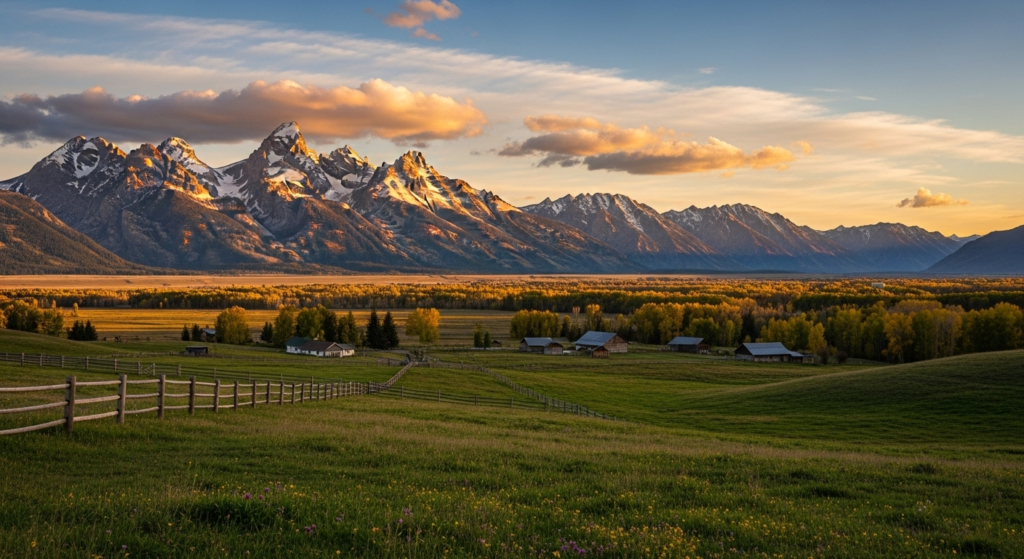
Specifically, the towns of Victor and Driggs.
These two towns are roughly 25-35 miles from Jackson. When I looked here, the panic subsided. I found cabins, motels, and glamping tents for 40% to 60% less than the prices in Jackson.
But the price isn’t the only reason to stay here. The vibe is completely different. Jackson can feel a bit like a theme park for billionaires. Driggs and Victor feel like authentic mountain towns where actual locals live. The food is great, the pace is slower, and the views of the “back” of the Tetons are still incredible.
The Catch: The Teton Pass Commute
I need to be 100% transparent about the drive because this is where the “Expertise” part of this guide matters. You cannot just glance at the mileage and assume it’s an easy 30-minute cruise.
To get from Driggs/Victor to Grand Teton National Park, you have to drive Teton Pass (Highway 22). Here is the accurate Google Maps Location.
- The Grade: It is steep (10% grades) and winding. If you are driving a massive RV or towing a trailer, this pass is white-knuckle territory (and sometimes prohibited for trailers depending on the season/weather). For a standard car or SUV? It’s totally fine, just take it slow on the curves.
- The Time: In perfect traffic, it takes about 45 minutes to get from Driggs to the town of Jackson, and another 15 minutes to the park entrance.
- The Traffic: During July and August, commuter traffic can get heavy around 8:00 AM and 5:00 PM.
How to “Hack” the Commute?
Since you are staying further out, you need to change your strategy. You can’t just pop back to the hotel for a midday nap.
Here is the exact schedule I used to make this work seamlessly:
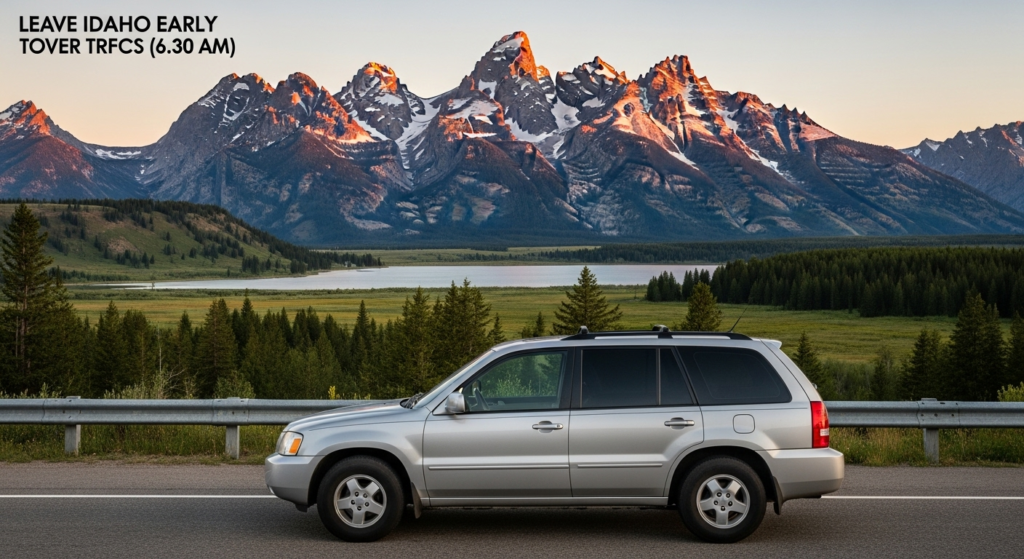
- Leave Idaho Early (6:30 AM): Beat the commuter traffic over the pass. You’ll watch the sunrise hit the Tetons as you descend into Jackson Hole. It’s a spiritual experience.
- Pack a Cooler: Since you aren’t going back to the room, bring lunch and plenty of water.
- Do the “Loop”: Drive north through the park, hit Jenny Lake early, loop up to Oxbow Bend, and come back down.
- Dinner in Jackson: After a full day hiking, grab a burger at The Bird or pizza at Hand Fire in Jackson to let the rush hour traffic die down.
- Sunset Drive Home: Drive back over Teton Pass at twilight.
Option B: Alpine, Wyoming
If Driggs and Victor are also booked, look at Alpine, WY. It sits at the junction of the Snake River and Greys River.
- The Pros: It’s a beautiful drive through the Snake River Canyon to get to Jackson. Flat driving, no high mountain pass like Teton Pass.
- The Cons: It is slightly further (roughly 45-55 minutes to Jackson), and it’s a smaller town with fewer amenities than Driggs.
Also read my topic on best off the beaten path places in the USA.
The Verdict
When I look back on my trip, I don’t regret “commuting” to the park one bit.
The drive over Teton Pass became one of my favorite parts of the day. Staying in Idaho gave me a break from the intense crowds of the National Park. And most importantly, it saved me about $1,200 over the course of three days.
So, to answer the question: Skip the overpriced lodge. Skip the stress. But do not skip the Tetons.
Is the drive over Teton Pass dangerous?
For cars, no. For RVs, yes. Teton Pass (Hwy 22) has a 10% grade (very steep) and sharp curves. If you are in a sedan/SUV: It is safe as long as you take the curves slowly and don’t ride your brakes on the way down. If you are towing a trailer/RV: It is white-knuckle territory. Many locals recommend avoiding it entirely with a trailer by driving the longer route through the Snake River Canyon (Alpine to Hoback Junction) instead.
How many days do I really need in Grand Teton?
Two full days is the sweet spot.
Day 1: Drive the 42-mile scenic loop, stop at Jenny Lake, and do the Hidden Falls hike.
Day 2: Sunrise at Schwabacher Landing or Mormon Row, then a secondary lake (String Lake or Taggart Lake) to relax.
One Day? You can see the highlights, but you will be rushing.
Three Days? Only necessary if you plan on doing long backcountry hikes (6+ miles).
Do I need a reservation to enter Grand Teton in 2025?
No. Unlike Glacier, Rocky Mountain, or Yosemite, Grand Teton does not require a timed-entry vehicle reservation for 2025. You just need a standard National Park pass ($35/vehicle) to get in. Note: This makes the park surprisingly busier because it catches the overflow of people rejected from Yellowstone/Glacier reservations.
Can I just sleep in my car if I can’t find a hotel?
Absolutely not. Rangers are extremely strict about this. You cannot sleep in your car at pullouts, trailheads, or parking lots. You will get a knock on the window and a fine. You must be in a designated campground, and nearly all campgrounds are now “Reservation Only” (booked months in advance).
The Hack: If you are desperate, you can camp on National Forest land (Shadow Mountain) just outside the park boundaries for free (dispersed camping), but you need a high-clearance vehicle.
What time do the parking lots actually fill up?
Jenny Lake (The Hub): Full by 8:30 AM in July/August. If you arrive at 10:00 AM, you will circle for 45 minutes or be diverted to road parking a mile away.
Taggart Lake: Full by 9:00 AM.
String Lake: Full by 9:30 AM.
The Solution: Arrive before 8:00 AM or after 4:00 PM. The middle of the day is a parking nightmare.
Is Jackson Hole the same thing as Grand Teton?
No.
Jackson Hole: The name of the entire valley (the geographic bowl).
Jackson: The main town with the antler arches, bars, and shops (15 mins south of the park).
Grand Teton: The National Park itself (the mountains and lakes).
Teton Village: A ski resort town at the base of the mountain, 20 minutes from the town of Jackson.
Tip: Don’t book a hotel in “Jackson Hole” without checking if it’s in Town, the Village, or way out in Hoback. The distances are huge.
Is it cheaper to buy the Annual Pass?
Yes, if you visit Yellowstone too.
Grand Teton Entry: $35
Yellowstone Entry: $35
Total: $70
Annual “America the Beautiful” Pass: $80 If you visit both parks (which 90% of people do), the Annual Pass pays for itself immediately, and it lets you skip the credit card lane at the gate (saving time).
Can I see the Tetons without hiking?
Yes, easily. Grand Teton is one of the most “windshield-friendly” parks in the US. The mountains rise drastically from the flat valley floor, meaning you get world-class views right from the highway.
Must-Do Drive: The “Inner Loop” (Teton Park Road) has the best up-close views.
Must-Do Stops: Oxbow Bend, Snake River Overlook, and Schwabacher Landing require almost zero walking for postcard photos.
Are bears actually a problem in the towns “further out”?
Yes. Do not assume that because you are in a rental cabin in Driggs or Alpine that you are safe from bears. Grizzlies and Black Bears are active in Teton Valley (Idaho) and the Snake River Canyon.
Rule: Lock your car doors. Don’t leave trash on the porch.
Reality: You are more likely to see a moose in town than a bear, but carrying bear spray is smart even on casual walks near the treeline.

