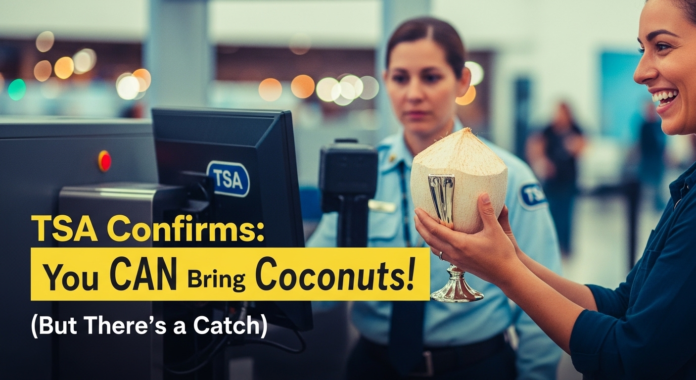
You can’t bring a full bottle of water through security, but you can bring a tropical fruit filled with 20 ounces of liquid. Welcome to the weirdest loophole in travel security.
The “Coconut Loophole” Explained
In a clarification that has stunned frequent flyers, the Transportation Security Administration (TSA) has confirmed that whole, unopened coconuts are allowed in carry-on bags.
Despite the strict 3-1-1 liquid rule—which bans liquids over 3.4 oz (100ml)—a TSA spokesperson confirmed to Travel + Leisure that coconuts are exempt because they are viewed as a solid food item rather than a liquid container.
The Official Stance:
- Carry-On: Allowed (Whole & Unopened)
- Checked Bag: Allowed
- The Logic: Since the liquid is naturally sealed inside the shell and not easily accessible (you can’t just unscrew a coconut), it passes the security check where a bottle of Evian fails.
The “Catch”: Where It Gets Complicated
Before you pack a crate of coconuts for your flight home from Maui, you need to know the exceptions. While TSA (security) allows it, USDA (agriculture) might stop you.
1. The “Mainland” Restriction
If you are flying from Hawaii, Puerto Rico, or the U.S. Virgin Islands to the U.S. mainland, most fresh fruits—including coconuts—are prohibited by the USDA to prevent the spread of invasive pests.
- Rule of Thumb: If you are flying domestically within the continental U.S. (e.g., Florida to New York), you are safe. If you are crossing an ocean border, expect it to be confiscated.
2. The “Spontaneous Combustion” Risk (Dried Coconuts)
While fresh coconuts are fine, dried coconut meat (Copra) is actually on the “Do Not Fly” list for many airlines.
- Why? Dried coconut has a high oil content and is considered a fire hazard because it can theoretically self-heat and combust. This is why many international airlines (especially in India and Southeast Asia) strictly ban dried coconuts in checked luggage.
3. Officer Discretion
As always, the TSA officer at the checkpoint has the final say. If you show up with a duffle bag full of 15 coconuts, it will likely trigger a secondary screening, and they reserve the right to reject anything they deem a security anomaly.
Expert Advice: How to Fly with a Coconut
If you plan to use this hack to stay hydrated (or just as a souvenir):
- Keep it accessible: Do not bury it at the bottom of your bag. Place it in a bin so the X-ray operator sees it clearly.
- Bring a corkscrew: TSA allows corkscrews (without blades) in carry-ons. This is the easiest way to puncture the “eye” of the coconut once you are airside to drink the water.
- Check the “Slosh”: Ensure the coconut is fully intact. If it has any cracks or leaks, it will be treated as a liquid spill and confiscated.
Quick Summary: The Coconut Rule
| Item | Carry-On? | Checked? | Condition |
| Whole Coconut | YES | YES | Must be unopened/intact. |
| Coconut Water | NO | YES | If in a bottle/carton >100ml. |
| Dried Coconut | YES | NO* | *Check airline rules (fire risk). |
| Coconut Oil | NO | YES | Must follow 3-1-1 rule. |
Also read – Heathrow’s 100ml Liquid Rule is Back: What Travelers Need to Know (and Pack)
Why are coconuts allowed through TSA if they have liquid inside?
TSA considers a whole, unopened coconut to be a “solid food item.” Because the liquid is naturally sealed inside a hard shell and cannot be easily accessed or poured out like a bottle, it is exempt from the standard 3.4 oz liquid limit.
Can I bring a coconut from Hawaii to the US mainland?
Generally, no. While TSA security might allow it, the USDA (APHIS) prohibits bringing most fresh fruits and vegetables from Hawaii, Puerto Rico, or the US Virgin Islands to the mainland to prevent the spread of invasive pests.
Can I bring a metal straw to drink my coconut on the plane?
Yes! Metal straws are allowed in carry-on bags. Pair it with a bladeless corkscrew (also allowed) to poke a hole in the coconut’s “soft eye” once you are past security for a fresh in-flight drink.
Is dried coconut allowed on planes?
Dried coconut (copra) is tricky. While TSA allows solid foods, many airlines ban bulk dried coconut meat in checked luggage because it is highly flammable and susceptible to spontaneous combustion due to its high oil content. Retail-packaged dried coconut snacks are usually fine.
Can I bring coconut oil in my carry-on?
No. Coconut oil is a paste/liquid and must follow the 3-1-1 rule. It must be in a container of 3.4 oz (100ml) or less and fit in your single quart-sized clear bag. Frozen coconut oil is allowed if it is frozen solid at the time of screening.
Will TSA cut open my coconut?
Unlikely. TSA officers use X-ray machines to screen items. If the X-ray is unclear, they may swab the outside of the coconut for explosives, but they will not crack it open. If they cannot clear it without opening it, they will simply not allow it through.
Can I bring a whole watermelon through TSA?
Technically, yes, if it fits in the bin! Like coconuts, whole fruits are considered solids. However, a massive watermelon might be flagged as a “bludgeon” risk or simply be too difficult to screen, so expect delays or rejection based on officer discretion.
Does the coconut count as a personal item?
If you are holding a loose coconut, it doesn’t count as a bag, but it must be screened. If you have a bag full of coconuts, that bag counts towards your carry-on allowance.
Can I bring coconut water in a bottle?
No. Once the coconut water is removed from the shell and put in a bottle, it is a liquid. It is strictly limited to 3.4 oz (100ml). If you want more, you must buy it at a shop after security.
What other foods are surprisingly allowed through TSA?
You can bring live lobsters (in water, if inspected), frozen liquids (if solid), whole cakes, and even pizza. The general rule is: if it can be spilled, spread, sprayed, or poured, it’s restricted. If not, it’s likely allowed.

