
For decades, the H-1B visa has been the golden ticket for skilled professionals (especially from India) to work in the United States. However, a new piece of legislation introduced in the US House of Representatives is proposing to abolish the program entirely.
Here is a breakdown of the EXILE Act, who is behind it, and what it means for the future of US immigration.
What Is the EXILE Act?
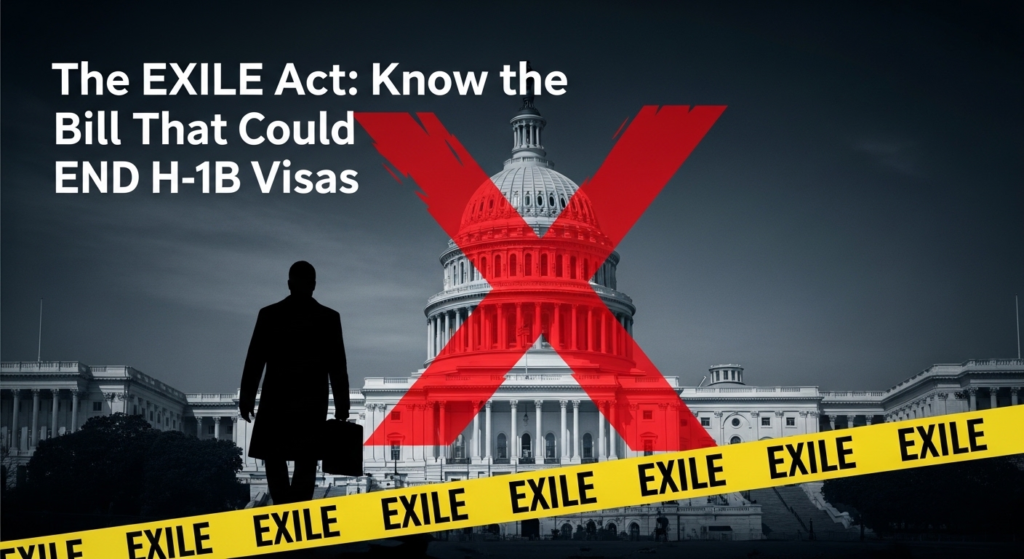
The EXILE Act (Executive Action to Initiate Liberty and End the H-1B Program Act) is a legislative bill introduced by US Representative Greg Steube that seeks to fully repeal the H-1B visa category from the Immigration and Nationality Act.
Unlike previous bills that sought to raise minimum wages or limit quotas, the EXILE Act does not aim to reform the system – it aims to eliminate it. If passed, the bill would strip the authority of the US government to issue visas to “specialty occupation” workers, effectively shutting the door on hundreds of thousands of IT professionals, engineers, and scientists.
The Rationale: Why Representative Steube Wants to End H-1B
Congressman Greg Steube (R-Florida) argues that the H-1B program has been weaponized by Big Tech and other corporations to replace American workers with cheaper foreign labor.
In his statement regarding the bill, Steube emphasized an “America First” approach. His primary arguments include:
- Wage Suppression: He claims the influx of foreign workers keeps wages lower for US citizens in the tech sector.
- Job Theft: The bill alleges that corporations are prioritizing H-1B workers over qualified American graduates.
- Outsourcing Loophole: Critics of the program have long argued that it is used to train foreign workers who then facilitate outsourcing jobs overseas.
The Target Demographic: Impact on Indian Professionals
The passage of the EXILE Act would disproportionately affect Indian nationals, who currently receive nearly 70% of all H-1B visas issued annually.
For the Indian tech community – both in the US and those in cities like Bengaluru, Hyderabad, and Pune aspiring to move – this bill represents an existential threat to the standard US career pathway.
- Current Holders: It creates uncertainty for those currently in the US on H-1B status regarding renewals.
- Green Card Backlog: For thousands of Indians stuck in the decades-long Green Card backlog, the H-1B is the only status allowing them to remain in the US. Repealing it could technically force them to self-deport.
Political Reality: Will the EXILE Act Pass?
While the introduction of the bill generates headlines, immigration experts believe the likelihood of the EXILE Act passing in its current “total repeal” form is low, though it signals rising hostility.
- Corporate Pushback: Major US corporations (Google, Microsoft, Amazon) rely heavily on the H-1B program to fill talent gaps. Their lobbying power in Washington is immense and would likely block a total repeal.
- Legislative Hurdles: Even if the bill passes the Republican-controlled House, it would face significant challenges in the Senate, where filibuster rules require 60 votes.
- The Real Danger: The introduction of such extreme bills often shifts the “Overton Window,” making moderate restrictions (like higher wage floors or stricter audits) seem more reasonable and more likely to pass.
The EXILE Act vs. Current H-1B Rules
| Feature | Current H-1B System | Proposed EXILE Act |
| Status | Active (85,000 annual cap). | Repealed (0 visas issued). |
| Purpose | Allows US firms to hire foreign talent. | Forces firms to hire US citizens only. |
| Dependents | Spouses (H-4) allowed. | H-4 status would likely vanish. |
| Primary Beneficiaries | Indian & Chinese Tech Professionals. | None. |
| Sponsor | US Citizenship & Immigration Services (USCIS). | Program defunded/terminated. |
What does the EXILE Act stand for?
The EXILE Act stands for the “Executive Action to Initiate Liberty and End the H-1B Program Act.” It is a bill introduced in February 2026 to remove the H-1B visa classification from US immigration law.
Who introduced the bill to ban H-1B visas?
The bill was introduced by Rep. Greg Steube, a Republican Congressman from Florida. He is a staunch advocate of “America First” policies and argues that the visa program harms American workers.
Will the H-1B visa program be stopped in 2026?
It is unlikely that the program will be stopped completely in 2026. While the bill has been introduced, it must pass through the House, the Senate, and be signed by the President to become law. Given the economic reliance on H-1B workers, a total ban faces steep opposition.
How does the EXILE Act affect H-4 visa holders?
Since the H-4 visa is a “dependent” visa tied directly to the primary H-1B holder, repealing the H-1B program would automatically eliminate the H-4 visa category. This would strip spouses of their legal status and work authorization (H-4 EAD).
Has the EXILE Act been passed by Congress?
No. As of 2026, the bill has only been introduced. It has not yet been voted on by the House Judiciary Committee or the full House of Representatives.
Why are Republicans targeting the H-1B visa?
Many conservative lawmakers view the H-1B visa as a tool for wage suppression. They argue that instead of hiring American STEM graduates at market rates, companies import cheaper labor, which they believe depresses wages and increases unemployment among US citizens.
What should current H-1B holders do now?
Immigration attorneys advise H-1B holders to remain calm but vigilant. Ensure your current visa status is valid, keeps copies of all documents, and consider alternative long-term options (like the EB-1 or EB-2 NIW Green Card categories) if eligible, to reduce reliance on the H-1B.

