
Traveling with Delta Air Lines means understanding the carry-on and personal item rules so you avoid hassles at the gate and make the most of your free baggage allowance. This comprehensive guide breaks everything down clearly and accurately based on Delta’s official policy and related verified sources.
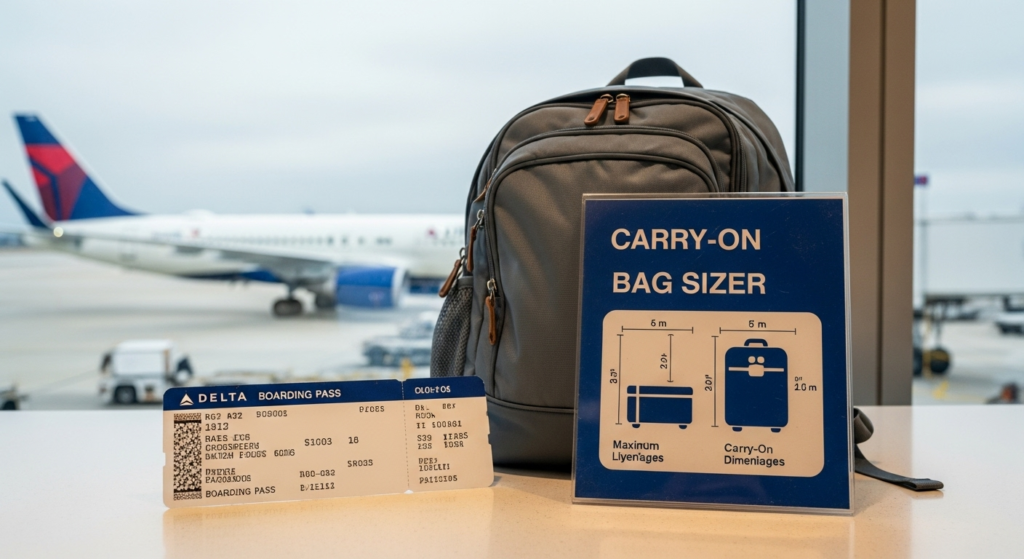
What Delta Allows On Board?
Every Delta passenger may bring two items on board free of charge:
1. One carry-on bag
2. One personal item that fits under the seat in front of you
These allowances are standard across most fare types, including Main Cabin and many international itineraries. Exceptions apply for specific aircraft types (e.g., Delta Connection with limited overhead space) and fare classes.
Quick Comparison
| Item Type | Where It Stows | Allowed Free |
|---|---|---|
| Carry-on bag | Overhead bin | Yes |
| Personal item | Under the seat | Yes |
Delta Air Line Carry-On Bag Size
Before we get into personal item specifics, it’s helpful to know Delta’s carry-on size rules since personal items must be smaller and fit under the seat.
- Carry-on maximum dimensions:
22 x 14 x 9 inches (56 x 35 x 23 cm), including wheels and handles. - Total linear inches: 45 inches (length + width + height) is the guideline to meet.
If your carry-on exceeds these dimensions, agents may require it to be gate checked – often free of charge depending on space.
What Is a Personal Item on Delta?
Delta’s official policy defines a personal item as:
“A purse, briefcase, small backpack, belt bag, fanny pack, camera bag, diaper bag, laptop bag, or item of similar size that will fit under the seat in front of you.”
Key Points
- The personal item must fit under the seat in front of you, not in the overhead bin.
- Examples:
- Laptop bag
- Small backpack
- Purse or tote
- Diaper bag
- Briefcase
- Camera bag
Anything larger that cannot fit under the seat may be considered a carry-on and potentially gate checked.
On more thing, Delta Airlines also work for the accessibility for it’s needy customers. Maybe, the luggage room and baggage requirements are different there. I have written an article previously on that too which you can check here.
Personal Item Size: Official vs. Practical
Official Standpoint
Delta does not publish exact dimensional limits for personal items on its baggage policy page. Instead, the requirement is that the item be “similar in size” to a purse or laptop bag and fit under the seat.
Practical Guidelines Travelers Use
Because Delta does not list exact personal item dimensions, many experienced travelers use recommended dimensions that reasonably fit under most airplane seats:
- Suggested personal item size:
17 x 13 x 9 inches (43 x 33 x 23 cm) - Approximate under-seat space:
Many aircraft under-seat spaces measure up to 20 x 15 x 11 inches (varies by aircraft and seat row).
Why This Matters
If your personal item is larger than the under-seat space:
- It may be flagged at boarding.
- You could be asked to gate check it (free or for a fee depending on situation).
- It may take up legroom if forced to keep it at your feet.
How to Choose the Right Personal Item
Here’s how to make the most of your allowance without risking a gate check:
Choose By Purpose
- Laptop bag: Great for tech and documents.
- Small backpack: Best for day trips or extra clothes.
- Tote/Purse: Ideal for essentials like wallet, passport, snacks.
Size Before You Fly
- Measure your bag (including pockets and structure).
- Prefer bags with soft sides and flexibility — they’re easier to squeeze under seats.
Under-Seat Differences by Aircraft
Keep in mind:
- Not all aircraft have the same under-seat space.
- Bulkhead seats may have reduced or no under-seat storage.
- Regional jets often have smaller under-seat areas.
This means a bag that fits comfortably on one Delta flight could be tight on another. When in doubt, err on the smaller side.
Other Carry-On Items Allowed
Delta also allows several additional smaller items that do not count toward your personal item or carry-on limit, provided they fit safely with your bag:
- Jackets or outerwear
- Umbrellas
- Food or drinks from the airport
- Duty-free purchases
- Mobility aids (wheelchairs, walkers)
- Infant items (strollers, breast pumps)
These can be layered on or carried separately without counting as your main allowed bags.
Common Myths & Clarifications
Myth 1: Personal Items Must Have Exact Published Size
Fact: Delta doesn’t list strict dimensions. The requirement is that the bag be small enough to fit under the seat in front of you.
Myth 2: Personal Items Are Always Checked if Close in Size to Carry-On
Fact: Agents and gate staff often use discretion. If your bag fits under the seat, it should be allowed; if not, it might be gate checked.
Myth 3: Personal Items Can’t Be Soft-Sided
Fact: Soft-sided bags are often easier to fit under the seat and are preferred for maximizing space.
Tips to Avoid Trouble
Arrive Early:
Gate agents inspect bags as boarding begins; tight spaces can lead to early checks.
Measure Before You Pack:
Measure your bag with handles and wheels — airlines include these in measurements.
Use Packing Organizers:
Internal cubes make it easier to fit more while staying within limits.
Know Your Aircraft:
If you’re on regional jets or smaller aircraft, under-seat space may be less than Delta’s standard.
What Happens If You Exceed Limits?
If your personal item or carry-on is too large:
- You may be asked to gate check the item.
- Some flights may charge a checked luggage fee if you’re forced to check it and don’t have checked bags already.
- Security may reassign oversized bags to checked status before boarding.
Final Takeaways
- Delta allows one carry-on bag + one personal item for free.
- Personal items must be small enough to fit under the seat in front of you.
- Recommended size: ~17 x 13 x 9 inches for smooth boarding.
- Always measure with wheels and handles, and choose soft-sided bags when possible.
With the right bag and a bit of planning, you can make your Delta flight smoother and avoid last-minute gate checks.

