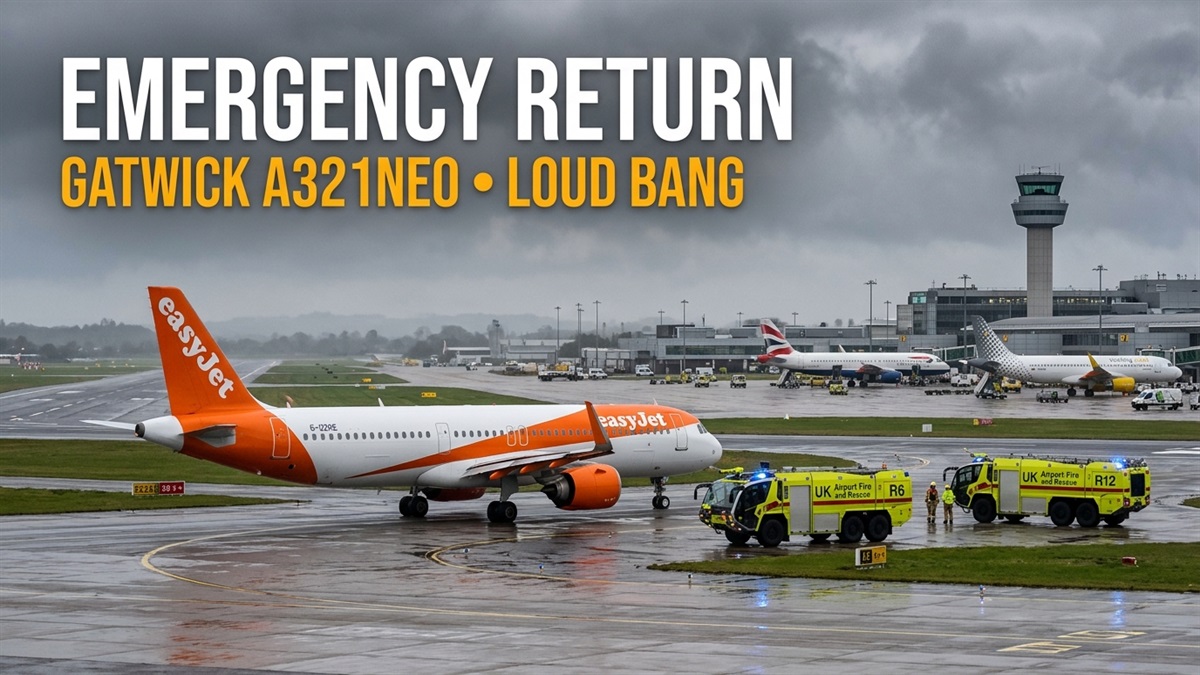
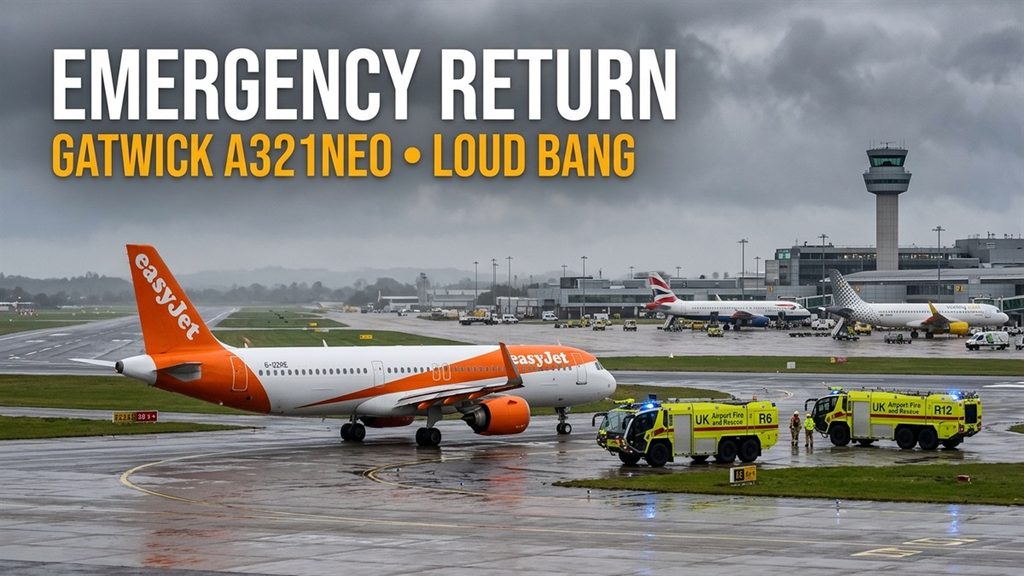
EasyJet Flight EZY816 from Edinburgh to London Gatwick declared a mid-air emergency and returned safely to Edinburgh Airport on Thursday evening, November 26, 2026, after a loud bang came from its left engine shortly after takeoff. All passengers and crew landed safely roughly 50 minutes after departure with zero injuries, and easyJet arranged a replacement aircraft to complete the journey to Gatwick later that night.
Residents across West Lothian and Livingston reported hearing a sharp boom overhead—captured on multiple home doorbell cameras—minutes after the Airbus A321neo (registration G-UZMC) lifted off around 9:00 PM local time. Automated aircraft data flagged a left-engine stall and high exhaust gas temperatures, prompting pilots to squawk 7700 and shut down the affected engine as a precaution.
Minute-by-Minute Timeline of easyJet Flight EZY816’s Emergency Return to Edinburgh
The flight crew followed textbook single-engine return procedures, leveling off at 5,000 feet before bringing the A321neo back onto the Edinburgh runway. Emergency vehicles met the jet on arrival as standard airport protocol whenever an aircraft lands with one engine shut down.
| Flight Stage | Approximate Status / Detail | What Happened During Flight EZY816 |
|---|---|---|
| Takeoff from Edinburgh (EDI) | ~9:00 PM GMT, Nov 26, 2026 | Airbus A321neo (G-UZMC) departed bound for London Gatwick (LGW). |
| Climb Over West Lothian | Minutes after liftoff | Residents in Livingston and West Lothian heard a loud bang; automated ACARS logs recorded a No. 1 (left) engine stall and high exhaust gas temperatures. |
| Emergency Declaration | Squawk 7700 at ~5,000 feet | Pilots declared a general emergency, shut down the left engine, and stopped climbing to stabilize the jet. |
| Holding & Approach | 44–53 minutes airborne | Crew circled to manage weight and prepare checklists before making a controlled single-engine approach into Edinburgh. |
| Safe Landing & Rebooking | Back at Edinburgh Airport | Aircraft landed safely with emergency crews standing by; no injuries reported and a replacement jet flew passengers to Gatwick later that evening. |
What Caused the Loud Bang on the easyJet Airbus A321neo Left Engine?
A jet engine compressor stall happens when smooth airflow through the engine is suddenly disrupted, causing a sharp pressure backfire that sounds like an explosion or gunshot from the ground. High exhaust gas temperatures often appear at the same moment because unburned fuel ignites unevenly inside the disrupted airflow.

While a loud bang is frightening for passengers and nearby residents, shutting down the affected engine is a routine safety step—not a loss of control. Commercial twin-engine aircraft like the Airbus A321neo are strictly certified under UK Civil Aviation Authority (CAA) and European Union Aviation Safety Agency (EASA) airworthiness standards to climb, cruise, and land safely on a single operating engine.
How UK Aviation Authorities Investigate an In-Flight Engine Shutdown
Every commercial in-flight engine shutdown in UK airspace triggers mandatory technical reporting and borescope engine inspections before the aircraft can return to passenger service. Engineers inspect the fan blades, compressor stages, and cockpit data recorders to confirm whether the stall resulted from a mechanical component fault or an external event such as a bird strike.
Depending on initial engineering findings, mandatory occurrence reports are logged with the UK Civil Aviation Authority (CAA) and reviewed for potential safety inquiry by the UK Air Accidents Investigation Branch (AAIB). Regional aviation infrastructure and resilience around Edinburgh are also monitored alongside broader Transport Scotland connectivity oversight.
UK261 Compensation and Passenger Rights After an Emergency Return to Edinburgh
Technical engine faults generally count as within an airline’s control under UK261 law, meaning delayed passengers on easyJet Flight EZY816 may qualify for £220 in statutory compensation if they arrived at London Gatwick three hours or more late. The key exception is if investigators prove an external “extraordinary circumstance,” such as a bird strike, directly caused the engine stall.
Passengers caught in an emergency return or late-night aircraft swap should take these five practical steps immediately:
- Record the exact arrival time at Gatwick: Under the UK CAA Delays and Cancellations Guide, delay compensation is calculated from the moment the replacement aircraft’s doors open at London Gatwick—not when it leaves Edinburgh.
- Claim care and refreshments on the spot: Regardless of whether a fault is technical or a bird strike, airlines must provide reasonable food, drinks, and overnight hotel accommodation (plus transport to the hotel) if a replacement flight pushes departure to the next day.
- Keep boarding passes and receipts: Save both original EZY816 boarding passes and any replacement flight confirmations, along with itemized receipts for meals or late-night taxis if airline vouchers run out.
- Submit claims directly to the airline first: Filing directly through easyJet’s official compensation portal avoids third-party claims agencies taking 25% to 35% of your payout.
- Escalate unresolved disputes for free: If an airline rejects a technical-fault claim by citing extraordinary circumstances without proof, passengers can escalate the case at no cost through the CAA’s approved Alternative Dispute Resolution scheme.