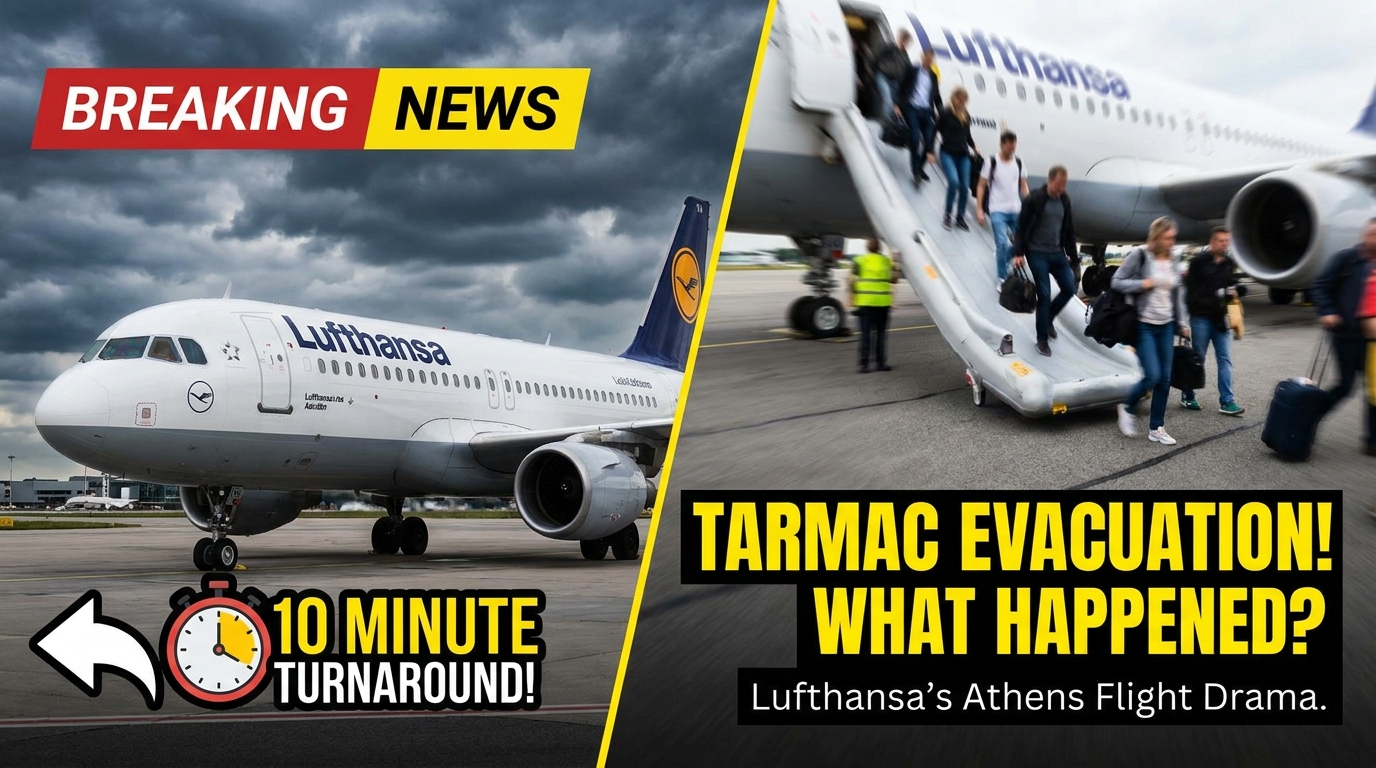
A fire warning, emergency slides, and three injuries. Here is everything that actually happened on Lufthansa Flight LH1753, and what every traveler flying Europe this summer needs to know right now.
You board a Lufthansa flight in Athens. It is a routine, under-three-hour hop to Munich. You are thinking about your connection, your hotel, maybe what to eat when you land. Then, about ten minutes after takeoff, something changes in the cabin. There is a smell. The plane stops climbing. The crew’s tone shifts. And within minutes, you are sliding down an inflatable emergency chute onto the tarmac, surrounded by fire trucks, with no bag and no idea what just happened.

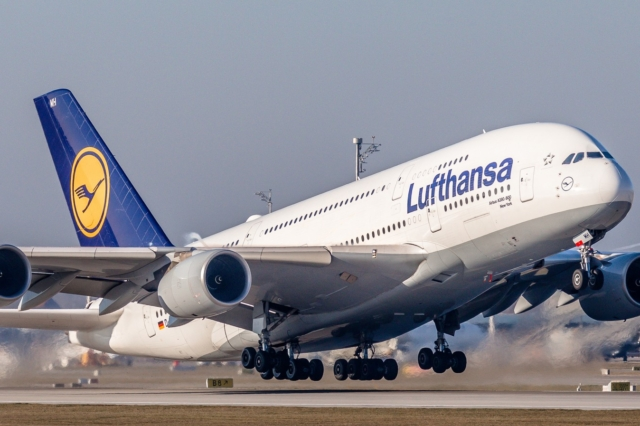
That is exactly what passengers on Lufthansa Flight LH1753 experienced on May 11, 2026, at Athens International Airport Eleftherios Venizelos.
This is not a story about a crash. Nobody died. But it is a story that every traveler flying short-haul in Europe should read before they board their next flight, because the chaos, confusion, and unanswered questions that follow a mid-air emergency are something almost nobody prepares for.
What Exactly Happened on Lufthansa Flight LH1753
The flight turned around because the crew received an onboard fire warning shortly after takeoff.
Flight LH1753, operated by an Airbus A321neo with the registration D-AIEA, departed Athens that evening bound for Munich. It never made it past the initial climb. According to aviation incident reports, the cockpit received a fire warning linked to the aircraft’s auxiliary power unit, known as the APU. The APU is a small engine that handles electrical power and air conditioning when the main engines are not running at full thrust. A warning there is taken extremely seriously.
Then, passengers near the rear of the cabin reported a noticeable smell of smoke or fumes, which meant this was not just a single cockpit alert that could be written off as a faulty sensor. The combination of a technical warning and a physical smell in the cabin left the crew with one option.
They turned back.
Tracking data shows the aircraft:
- Halted its climb at a relatively low altitude
- Circled briefly to line up for an immediate return
- Landed back at Athens approximately 10 to 15 minutes after departure
- Was met on the runway by emergency services already positioned on the aprons

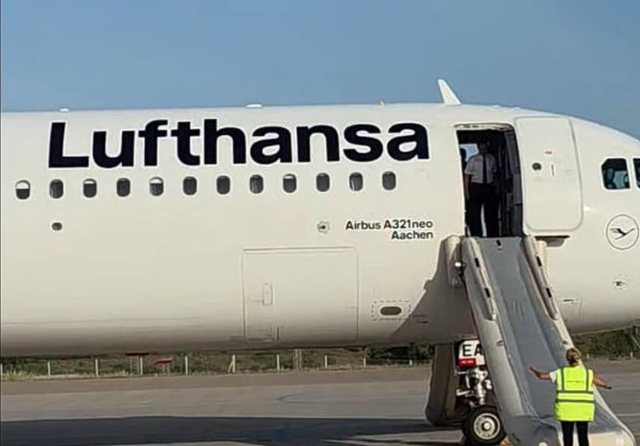
The whole thing unfolded fast. Faster than most passengers on board likely expected when they first noticed something was off.
Also read – Riyadh Air Adds Daily Riyadh–Cairo Flights & It Will Change Many Things
Why This Is More Serious Than It Sounds (Even Though Nobody Died)
The real issue here is not what happened, it is how close this could have been to something far worse.
There was no confirmed sustained fire. The aircraft landed safely. The crew did everything right. But here is what makes this incident genuinely alarming for regular travelers:
- A fire warning in flight at low altitude means the crew has almost no time to assess. They cannot fly around troubleshooting. They come back immediately.
- The APU area of an aircraft is a known point of vulnerability. Fluid leaks, overheating, sensor failures can all trigger warnings there.
- The decision to do a full slide evacuation on a remote stand rather than taxi to a gate tells you the crew was not taking any chances. When you deploy the slides, you are treating it as a real emergency, not a precaution.
- Three passengers were injured during the evacuation itself, not from smoke or fire, but from the physical act of going down a steep inflatable slide at speed. Broken wrists, twisted ankles, bruised ribs. This is an accepted risk of emergency egress, but it is not nothing.
I have covered aviation incidents for years, and the part that always strikes me is this: the safest outcome in a situation like this still produces injured passengers, stranded travelers, a grounded aircraft, and a wave of confusion that lasts for days.
Who Was Affected and What Happened to Passengers After the Evacuation
Every single passenger and crew member on Flight LH1753 was affected, and the disruption did not end when they hit the tarmac.
Here is the sequence of events after the evacuation:
- Passengers were directed to leave all belongings on the aircraft. No bags, no carry-ons, no personal items. You slide, you walk, that is it.
- Emergency crews and fire vehicles surrounded the aircraft on the remote stand while passengers were escorted across the apron.
- Everyone was taken to the terminal for medical assessment and rebooking assistance.
- The aircraft, D-AIEA, remained grounded at Athens for technical inspection as of May 12, 2026.
The immediate aftermath of an emergency like this is where the real chaos lives. Think about it:
- Your passport might be in your jacket in the overhead bin.
- Your medication might be in your checked bag.
- Your phone might be at 4%.
- You have no idea when your next flight is, or who is responsible for booking it.
Are You Entitled to Compensation If This Happens to You?
Yes, but it is complicated, and airlines count on travelers not knowing the details.
Under EU Regulation 261/2004, passengers are entitled to care and compensation when flights are disrupted. However, safety-related emergencies create a grey area that airlines sometimes use to reduce their liability. Here is what you need to know:
| Situation | What the Airline Must Provide |
|---|---|
| Flight cancelled or heavily delayed | Meals, refreshments, hotel if overnight, rebooking |
| Disruption due to safety emergency | Care and rebooking generally still required |
| Compensation (250 to 600 EUR) | May be challenged as “extraordinary circumstance” |
| Your belongings left on grounded aircraft | No standard rule; you must request retrieval formally |
The key things to do immediately if this ever happens to you:
- Take photos of everything, including evacuation scenes if safe to do so
- Keep every receipt for food, transport, and accommodation
- Request written confirmation of the disruption and its cause from the airline
- Do not accept a voucher as a substitute for cash compensation without reading the conditions
- File a formal complaint in writing within a few days while details are fresh
Consumer advocates dealing with the LH1753 disruption are already advising affected passengers to hold on to all documentation and monitor official Lufthansa channels carefully.
What I Noticed That No One Else Is Talking About
The aircraft involved, D-AIEA, is part of Lufthansa’s A321neo fleet powered by Pratt and Whitney GTF engines, and that detail matters right now.
I want to be clear: there is no official determination yet linking this specific incident to broader engine concerns. The investigation is ongoing. But it is a fact that the Pratt and Whitney geared turbofan engine, which powers many A321neo aircraft globally, has been under heightened industry monitoring for inspection and durability issues. Regulators and airlines worldwide have been managing this situation for the past few years.
That does not mean your next A321neo flight is dangerous. It absolutely does not. But it does mean that incidents involving this fleet type will receive extra scrutiny, and that is a good thing. More scrutiny means faster answers and, ultimately, safer flying.
What I also find worth noting is how this incident unfolded geographically. Athens is a major hub with extensive emergency infrastructure. Had this been a smaller regional airport, the response time, the medical resources, and the rebooking options would all have looked very different. The three passengers who were injured got attention quickly. That might not have been true everywhere.
The broader lesson is not that flying is dangerous. It is that where you connect through matters, and that modern aviation safety protocols, when followed correctly, work exactly as designed. No lives were lost here. That is not luck. That is the system functioning.
What Should You Do Before Your Next Flight This Summer?
You cannot prevent a fire warning. But you can be the most prepared person in that cabin if one happens.
Before you board any flight, particularly short-haul European routes this summer:
- Read the safety card. Every single time. Yes, even if you have flown a hundred times. The exit locations change by aircraft type.
- Count the rows to the nearest exit. Not the nearest door. The nearest exit. In smoke, you navigate by touch and count.
- Do not put critical documents in the overhead bin. Passport, medication, phone charger. Keep them on your person or in the under-seat bag.
- Wear shoes you can run in. Flip-flops and heels cost people injuries on emergency slides every single time.
- Know that if the crew says jump, you jump. You do not wait, you do not grab your bag, you go. Every second matters.
I know this sounds like standard airline safety advice, and it is. The difference is that this week, 180-plus people on a flight out of Athens found out the hard way that this advice is not theoretical.
The Bottom Line
Aviation is still the safest way to travel. But safety does not mean seamless, and it does not mean painless. What happened on May 11, 2026, over Athens was a reminder that the most routine flight in the world can become anything but, in under ten minutes.
The system worked. The crew acted correctly. The airport responded well. And the people who got hurt got hurt because emergency slides are violent, not because anyone failed them.
Know your exits. Keep your documents on your body. And if the crew says go, you go.