

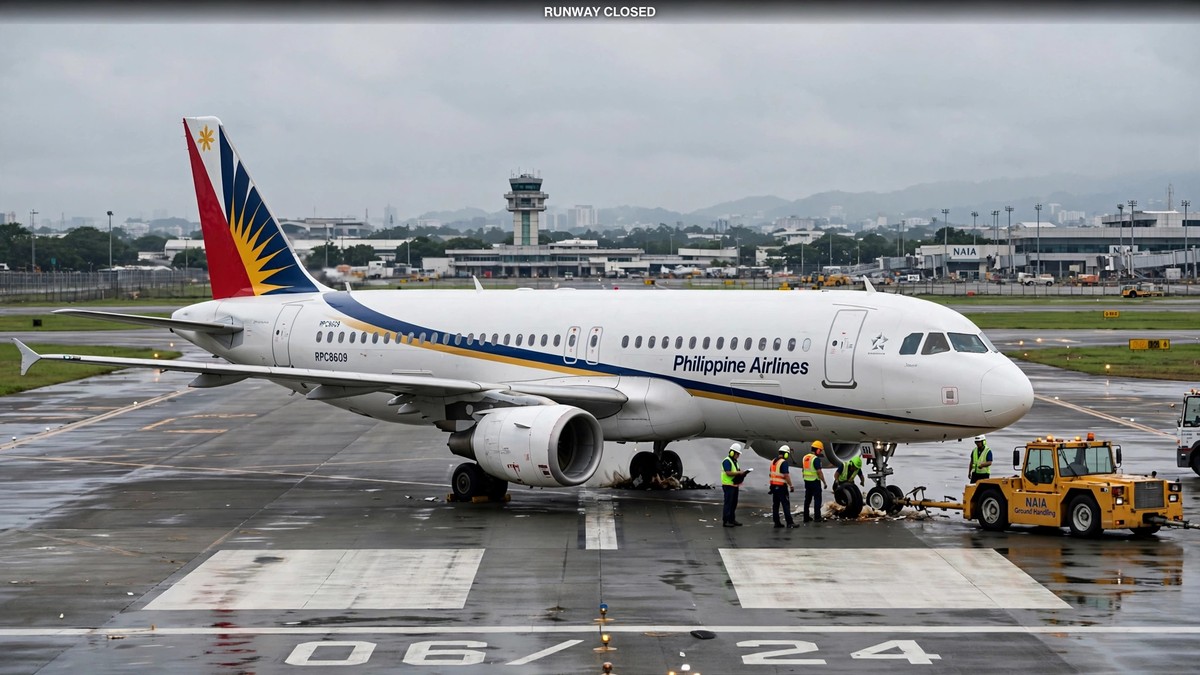
Manila airport runway closure stranded thousands of travellers on Saturday 29 November 2026, after a Philippine Airlines jet returned to Ninoy Aquino International Airport (NAIA) with a hydraulic system problem and stopped on the main runway with burst tyres. The aircraft could not move, so runway 06/24 stayed closed for several hours while crews replaced the damaged tyres and towed the jet away. Thirteen incoming flights were diverted to Clark and Cebu, two more flights were cancelled, and normal runway operations only resumed at around 5:55 p.m. local time.
Nobody was hurt. Philippine Airlines confirmed that all passengers and crew disembarked safely after the emergency landing. The disruption, though, rippled far beyond Manila: long-haul arrivals from Dubai, Doha, Bahrain, Riyadh, Singapore, Tokyo and Hong Kong all landed at different airports, leaving passengers to work out how to reach Manila.
What Happened to PAL Flight PR2923 on 29 November 2026
Philippine Airlines flight PR2923 was a domestic service from Manila to Daraga in Albay, in the Bicol region. The aircraft, an Airbus A320, departed Ninoy Aquino International Airport on the morning of Saturday 29 November 2026. En route, the crew reported a hydraulic system problem and turned the aircraft back to Manila as a precaution rather than continuing to Daraga.
The jet landed back at NAIA at around 11:45 a.m. local time. The landing itself was safe, but the aircraft stopped on the main runway, runway 06/24, with burst main landing gear tyres. With its tyres damaged, the jet was disabled where it stood and could not taxi off the runway under its own power. That single fact turned a precautionary return into an airport-wide disruption.
Ground crews began working to replace the damaged tyres at around 12:50 p.m., so that the aircraft could be towed clear. Airport operator New NAIA Infra Corp. (NNIC) said in an update at 2:30 p.m. that runway 06/24 remained closed while inspections and debris removal continued. The ABS-CBN report on the incident carries the full sequence of events as confirmed by the Civil Aviation Authority of the Philippines.
Hydraulic systems power the brakes, the steering on the ground and parts of the flight controls, so a fault means the crew takes the safest option available. On this flight, that option was to return to Manila, land, and stop the aircraft as soon as it was safely down — even though that left it sitting on the runway.
Why One Stuck Jet Closed Manila Airport’s Main Runway
One disabled aircraft closed Manila’s main runway because NAIA has only two runways, and the jet was sitting on the longer, busier one. Runway 06/24 is the airport’s primary runway. The secondary runway, runway 06/13, stayed in use throughout the incident, but a single runway cannot carry the full schedule of the Philippines’ busiest airport. Delays built up quickly, and incoming flights that could not be held in the air any longer had to go elsewhere.
Manila Airport Runway Closure: All 13 Diverted Flights
Thirteen incoming flights were diverted, according to the Civil Aviation Authority of the Philippines (CAAP) list issued as of 3:30 p.m. on 29 November. Eleven went to Clark International Airport and two went to Cebu. Two Philippine Airlines flights were also cancelled outright: PR2823 from Manila to Bicol and PR2924 from Bicol to Manila. In total, the incident affected 15 flights.
| Flight | Route | Diverted to |
|---|---|---|
| PAL891 | Taipei to Manila | Clark |
| CEB313 | Taipei to Manila | Clark |
| PAL659 | Dubai to Manila | Clark |
| PAL1454 | General Santos to Manila | Clark |
| CEB111 | Hong Kong to Manila | Clark |
| SIA910 | Singapore to Manila | Clark |
| ANA869 | Tokyo to Manila | Clark |
| RX1873 | Riyadh to Manila | Clark |
| UAE332 | Dubai to Manila | Clark |
| GFA154 | Bahrain to Manila | Clark |
| QTR932 | Qatar to Manila | Clark |
| CEB3930 | Bangkok to Manila | Cebu |
| PAL210 | Melbourne to Manila | Cebu |
The list tells its own story about the scale of the disruption. Five of the diverted flights were long-haul services from the Middle East — Dubai, Riyadh, Bahrain and Doha — carrying large numbers of overseas Filipino workers and holiday travellers.
The two cancellations hit the same route the stricken aircraft was flying. With PR2923 stuck on the runway and its return leg unable to operate, PAL cancelled PR2823 from Manila to Bicol and PR2924 from Bicol back to Manila. Passengers booked on those services needed rebooking onto later flights or alternative transport.

What Diverted Passengers Should Do Now
If you were on one of the diverted flights, your first step is to contact your airline, not the airport. Airlines, not airport operators, decide what happens next: whether the aircraft continues to Manila once the runway reopens, whether passengers are bussed, or whether they are rebooked onto another flight. The advice from the authorities on the day was clear — passengers should coordinate with their respective airlines for the latest flight updates.
- Check your flight status with the airline first. Use the airline’s app, website or hotline rather than a general flight tracker. Philippine Airlines and Cebu Pacific both publish rebooking information for disrupted flights.
- Do not leave the diversion airport until you know the plan. If the airline is arranging onward transport or a continuation flight, leaving early can mean losing your seat.
- Keep every receipt. Meals, transport and any hotel stay forced by the diversion should be documented. Photograph boarding passes and booking confirmations too.
- Ask about your checked baggage. Bags usually stay with the aircraft, but if you are bussed to Manila while the aircraft flies on later, your luggage may arrive on a different schedule. Get a baggage reference number before leaving.
- Rebook connecting flights before they are missed. If you had an onward connection from Manila, tell the airline now. A missed connection rebooked early is usually free.
- Allow extra time for the road journey. Clark to Manila is roughly a two-hour drive in normal traffic, and longer on a Saturday evening. Confirm the bus departure time and meeting point in writing.
For passengers diverted to Clark, the Clark International Airport website carries terminal and transport information for onward travel to Manila. For the two flights sent to Cebu, Mactan-Cebu International Airport is the diversion airport, and onward travel to Manila from there means another flight — one more reason to speak to the airline first.
One mistake to avoid is booking your own onward transport before checking with the airline. If the airline is obliged to carry you to your destination, a self-booked bus or flight can complicate a refund or compensation claim. Get the airline’s plan first, in writing if possible, and only then arrange anything yourself.
Manila Airport Runway Closure: Timeline of the Day
The disruption lasted most of the working day. The sequence below, drawn from the CAAP and NNIC updates reported by ABS-CBN, shows how a single morning incident kept Manila’s main runway out of action until the early evening.
| Time (local, 29 Nov 2026) | What happened |
|---|---|
| Morning | PAL flight PR2923 departs NAIA for Daraga, Albay |
| En route | Crew reports a hydraulic system problem and returns to Manila |
| Around 11:45 a.m. | PR2923 lands back at NAIA and stops on runway 06/24 with burst tyres |
| Around 12:50 p.m. | Crews begin replacing the damaged tyres so the jet can be towed off |
| 2:30 p.m. | NNIC says runway 06/24 remains closed; inspections and debris removal continue |
| 3:30 p.m. | CAAP lists 13 diverted flights and 2 cancellations; 15 flights affected in total |
| Around 5:55 p.m. | Normal runway operations resume; runway 06/24 reopens |
The six-hour gap between the landing and the reopening explains the scale of the disruption. Replacing burst tyres on a disabled aircraft is not a quick job, and the runway cannot reopen until the aircraft is clear and the surface is inspected.
The secondary runway, 06/13, kept working throughout, which is why the airport did not shut down entirely. But a single runway at NAIA means reduced capacity, longer queues and diversions for any flight that cannot wait. Travellers flying through Manila in the days after the incident should still check their flight status before heading to the airport, as aircraft and crews end up out of position and schedules take time to recover.
What This Means for Flights Through Manila Next
The runway has reopened and normal operations have resumed, but the incident is a useful reminder for anyone flying through Manila. The airport’s two-runway layout means a single disabled aircraft can disrupt a whole day of flying, and the nearest diversion airports are far enough away that a diversion becomes a genuine journey in itself. Clark International Airport, which took eleven of the diverted flights, is roughly 90 kilometres north of Manila; Cebu, which took two, is an entirely different island. Passengers who build buffer time into Manila connections, and who know their airline’s disruption policy before they travel, will always cope better when something like this happens.
PAL will now investigate the hydraulic fault and the tyre damage with the regulator. The airline has confirmed that everyone on PR2923 disembarked safely, and the focus now shifts to getting diverted passengers to Manila and back on schedule.
Also read: Jakarta Airports Reopen: Airlines Run Relief Flights
Also read: Maldives E-Gates at Velana Airport: Arrival Guide
The Manila airport runway closure on 29 November 2026 was caused by a single aircraft in the wrong place at the wrong time — a jet that did everything right by returning to Manila, and then could not move. Thirteen flights diverted, two cancelled, and a runway closed for six hours: that is the cost of a hydraulic fault at the Philippines’ busiest airport.


