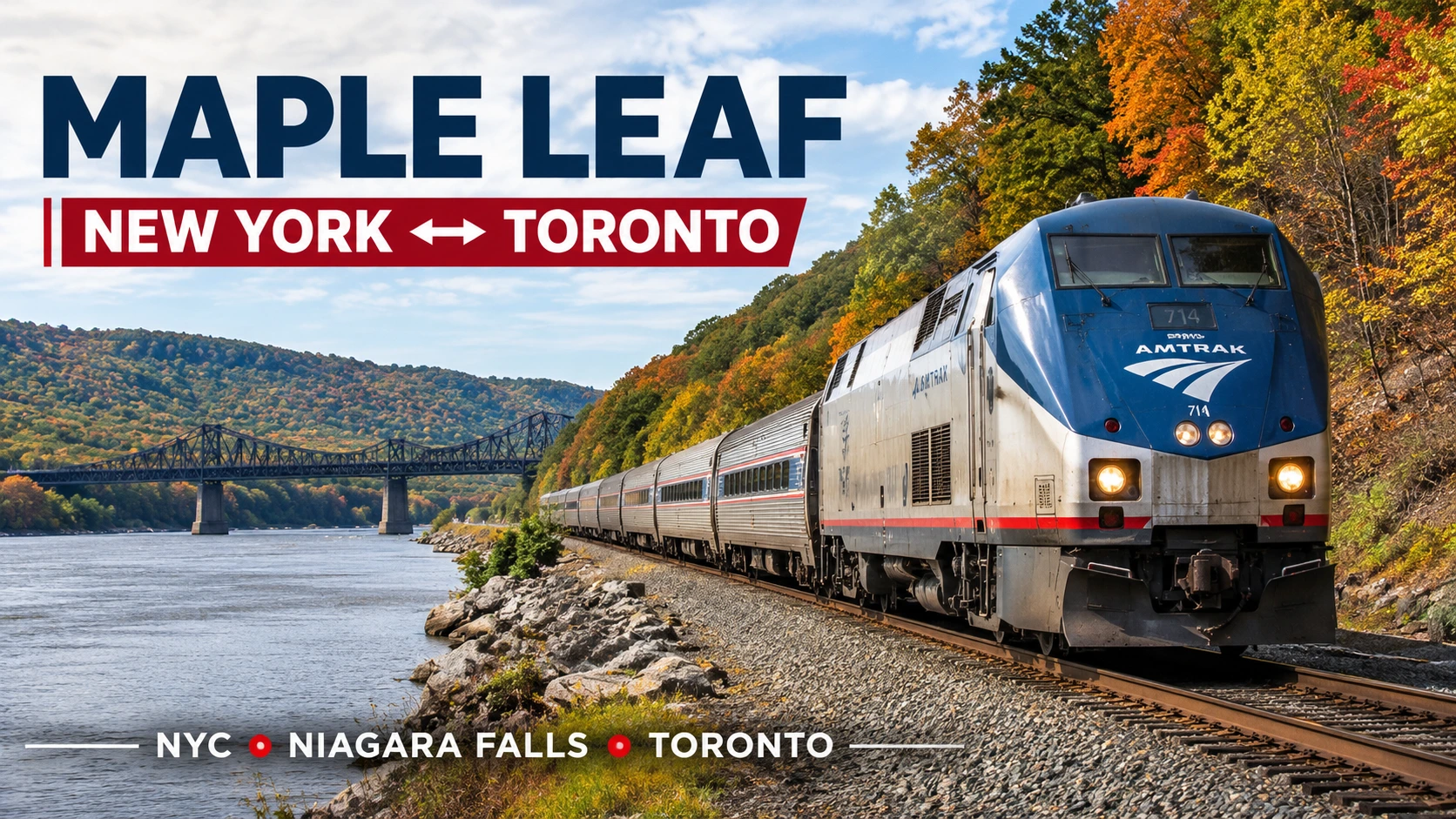
Amtrak operates one daily international train—the Maple Leaf—connecting New York City’s Moynihan Train Hall directly to Toronto Union Station. Covering 544 miles in roughly 12.5 hours, this inter-city rail service completely bypasses airport congestion and offers passengers ground-level views of the Hudson River Valley, upstate New York’s Finger Lakes region, and the Niagara Gorge.
Daily Departure Times and Total Route Duration
The Maple Leaf runs exactly one northbound and one southbound train every single day. The northbound train (Train 63) leaves Manhattan at 7:15 AM, pulling into Toronto just before 8:00 PM. The southbound train (Train 64) leaves Toronto at 8:20 AM and arrives back in New York City shortly after 9:15 PM. Booking directly through the official Amtrak scheduling portal guarantees the most accurate real-time departure tracking if winter weather slows down the upstate New York segment.
| Direction | Train ID | Departure Station & Time | Arrival Station & Time |
| Northbound | 63 | New York (NYP) – 7:15 AM | Toronto (TWO) – 7:43 PM |
| Southbound | 64 | Toronto (TWO) – 8:20 AM | New York (NYP) – 9:16 PM |
The Mandatory Niagara Falls Border Check Protocol
You cannot simply sleep through the international border crossing. When the train reaches the Niagara Falls stations, federal law dictates a mandatory pause for customs and immigration processing.
- Northbound to Canada: Passengers must detrain with all their personal luggage at the Niagara Falls, Ontario station. The Canada Border Services Agency (CBSA) physically inspects your passport and bags inside the terminal before allowing you to reboard and continue to Toronto.
- Southbound to the United States: U.S. Customs and Border Protection officers typically board the train on the New York side of the border to inspect travel documents directly in the aisles.
Always carry a valid physical passport. A standard driver’s license will not grant you international entry, and border agents will force you to abandon the trip immediately if your paperwork is missing.
Also read – 10 Cozy Small Towns in America That Actually Feel Like a Christmas Postcard …

Key Regional Stops: Hudson Valley to the Finger Lakes
The Maple Leaf acts as a crucial transport corridor for upstate New York, stopping at over a dozen regional stations before hitting the Canadian border.
- Albany-Rensselaer (ALB): This major hub marks the end of the initial Hudson River segment. Expect a slightly longer pause here as Amtrak crew members frequently rotate shifts.
- Syracuse (SYR) & Rochester (ROC): These central stations serve as the primary drop-off points for tourists exploring the Finger Lakes wine region or visiting major regional university campuses.
- Buffalo Exchange Street (BFX): Located in downtown Buffalo, this stop is heavily utilized by local commuters and tourists heading to the Lake Erie waterfront before the train pushes directly north toward the falls.
Coach vs. Business Class Fares and Onboard Amenities
Train fares fluctuate constantly based on seasonal demand, but a standard one-way Coach ticket typically starts around $130 to $150 USD if booked several weeks in advance.
Business Class upgrades offer a distinct, quieter carriage featuring premium leather seating, extended footrests, and complimentary non-alcoholic beverages. Both ticket tiers grant access to the shared Café Car, which serves hot sandwiches, snacks, and beer from early morning until late evening.
Wi-Fi Reliability and 12-Hour Trip Preparation
While Amtrak advertises onboard Wi-Fi for the Maple Leaf, the connection relies on cellular towers that frequently drop out through the rural stretches of upstate New York and across the international border. You should download movies, podcasts, and offline maps to your device before leaving the terminal.
Furthermore, relying entirely on microwaved train food for a 12-hour journey gets expensive quickly. Experienced riders utilize the food concourse in New York City to purchase fresh sandwiches and salads before boarding. Amtrak legally allows passengers to bring their own food and non-alcoholic drinks to consume at their seats, saving you significant money over the course of the day.
Seating Strategies for the Best Hudson River Views
Because Amtrak does not assign specific seat numbers in Coach class on the Maple Leaf, your boarding position dictates your view for the entire 12-hour ride.
If you are traveling northbound from NYC to Toronto, claim a window seat on the left side of the train. The tracks hug the waterline, giving you completely unobstructed views of the Hudson River and the Catskill Mountains for the first two hours of the journey.
When traveling southbound from Canada to New York, secure a seat on the right side of the carriage for the exact same waterfront perspective.