

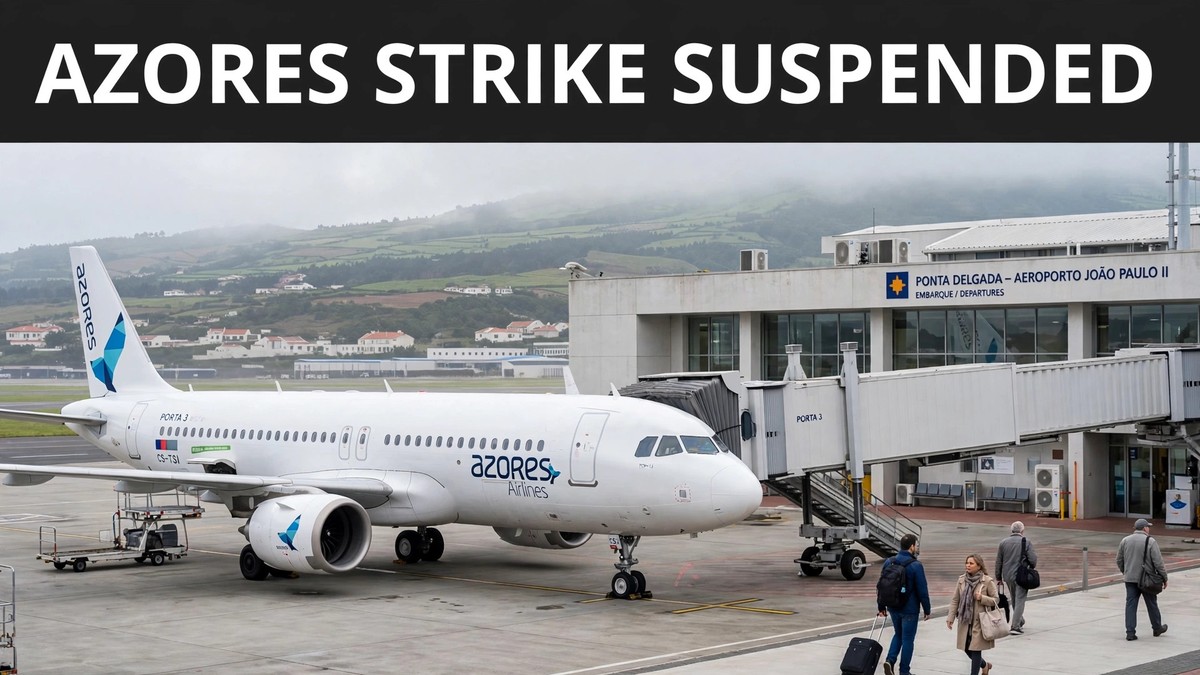
The Azores Airlines strike planned for 1 to 3 December 2026 has been suspended, so Azores Airlines flights on those dates are expected to run normally — but the strike notice has not been withdrawn, and passengers booked to or from the Azores should still check their booking before travelling. The suspension was announced on Saturday 21 November, after the SATA Group board met the cabin crew union SNPVAC at DGERT, the Portuguese labour ministry’s employment relations department, the previous afternoon.
That single fact changes everything about this story. A week earlier, on 17 November, the same union had served formal notice of a three-day cabin crew strike over the airline’s failure to apply its company agreement. The notice is now paused while talks continue, which means the disruption passengers were bracing for is off — for now. The dispute itself is not settled, and the union can reactivate the notice if negotiations break down, so the rights and the action plan below still matter for anyone holding a December ticket.
| Azores Airlines strike: the facts at a glance | Detail |
|---|---|
| Strike dates announced | 1, 2 and 3 December 2026 |
| Current status (30 November 2026) | Suspended since 21 November — flights expected to run normally |
| Who called it | SNPVAC, the national civil aviation flight personnel union |
| Who is affected | Azores Airlines cabin crew — the SATA group’s airline for flights to and from the Azores |
| Why | Union says the airline is not applying its company agreement in full |
| What to do now | Check your booking with the airline before travel; keep your booking reference and any messages |
Azores Airlines Strike: How a Three-Day Walkout Was Called, Then Paused
The Azores Airlines strike was called after an emergency general meeting of cabin crew, and the union served notice on the company on Tuesday 17 November. The Portugal Brief reported the notice on 17 November, citing RTP and the Lusa news agency, and the union said at the time that it remained “fully available” to negotiate and that avoiding the strike was “in the company’s hands”.
Four days later the picture changed. On Friday 20 November, the SATA board met SNPVAC at DGERT, with concessions from both sides, and on Saturday 21 November the SATA Group said in a statement that an understanding had been reached and the strike notice was suspended. Azores1 reported the suspension the same day, citing Lusa, and TripOver confirmed that the notice is suspended, not withdrawn, with talks continuing on the open issues. Neither side has published the terms of the understanding.
The timing matters for passengers. A suspended notice is not a cancelled dispute. If talks collapse, the union could revive the December dates with fresh notice, and that is exactly why the airline’s own advice — check your booking before you travel — still stands. For now, though, there is no strike to plan around, and no wave of cancellations to expect on 1, 2 or 3 December.
Why Azores Airlines Cabin Crew Called the Strike: The Six Grievances
The strike is about the company agreement, not pay alone. The union’s complaint is that Azores Airlines is not applying its acordo de empresa — the company-level collective agreement — in full. The Portugal Brief, drawing on Jornal de Negócios, listed six grievances from the union’s statement, and they explain why crew reached for a strike rather than another round of talks.
First, crew on legally protected flexible working hours lose part of the agreement’s benefits. Second, flights the company labels as “charter” are left outside the agreement’s terms, so the same work is treated differently depending on how the flight is classified. Third, sick leave is judged against each crew member’s individual record, because managers say some crew abuse it — a practice the union rejects. Fourth, crew are not told about flight cancellations in good time, leaving them to learn about disrupted rosters late. Fifth, the board treats long-running complaints as “new questions” each time they are raised. And sixth, different professional groups are treated differently in the same situation.
Read together, the six points describe a workforce that feels the written agreement is being applied selectively. That is also why the dispute has proved hard to settle: it is not one demand that can be met with a single payment, but a set of working practices the union wants honoured as written. The 21 November understanding keeps talks going on those points, including flexible-schedule crew, charter flight conditions and sick-leave validation, which SNPVAC cited when it filed the notice.
Which Azores Airlines Flights Are at Risk on 1-3 December?
Right now, no Azores Airlines flights are at risk on 1, 2 or 3 December, because the cabin crew strike covering those dates is suspended. That is the direct answer, and it is the one that matters most to anyone holding a ticket for the first week of December. Flights between the Azores and mainland Portugal, and the airline’s international routes, are expected to operate as scheduled.
Two cautions belong next to that answer. The first is that the strike notice is suspended rather than withdrawn, so a breakdown in talks could still put December flights back in doubt — the union has not given up the leverage, and passengers should watch for fresh announcements rather than assuming the dispute is over. The second is that a minimum-services question still hangs over any revived strike. Article 537 of Portugal’s Labour Code lists passenger transport and airports among the sectors that meet “essential social needs”, so in those sectors the union and striking workers must provide minimum services. For the SATA handling strike in October, an arbitration ruling fixed which flights had to run. But neither report mentioned minimum services for this cabin crew strike, and no minimum-service flight list was ever published, so there is no list of protected flights to quote.
Passengers should also keep this cabin crew dispute separate from the handling strike that ran alongside it. The ground-handling walkout called by the SINTAC and SITAVA unions for 26 to 29 November was a different dispute, involving different workers, and it went ahead while the cabin crew strike was suspended. That handling action is the one the site covered earlier, with free rebooking for affected passengers.
Also read: Azores Flight Strike Ends Tonight: Free Rebooking to Dec 8

Azores Airlines Strike and Your EU261 Rights: Refund, Re-Routing and Compensation
If an Azores Airlines flight is cancelled, EU air passenger rights give you a choice, not a voucher you have to accept. Regulation (EC) No 261/2004 applies to Azores Airlines flights from Portugal and on its flights into the EU, and the European Commission’s guidance says a cancelled passenger can choose a refund, re-routing at the earliest opportunity, or re-routing on a later date that suits them. The airline must also provide care at the airport, such as meals while you wait, and a refund must be paid within seven days.
Compensation is a separate right, and the amount depends on distance: €250 for flights of 1,500 kilometres or less, €400 for intra-EU flights over 1,500 kilometres and other flights between 1,500 and 3,500 kilometres, and €600 for all other flights, according to the EUR-Lex summary of the regulation. Most Azores–mainland Portugal routes fall in the €250 or €400 bands, while longer international routes can reach €600 — the exact band depends on the route, not on the reason for the cancellation.
The timing rule is the one passengers get wrong most often. Compensation is due if the airline tells you about the cancellation less than 14 days before departure. Between 7 and 14 days, or under 7 days, the airline can avoid paying only by offering re-routing within the time limits the rules set — for example, a replacement flight that departs no more than two hours before the original time and arrives less than four hours late. Because the strike notice was served on 17 November, any cancellation of a 1 December flight announced after that date would already fall inside the 14-day window.
One more point protects passengers specifically in a strike like this. An airline cannot plead its own staff’s strike as an “extraordinary circumstance” to avoid paying compensation. In the Airhelp v SAS case (C-28/20), the EU Court of Justice ruled in March 2021 that a strike by an airline’s own staff, called by their union to win better conditions, does not release the carrier from compensation — and that holds even when the strike is lawful. A strike by air traffic controllers or airport staff is a different matter, but a cabin crew strike called by the airline’s own union is not an excuse.
Also read: EU261 Compensation: How to Claim for a Delayed or Cancelled Flight
Azores Airlines Strike Passenger Action Plan: 5 Steps Before You Travel
Check your booking before you travel, and do it through the airline’s own channels. That is the single most useful step right now, because the situation can change if talks break down. The five steps below take a few minutes and cover the realistic scenarios for a December booking.
1. Check your flight status 48 hours before departure, and again on the day. Use the airline’s manage-booking page or flight-status tool rather than a third-party tracker, and make sure the contact email and phone number on the booking are current so the airline can reach you. If the flight is cancelled, screenshot the cancellation message with the time it arrived — that timestamp decides the 14-day compensation question.
2. Do not cancel the ticket yourself. A passenger-cancelled booking usually means a refund under the fare rules only, which can be far less than the EU261 refund and re-routing rights. Wait for the airline to cancel or offer a change, and if the airline offers a free date change — as it did during the October handling strike — take the change rather than a refund if you still need to travel.
3. Keep every document. Keep the booking reference, the original itinerary, the cancellation or delay message, boarding passes, and every receipt for meals, transport and accommodation. A compensation claim is decided on documents, and a missing receipt is the most common reason a care claim is reduced.
4. Know the three choices before you accept anything at the airport. Refund, re-routing at the earliest opportunity, or re-routing on a later date of your choosing. The airline must offer all three, and it cannot push a voucher as the only option. If the airline refuses, Portugal’s civil aviation authority, ANAC, handles passenger complaints.
5. Claim compensation in writing, and quote the case law if refused. If a cancellation is blamed on the strike, the Airhelp v SAS ruling is the answer: an own-staff strike is not an extraordinary circumstance. State the flight, the date, the cancellation time and the compensation band, and keep a copy of the claim.
Why the Azores Airlines Strike Landed at a Sensitive Moment
The dispute arrived while Azores Airlines is being privatised, with at least 75 percent of its capital for sale and binding bids due by 9 December, according to Jornal de Negócios. That deadline falls just six days after the strike would have ended, and it puts the airline’s management under pressure from two directions at once: a workforce dispute that can ground aircraft, and a sale process that rewards stability. The airline lost €22.5 million in the first nine months of the year, which is the financial backdrop to both the dispute and the privatisation.
The cost of disruption is already visible. SATA’s president has warned that a wave of strikes would have a strong impact on the group’s accounts, and reporting on the dispute put the estimated cost of the cabin crew and ground-handling strikes, including those already held and planned, at around €14 million. That figure covers the group’s strikes collectively, not the cabin crew action alone, and it helps explain why both sides found reason to reach an understanding at DGERT on 20 November rather than let the December walkout go ahead.
For passengers, the practical meaning is simple. The December strike is suspended, flights are expected to run, and the privatisation deadline on 9 December gives both sides a reason to keep talking rather than return to the picket line. But the grievances are unresolved, the notice is only suspended, and the EU261 rights in this article apply in full if the strike returns. Check the booking, keep the documents, and travel with the action plan above in mind.


