

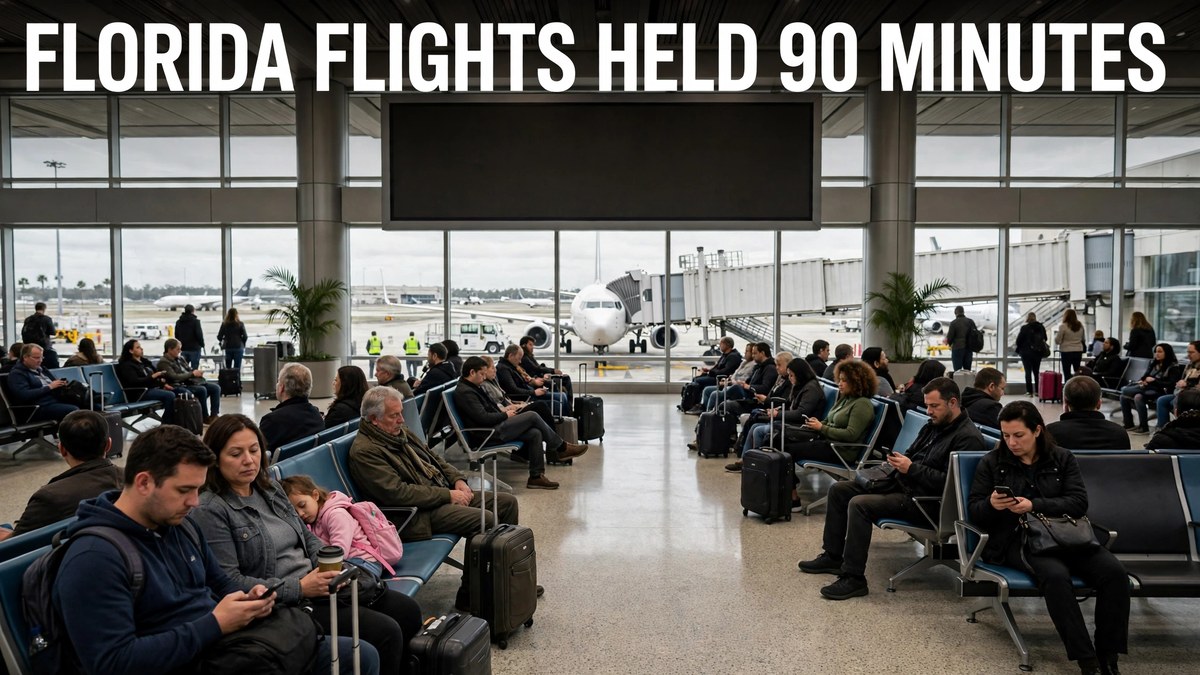
Florida flight delays hit the Gulf Coast on Sunday, 29 November 2026, as air traffic controllers held departures at the gate to meter heavy northbound holiday traffic out of the state. Flights leaving Tampa, Fort Myers, Sarasota and Naples were running late by the middle of the day, with the longest waits reaching 90 minutes at Sarasota Bradenton International.
The delays landed on the busiest travel day of the Thanksgiving period. The FAA Command Center operations plan, issued at 11:35 a.m. Eastern, listed “high snowbird volume” as a constraint across the national airspace, along with a staffing trigger for Tampa operations until 3 p.m. Eastern. At 12:35 p.m. Eastern, the FAA status page showed departure delays of 46 minutes to an hour at Tampa and Fort Myers, and up to 90 minutes at Sarasota, as reported by Deep Arrival.
The message for anyone flying out of Florida this afternoon is simple: check the flight in the airline app before leaving for the airport, and expect a later pushback than the printed time. The holds happen on the ground, before takeoff, so the app and the departure board often disagree by half an hour or more.
Florida Flight Delays at a Glance on 29 November 2026
The picture at midday was consistent: volume, not weather, was doing most of the damage, with thunderstorms adding pressure at Naples. Here is the FAA position at 12:35 p.m. Eastern on Sunday, 29 November.
- What is happening: FAA departure holds and traffic management stops at Florida airports, driven by heavy holiday and snowbird volume.
- Worst affected: Sarasota Bradenton, with departures 1 hour 16 minutes to 1 hour 30 minutes late.
- Also delayed: Tampa and Fort Myers at 46 minutes to 1 hour, Naples at about an hour, Fort Lauderdale at 30 to 44 minutes and easing.
- Not delayed at midday: Orlando International was not listed with delays at 12:35 p.m. Eastern, though conditions can change fast as East Coast storms build.
- When it should ease: snowbird reroutes run to 2 p.m. Eastern, the Tampa staffing trigger and altitude caps to 3 p.m., and Florida to Midwest reroutes to 4 p.m.
Tampa Flight Delays Reach an Hour as Staffing Trigger Bites
Tampa International departures were running 46 minutes to an hour late at 12:35 p.m. Eastern under a traffic management stop for volume, with the trend increasing. The FAA plan lists a staffing trigger for Tampa operations until 3 p.m. Eastern, which usually means controllers there are spacing flights more widely than normal.
Tampa is carrying one of its biggest crowds of the year, with 87,000 to 89,000 travellers expected each on Sunday, 29 November, and Monday, 30 November, the two busiest days of the Thanksgiving period. The airport advises arriving two hours early for domestic flights and three hours early for international flights, and on a day like this it is worth following.
Fort Myers and Sarasota Flight Delays: Airport by Airport
The delays were not spread evenly, and the airport makes a real difference to how long the wait will be. The table below gives the FAA-listed departure delays at 12:35 p.m. Eastern on Sunday, 29 November 2026.
| Airport | Departure delay at 12:35 p.m. Eastern | Reason listed | Trend |
|---|---|---|---|
| Tampa International (TPA) | 46 minutes to 1 hour | Traffic management stop for volume; staffing trigger until 3 p.m. | Increasing |
| Southwest Florida International, Fort Myers (RSW) | 46 minutes to 1 hour | Ground stop and spacing by Jacksonville Center | Increasing |
| Sarasota Bradenton (SRQ) | 1 hour 16 minutes to 1 hour 30 minutes | Compacted demand | Increasing |
| Naples Municipal (APF) | About 1 hour | Departure holds, plus arrival delays tied to thunderstorms | Increasing |
| Fort Lauderdale-Hollywood (FLL) | 30 to 44 minutes | Volume | Easing |
| Orlando International (MCO) | No delay listed | Not listed with delays at midday | Watch for change |
Fort Myers showed the same 46-minute-to-an-hour range as Tampa, under a ground stop and spacing set by Jacksonville Center, the facility that handles most flights leaving Florida. Sarasota Bradenton was the worst of the group, with departures held between 1 hour 16 minutes and 1 hour 30 minutes for compacted demand. Naples showed departure holds of about an hour, plus arrival delays tied to thunderstorms. Fort Lauderdale was the one bright spot, with departures 30 to 44 minutes late and the trend easing. An independent check of the FAA airport status at 12:48 p.m. Eastern showed the same ranges, and the live ground-stop tracker confirmed the pattern into the afternoon.
Why Florida Flights Are Being Held: Snowbird Volume and Altitude Caps
The root cause is volume. The FAA plan names high snowbird volume as a national en route constraint, and many snowbird routes due to end at noon Eastern were extended to 2 p.m. Those routes send Florida flights toward the Northeast and Midwest on longer paths, spreading traffic out so no single corridor overloads.
A separate FAA advisory sent at 12:17 p.m. Eastern added a second layer. Departures from Jacksonville Center airports and Tampa bound for the Atlanta and southern Washington areas are capped at 23,000 feet or below until 3 p.m. Eastern, because of volume at higher altitudes. The FAA tells airlines to plan fuel accordingly, and for travellers the bigger effect is the wait before departure, since flights are held on the ground until a slot opens.

Atlanta, Charlotte and Washington Connections Most Exposed
Connections in Atlanta, Charlotte and the Washington area are the ones most exposed to a late arrival from Florida this afternoon. Those are the hubs where the altitude caps bite hardest, and where a 46-minute delay out of Tampa or Fort Myers can turn into a missed onward flight.
The risk is highest for passengers on tight connections of under an hour: a 50-minute delay on the first leg leaves almost no margin, and the airline’s options narrow to rebooking on a later flight or, on a busy holiday Sunday, the next morning. If the connection is already looking tight, ask the airline about a later connection or a nonstop while there is still time to change it.
What to Do If You Are Flying Out of Florida Today: Passenger Checklist
The holds are a traffic management problem, not a cancellation wave: the FAA notices describe departure holds and reroutes, not cancellations. Work through this checklist before leaving home.
- Check the flight in the airline app first. Do it before leaving for the airport and again before security. The app shows the revised pushback time; the printed itinerary does not.
- Do not leave for the airport late. A departure hold does not shorten the security queue. Keep the arrival time planned, and treat the delay as extra time at the gate, not at home.
- Track the inbound aircraft. If the plane coming in to collect you is itself delayed, the departure will slip further.
- Protect a tight connection early. Call or message the airline, or speak to the gate agent, about a later connection or a nonstop while options still exist.
- Keep essentials in the cabin bag. Medication, chargers and a change of clothes should travel with you, not in the hold.
- Watch the evening weather. Rain and thunderstorms are expected across the eastern United States into Monday, and East Coast storms can force more reroutes and new holds later in the day.
When Will the Florida Departure Delays Ease?
The FAA’s own timetable gives a rough shape to the afternoon. At 2 p.m. Eastern, the Florida to Northeast reroutes and the extended snowbird routes are listed to end. At 3 p.m. Eastern, the Tampa staffing trigger and the Jacksonville Center altitude caps are listed to end. From 4 p.m. Eastern onwards, Florida to Midwest reroutes run to 4 p.m., and evening East Coast storms could bring new holds.
Those end times are not guarantees: the FAA can extend reroutes and caps if traffic stays heavy, and the trend at midday was increasing at most affected airports. Passengers flying in the evening should still check before travelling.
The Associated Press reported that the TSA projected it would screen more than 3 million passengers on Sunday, the busiest day of the Thanksgiving period, and that FlightAware counted nearly 4,300 US flight delays on Saturday. Florida’s holds are part of that national picture, and they are being managed the way the system is designed to manage them: slowly, on the ground, rather than in the air.
Also read: Amsterdam Schiphol fog delays and KLM cancellations and Manila airport runway closure diverts PAL flights.
Frequently Asked Questions About the Florida Flight Delays
Why are flights delayed at Tampa on 29 November? The FAA lists high holiday snowbird volume and a staffing trigger for Tampa operations until 3 p.m. Eastern, and departures were held 46 minutes to an hour at midday.
Is Orlando International affected? No. The FAA status page did not list delays at Orlando at 12:35 p.m. Eastern on Sunday, though conditions can change through the afternoon.
Are Florida flights being cancelled? The FAA notices describe departure holds and reroutes, not cancellations. Check with the airline for the status of a specific flight.
When will Florida departure delays ease? The FAA lists the reroutes and caps ending between 2 p.m. and 4 p.m. Eastern, but it can extend them if traffic stays heavy. Check the airline app before travelling.


