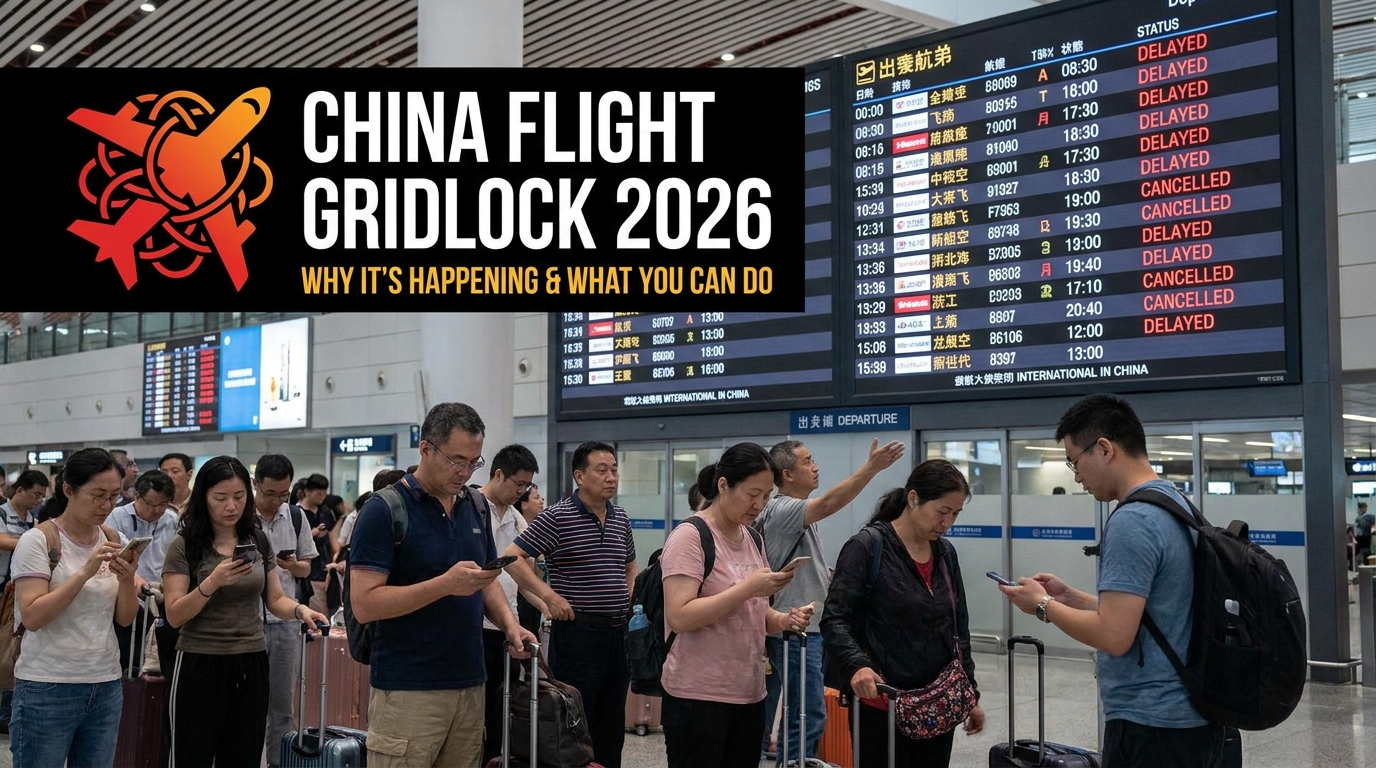
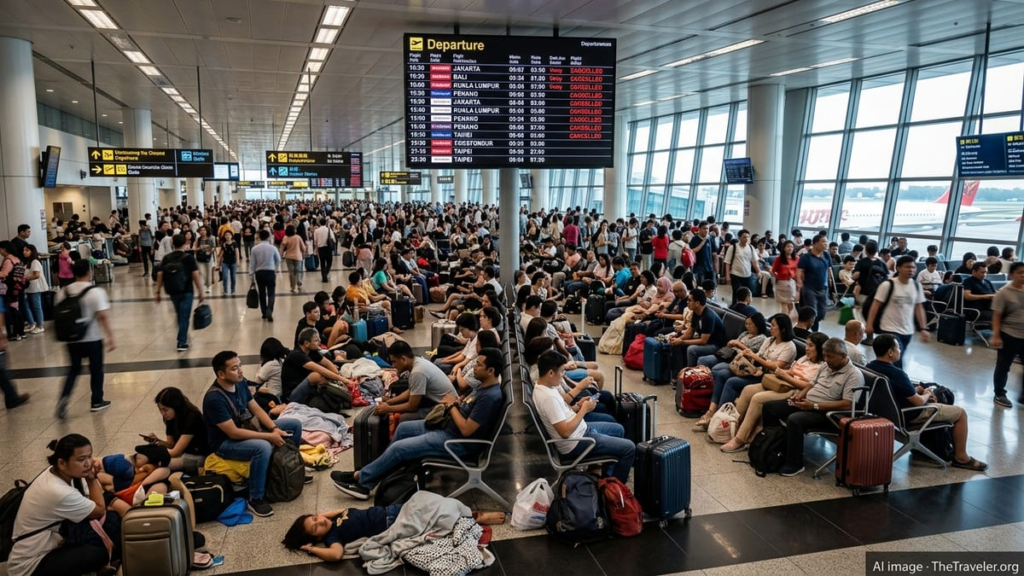
I just spent 11 hours stuck inside Shanghai Pudong airport last month. My connecting flight to Chengdu got delayed three times before it was finally cancelled at midnight. No hotel voucher. No clear information at the gate. Just hundreds of exhausted passengers camped on terminal floors.

That experience pushed me to dig deep into what is actually going on with flights across China this year. And honestly, the situation is far worse than most travel blogs are reporting.
Here is the short answer: Severe thunderstorms and strict air traffic flow controls are causing massive flight cancellations and delays across China’s biggest airports in 2026. Beijing, Shanghai, and Guangzhou are hit the hardest. If you are flying through China between May and September, you need a backup plan.
Why Are So Many Flights Getting Cancelled in China in 2026?
Two forces are slamming into each other at the worst possible time:
- Violent spring and summer storms — Thunderstorms, heavy rain, and low cloud cover are shutting down runways at major hubs repeatedly since April 2026
- Tight air traffic flow controls — China’s airspace funnels enormous volumes of commercial traffic through narrow, heavily managed corridors. When storms hit, authorities slow or completely stop departures from dozens of airports at once
This is not a minor inconvenience. On a single day in late April, tracking data showed more than 1,400 delays and over 150 cancellations across primary hubs in China. By May 11, another gridlock episode hit with over 400 flights disrupted in a single day.
The real problem? Airlines have packed their 2026 summer schedules with maximum flights to cash in on post-pandemic demand. There is almost zero slack in the system. One thunderstorm in Guangzhou can trigger a chain reaction that grounds flights in Beijing three hours later.
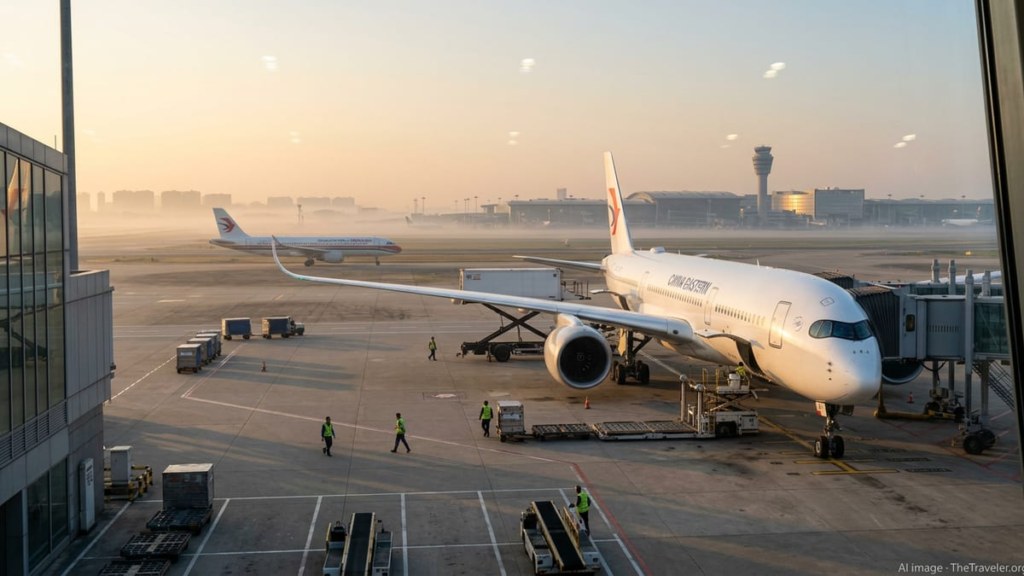
Which Chinese Airports Are Most Affected by Delays Right Now?
Not all airports are equally hit. Here is exactly where the worst disruptions are concentrated:
| Airport | City | Why It’s a Problem |
|---|---|---|
| Beijing Capital (PEK) | Beijing | Massive connecting traffic from north and west China; dual-airport system amplifies delays |
| Beijing Daxing (PKX) | Beijing | Shares airspace with Capital; flow controls affect both simultaneously |
| Shanghai Pudong (PVG) | Shanghai | Primary intercontinental gateway; tightly scheduled wide-body operations |
| Shanghai Hongqiao (SHA) | Shanghai | Dense short-haul traffic; narrow connection windows break easily |
| Guangzhou Baiyun (CAN) | Guangzhou | Sits directly in the Pearl River Delta storm path; highest disruption counts in south China |
| Shenzhen Bao’an (SZX) | Shenzhen | Rerouted traffic from Guangzhou creates secondary bottleneck |
| Chengdu Tianfu (TFU) | Chengdu | Growing hub with increasing connecting traffic; local weather adds pressure |
| Xi’an Xianyang (XIY) | Xi’an | Featured in multiple disruption events in May 2026 |
I have personally seen the Beijing dual-airport problem firsthand. A friend flew into Daxing for a connection through Capital. Storm delays pushed his arrival back by 4 hours. His connecting flight from Capital had already left. He spent the night in a transit hotel and lost an entire day of his trip.
Also read – What Wizz Air New UK to U.S. Flight Plans Means for Travelers?
What Is Causing the Air Traffic Flow Controls in China?
Flow controls are the silent killer of your travel plans. Most passengers have never heard of them, but they are responsible for a huge share of the delays.
Here is how it works:
- China’s civil airspace is shared with military operations, which limits the corridors available for commercial flights
- When storms, military activity, or other restrictions reduce capacity in these corridors, air traffic management slows or stops departures from dozens of airports simultaneously
- Aircraft already in the air are put into holding patterns, burning fuel and time
- Flights on the ground are held at gates or taxiways, sometimes for 3 to 5 hours
The structural issue is that China’s airspace design has not kept pace with the explosive growth in air travel. The same corridors that handled traffic 10 years ago are now carrying vastly more flights, and there is very little room for error.
How Are Passengers Being Affected on the Ground?
I have talked to dozens of travelers on forums and social media who flew through China this spring. Their stories paint a consistent picture:
- Hours-long queues at rebooking counters with limited staff
- Missed connections because airlines schedule tight 60-90 minute layovers that leave no room for delays
- Passengers sleeping in terminals when hotels are full near major airports
- Checked luggage arriving days late after being separated from rebooked passengers
- Minimal real-time information in English at some airports during disruption events
One pattern I keep seeing: airlines in China tend to delay flights rather than cancel them outright. This sounds better on paper, but it means you could board at 11 PM for a flight that was supposed to leave at 3 PM. You land at 2 AM in a city where all ground transport has stopped.
A traveler on a passenger rights forum described arriving in Kunming at 1:30 AM after a 7-hour delay from Shanghai. No metro, no buses, and a 45-minute taxi queue. That is the reality right now.
Also read – Safe Arrival Window for Solo Female World Cup …
When Is the Worst Time to Fly Through China in 2026?
Peak disruption season runs from late May through August. That is when thunderstorm activity is most intense across southern and central China.
Here is the risk breakdown by month:
| Month | Disruption Risk | What to Expect |
|---|---|---|
| April | Medium-High | Early storms already caused 200+ cancellations nationally |
| May | High | Multiple gridlock events; over 400 flights disrupted on May 11 alone |
| June | Very High | Core thunderstorm season begins; Guangzhou and Shanghai most exposed |
| July | Very High | Peak storm intensity; expect frequent multi-day recovery periods |
| August | High | Storms begin to ease but typhoon season adds coastal airport risk |
| September | Medium | Improving conditions but residual schedule pressure remains |
If you can move your trip to October or November, you will dodge the worst of it. Those are historically the smoothest months for Chinese aviation.
7 Practical Tips to Survive China Flight Chaos in 2026
I have learned these the hard way over multiple trips:
- Book morning flights — Thunderstorms typically build in the afternoon and evening. A 7 AM departure has a significantly better chance of leaving on time than a 5 PM one
- Allow 3+ hour connections — Forget the standard 90-minute layover. At Beijing, Shanghai, or Guangzhou, you need at least 3 hours to absorb delays
- Download the airline’s Chinese app — Chinese carriers often push real-time updates and rebooking options through their domestic apps (WeChat mini-programs or native apps) faster than international booking platforms
- Carry essentials in your hand luggage — Charger, medication, a change of clothes, and snacks. If your flight gets rebooked, your checked bag might not follow you
- Avoid connecting through the worst-hit hubs if possible — Consider routing through less congested airports like Xiamen, Nanjing, or Dalian when practical
- Buy flexible or refundable tickets — The small premium is worth it when cancellations hit. Some Chinese carriers allow free rebooking during published weather disruption events
- Keep screenshots of your booking and delays — Useful for insurance claims and compensation requests later
What Is China Doing to Fix the Flight Delay Problem?
China’s aviation regulator, the Civil Aviation Administration of China (CAAC), is actively working on several improvements:
- Collaborative Decision-Making (CDM) platforms — Sharing real-time data between air traffic control, airlines, and ground handlers at major airports to speed up recovery
- Upgraded air traffic management technology — Better radar, communication, and automation tools for managing congested corridors
- Refined slot allocation — Smarter scheduling that builds more buffer into peak-hour operations
- New airport infrastructure — Additional runways, taxiways, and terminal capacity at leading hubs; new airports in the Pearl River Delta and western provinces to spread traffic
- Severe weather contingency plans — Targeted protocols for the thunderstorm season with faster decision-making on cancellations vs delays
These are encouraging steps, but they will take years to fully roll out. For the 2026 summer season, travelers should plan as if the current level of disruption will continue or get worse before it gets better.
The Bottom Line for Travelers Flying Through China
China’s aviation system is under enormous strain right now. The combination of aggressive scheduling, severe weather, and structural airspace limitations creates a perfect storm — literally — for flight chaos.
If you are flying through Beijing, Shanghai, Guangzhou, or Chengdu this summer, expect delays. Build extra time into every connection. Have a backup plan for each segment. And carry everything you cannot afford to lose in your cabin bag.
I have been flying through Asia for years, and I have never seen disruption at this scale persist for this long. The smart move is to plan for the worst and be pleasantly surprised when things go smoothly.