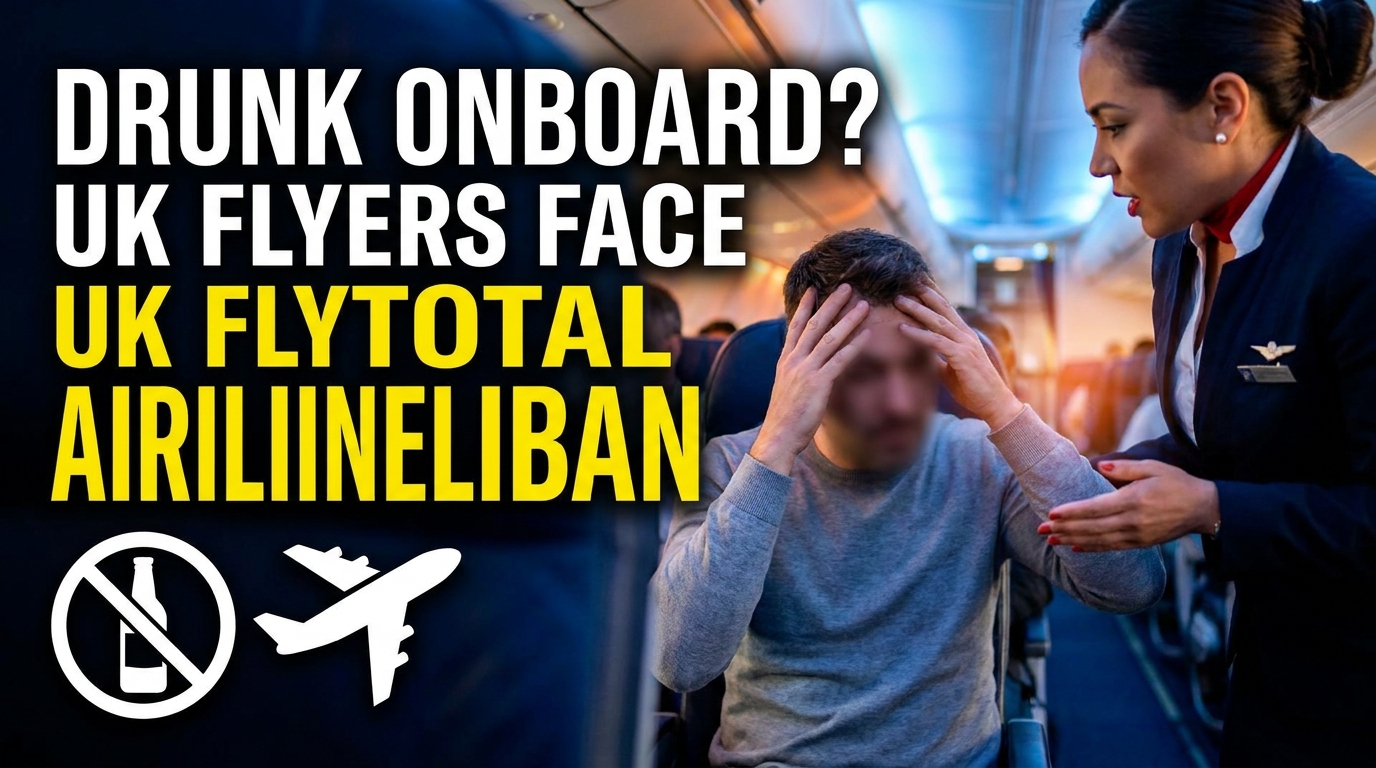
Being drunk onboard a UK flight can already get you arrested, fined, jailed, and banned by the airline. The new change being discussed is bigger: the UK government is exploring a plan that could let airlines share details of seriously disruptive passengers, so a person banned by one airline could also be refused by others. The proposal is still being developed, not fully active law today, but it shows how seriously the UK is now treating drunk and abusive behaviour in the air.

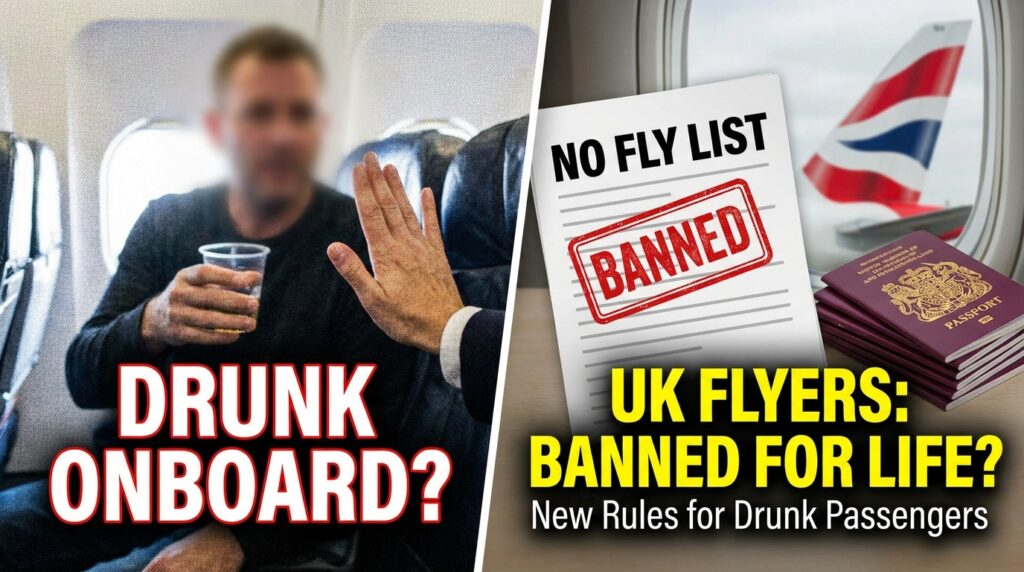
What Is the New UK Airline Ban Plan?
The UK government is looking at a national-style ban system for disruptive flyers. Under the plan being explored, airlines could share information about passengers who cause serious trouble, especially repeat offenders or people whose behaviour threatens safety.
Right now, the problem is simple: one airline can ban a passenger, but that person may still be able to book with another airline. The new proposal is designed to close that gap.

Sky News reported that officials at the Department for Transport and the Home Office are developing a scheme where airlines could notify the government about a disruptive passenger. If that person later checks in for another flight, a participating airline could be alerted and then decide whether to refuse them travel.
Can Being Drunk Onboard Ban You From UK Airlines Forever?
Yes, in serious cases, drunk or disruptive behaviour can already lead to a permanent ban from one airline. What may change is that the ban could become wider across UK airlines.
That does not mean every passenger who has one drink at the airport will be banned. The focus is on people who become drunk, aggressive, abusive, threatening, violent, or unsafe.
The Civil Aviation Authority says disruptive passengers risk:
- Arrest and criminal charges
- Heavy fines or imprisonment for up to two years
- Paying the full cost of a flight diversion
- Being permanently banned from flying with the airline
So the answer is clear: being drunk on a plane is not treated like normal bad manners. It can become a criminal and travel-ending mistake.
Is the UK Airline-Wide Ban Already Active?
No, the wider all-airline ban is not fully active yet. It is still a proposal at the concept stage. Officials are expected to discuss the plan with airlines, and the details still need to be worked out.
This matters because some headlines may make it sound like the rule is already in place. It is not.
Here is the current position:
| Question | Clear answer |
|---|---|
| Can airlines ban drunk passengers today? | Yes, individual airlines can ban passengers. |
| Is being drunk on an aircraft already an offence? | Yes, UK aviation rules treat it as an offence. |
| Can one airline currently share ban details with every other airline? | Not easily, because of data protection and information-sharing limits. |
| Is the UK creating a wider system? | The government is exploring one. |
| Could repeat offenders be refused by several airlines in future? | Yes, that is the aim of the proposal. |
Why Is the UK Considering This Now?
The UK is considering this because drunken and disruptive passenger incidents are no longer rare enough to ignore. A small number of passengers can ruin a flight for hundreds of people, scare families, delay holidays, and put crew in danger.
The government source quoted in reporting made the point directly: people should be able to enjoy a drink at the airport, but antisocial behaviour on flights is unacceptable because it threatens passengers and crew and disrupts holidays.
Airlines also want stronger action. Airlines UK chief executive Tim Alderslade said UK airlines have a zero-tolerance approach to disruptive behaviour and described a national ban list for the most serious cases as an important next step.

What Counts as Disruptive Behaviour on a Plane?
Disruptive behaviour is anything that creates distress, danger, delay, or safety risk onboard. It does not have to mean a physical fight.
The Civil Aviation Authority lists intoxicated, rude, aggressive, or otherwise disruptive behaviour as a safety concern because it can distress crew and passengers and even force an aircraft to divert.
Common examples include:
- Being visibly drunk while boarding or onboard
- Abusing cabin crew
- Threatening other passengers
- Refusing crew instructions
- Trying to smoke or vape onboard
- Opening duty-free alcohol during the flight
- Fighting, shouting, or causing panic
- Interfering with safety procedures
- Forcing the aircraft to return or divert
The key point is this: on a plane, crew instructions are safety instructions. Ignoring them can become a serious offence.
Also read – El Al Israel Launches Nonstop Tel Aviv–San Francisco Flights
What Happens If a Drunk Passenger Forces a Flight Diversion?
A flight diversion can turn one passenger’s bad decision into a huge cost. If a plane has to land somewhere else because of disruptive behaviour, the passenger may face criminal action, an airline ban, and a demand to pay costs.
Those costs can include:
- Extra fuel
- Landing charges
- Passenger accommodation
- Crew disruption
- Missed connections
- Aircraft schedule delays
- Legal and operational costs
Ryanair has already taken a tougher public stance on this issue. In May 2026, Michael O’Leary said Ryanair was diverting nearly one flight a day on average because of bad behaviour onboard, compared with around one a week 10 years earlier.
That is why the proposed UK system is not just about punishment. It is also about stopping repeat incidents before the aircraft doors close.
Is It Illegal to Be Drunk on a Plane in the UK?
Yes, it is an offence to get on or be on an aircraft while drunk. The Civil Aviation Authority states this clearly in its passenger safety guidance.
The UK government has also said airlines have the authority to stop passengers they believe are intoxicated from boarding an aircraft.
That means a passenger can get into trouble at two points:
- Before takeoff, if staff believe they are too drunk to fly
- During the flight, if they become disruptive or unsafe
This is where many travellers misunderstand the rules. Airport drinking is legal. Being drunk enough to be unsafe on an aircraft is not.
Why Airport Drinking Is Under More Scrutiny
Airport alcohol is becoming part of the wider debate because many disruptive incidents begin before boarding. Passengers may drink in the terminal, buy duty-free spirits, drink during delays, and then board already impaired.
The UK government previously reviewed airside alcohol rules and said that while it did not plan to extend all Licensing Act rules airside, more action was still needed. The government also noted that airlines already have powers to refuse passengers they believe are intoxicated.
The difficult balance is this:
| Issue | Why it matters |
|---|---|
| Airport drinking is part of holiday culture | Many passengers drink responsibly before flying |
| Some passengers drink too much before boarding | Crew inherit the problem once doors close |
| Delays can increase drinking time | Longer waits can mean more alcohol consumed |
| Duty-free alcohol can be misused | Some passengers open bottles before or during flights |
| Crew have limited space onboard | A disruptive passenger is harder to manage in the air |
The new proposal appears to target the worst offenders rather than ordinary travellers having one pint before a holiday.
Also read – Vietnam-Russia Travel Surges After Direct Flights & QR Payment
What Would a National Airline Ban List Actually Do?
A national-style ban list would make it harder for serious offenders to simply switch airlines. That is the main practical change.
At the moment, if someone is banned by Airline A, Airline B may not know about it. The proposed system could allow information to be shared in a controlled way, likely with government involvement because passenger data is sensitive.
A simple example:
- A passenger gets drunk and abusive on a flight.
- The airline bans them.
- The incident is reported under the proposed system.
- The passenger later tries to check in with another airline.
- That airline receives an alert.
- The airline decides whether to refuse travel.
The final decision would still sit with the airline under the plan described in reporting.
Will Every Drunk Passenger Be Banned From Flying?
No, the proposal is aimed at serious disruption, not casual drinking. A person having a glass of wine at the airport is not the target. A person abusing crew, ignoring safety instructions, starting fights, or forcing a diversion is.
This distinction is important because the public debate can easily become emotional. The issue is not alcohol itself. The issue is unsafe behaviour after alcohol.
The International Air Transport Association says unruly passenger incidents are committed by a minority but have a disproportionate impact because they threaten safety, disrupt crew and passengers, and cause delays or diversions.
What Travellers Should Do Before a UK Flight
The safest rule is simple: drink less than you think you can handle. Flying changes the situation. You are in a confined space, under crew authority, surrounded by strangers, and unable to leave.
Use this practical checklist:
- Do not board if you feel drunk
- Avoid mixing airport drinking with sleep deprivation
- Do not open duty-free alcohol before or during the flight
- Listen to crew instructions the first time
- Stop drinking if crew refuse service
- Do not argue with cabin crew
- Keep your group under control, especially on stag or hen trips
- Remember that “holiday mood” is not a legal defence
A useful real-life-style example: four friends fly from Manchester to Malaga after a long delay. They start drinking at 7 a.m., buy spirits at duty-free, and keep drinking at the gate. One becomes loud onboard and refuses to sit down. The aircraft returns to stand, police board, and the group’s holiday is over before takeoff. One person’s behaviour can cost everyone.
What Airlines Can Already Do to Drunk Passengers
Airlines already have strong powers to stop a drunk passenger from flying. They can refuse boarding, remove a passenger, call police, ban the passenger from future flights, and seek costs if the incident causes disruption.
| Airline action | What it means for the passenger |
|---|---|
| Refuse boarding | You do not fly and may not get a refund |
| Remove from aircraft | Police may be called |
| Ban from airline | You cannot book future flights with that carrier |
| Report incident | You may face investigation or charges |
| Claim costs | You may be asked to pay diversion or delay costs |
The proposed UK plan would add one major new layer: other airlines may also be warned.
Can Cabin Crew Refuse Alcohol Onboard?
Yes, cabin crew can refuse to serve alcohol if they believe it is necessary for safety. The government’s airside alcohol review said several airlines confirmed crew can refuse alcohol, suspend alcohol sales, or operate a dry service where needed for safety.
Passengers often forget that cabin crew are not just serving drinks. Their main role is safety. If they stop serving someone, arguing usually makes the situation worse.
Why This Proposal Could Change UK Travel Behaviour
The fear of being banned across airlines may become a stronger deterrent than a fine. Many people can imagine paying a fine. Fewer people want to explain to family, employers, or friends why they can no longer fly with major UK carriers.
This proposal could especially affect:
- Repeat offenders
- Passengers banned by one airline already
- People involved in alcohol-related incidents
- Travellers who abuse crew
- Groups whose behaviour causes delays
- Passengers who force diversions
For most travellers, nothing changes. For the small minority who treat aircraft like pubs in the sky, the consequences could become much heavier.
Final Take: Being Drunk Onboard Is Now a Serious Travel Risk
Being drunk onboard a UK flight can already ruin your trip, damage your record, and get you banned by an airline. The proposed UK plan could make the punishment much wider by helping airlines share information on serious offenders.
The clearest takeaway is this: the UK is moving toward tougher consequences for disruptive passengers, especially those linked to alcohol, abuse, and repeat behaviour.
A pint at the airport is not the issue. Turning that pint into abuse, threats, refusal to follow instructions, or a diversion is the issue.
For ordinary travellers, the advice is simple: enjoy your trip, respect the crew, stay in control, and do not be the reason a plane has to turn around.