The Ministry of Civil Aviation (MoCA) is accelerating India’s regional flight network by launching a competitive “Challenge Mode” and signing Memorandums of Understanding (MoUs) with 21 state governments. These moves are designed to strip away bureaucratic delays and incentivize states to develop airport infrastructure faster than ever before.


This strategy shifts the responsibility of airport growth from a central mandate to a state-led competition. By signing these 21 MoUs, states are now committed to providing land, simplifying clearances, and offering local incentives to attract airlines.
What is MoCA’s Challenge Mode and How Does it Work?
Challenge Mode is a performance-based framework where states compete to achieve specific aviation milestones in exchange for priority support and funding. Instead of a slow, one-size-fits-all rollout, the government now rewards states that can demonstrate “readiness,” such as having land cleared for takeoff or local demand data finalized.
This approach targets the biggest bottleneck in Indian aviation: land acquisition. Under Challenge Mode, states that resolve land disputes quickly move to the front of the line for central assistance and airline deployment.
Why did MoCA sign MoUs with 21 different states?
The 21 MoUs create a legal and operational pact to synchronize state-level infrastructure with the national UDAN (Ude Desh ka Aam Naagrik) goals. These agreements ensure that when the central government identifies a route, the state government has the runway and terminal readiness to support it without years of red tape.
These partnerships focus on three core areas: fast-tracking environmental clearances, reducing state taxes on aviation turbine fuel (ATF) where possible, and streamlining the “last-mile” connectivity from the airport to the city center.
| Key Focus Area | Traditional Approach | Challenge Mode / MoU Approach | Expected Outcome |
|---|---|---|---|
| Land Acquisition | Years of litigation and slow surveys | Pre-cleared land banks provided by states | Airports operational in months, not years |
| Clearances | Multiple state and central agency hops | Single-window clearance under MoU terms | Faster construction timelines** |
| Route Launch | Airline-driven request process | State-led demand generation and incentives | More flights to Tier-2 and Tier-3 cities |
| Infrastructure | Centrally funded, slowly executed | State-owned, centrally supported | Localized control and faster maintenance |

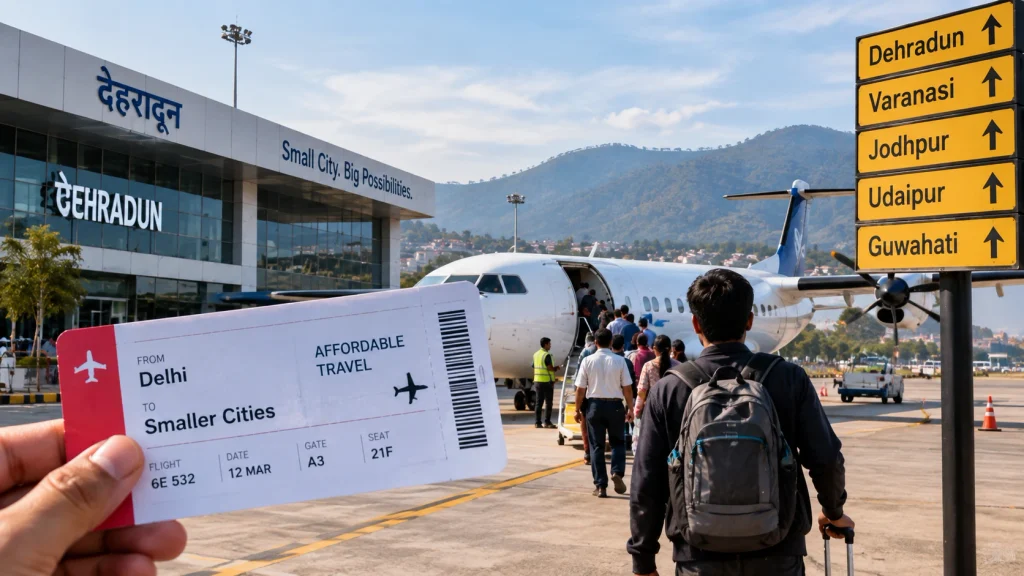
How will this increase flights to smaller Indian cities?
More flights will land in smaller cities because the financial risk for airlines is now lower. When a state signs an MoU, they often provide “Viability Gap Funding” or operational subsidies, making it profitable for an airline to fly a 50-seater aircraft to a remote town.
The focus is moving toward “hub-and-spoke” models. Instead of every small city trying to connect to Delhi or Mumbai, these MoUs encourage states to build regional hubs that connect smaller towns to the nearest major city, reducing overall travel time and cost for the passenger.
What should travelers expect from these new regional airports?
Travelers can expect smaller, more efficient terminals with significantly shorter check-in times and reduced commute distances to their homes. Since these airports are being built under a “lean” model, they avoid the chaos of mega-airports, focusing instead on quick turnarounds and basic, high-quality amenities.
However, because these are smaller operations, flight frequencies may initially be low. A route might start with just three flights a week, meaning flexibility in booking will be limited during the first six months of a new route’s launch.
Pro Tips for Navigating New Regional Airports
Booking flights to newly opened regional airports requires a different strategy than flying into an international hub. Follow these steps to ensure a smooth journey:
- Verify Ground Transport: New airports are often located far from the city center with limited Uber/Ola availability. Always pre-book a taxi or check with the Airports Authority of India (AAI) for official transport partners.
- Check Luggage Limits: Regional flights often use smaller aircraft (like ATRs or Q400s) with stricter weight limits. Overweight bags are more likely to be bumped on these flights than on a Boeing 73**
- Arrive Early, but Not Too Early: While these airports are smaller, the security staffing can be lean. Arriving 90 minutes before departure is usually plenty, but checking in online is mandatory to avoid long queues at the only available counter.
- Monitor “UDAN” Fares: Keep an eye on the Ministry of Civil Aviation’s official updates to find capped-fare flights that are significantly cheaper than standard commercial tickets.
Will this lead to cheaper airfares for the general public?
Airfares will likely drop on specific regional routes due to increased competition and state subsidies. When multiple states compete in “Challenge Mode,” they strive to make their airports the most attractive, which often leads to lower landing fees for airlines—a saving that can be passed down to the passenger.
Long-term costs will stabilize as the volume of passengers increases. As more people switch from overnight buses or trains to short-haul flights, the economy of scale will allow airlines to operate more flights per day, further driving down the ticket prices.