
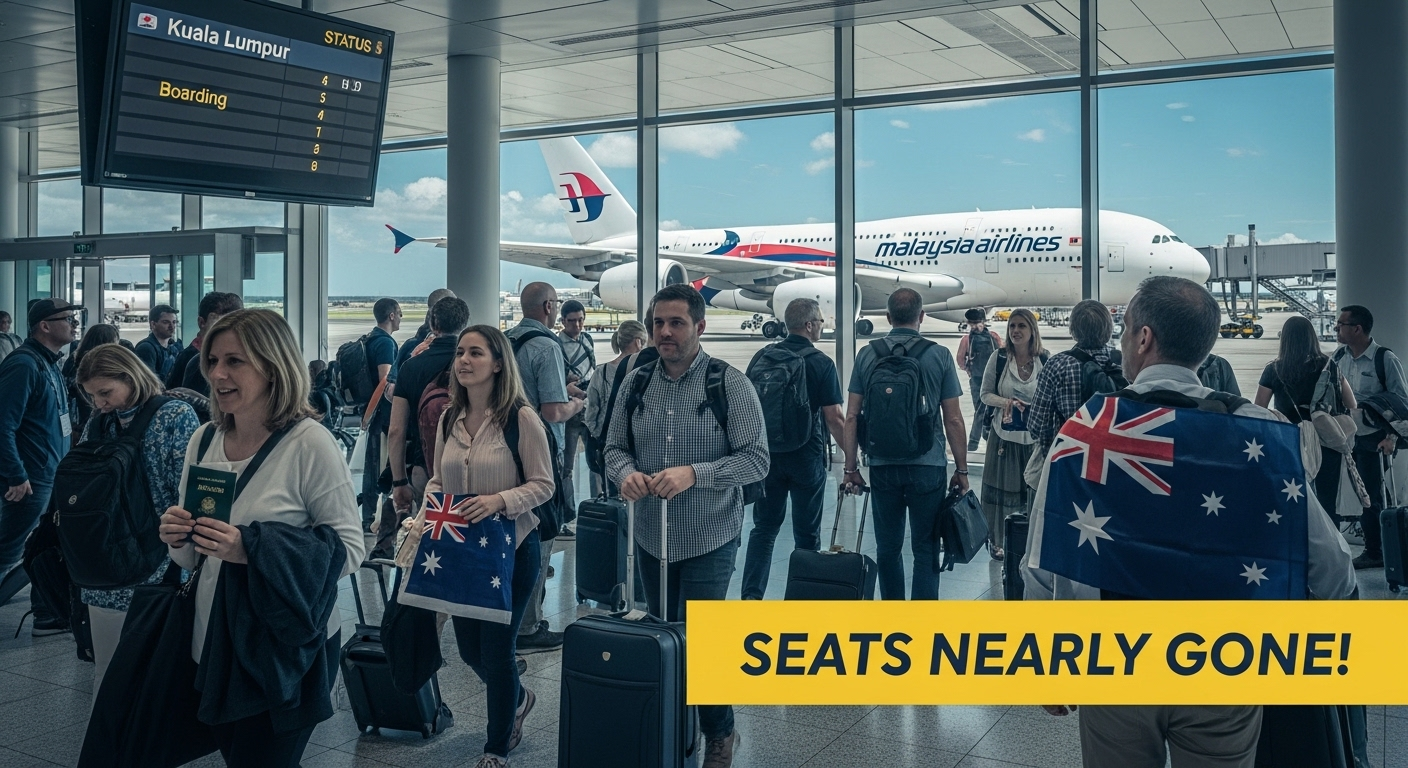
Something unusual is happening on flights between Australia and Kuala Lumpur. They’re almost completely full and it’s not slowing down.
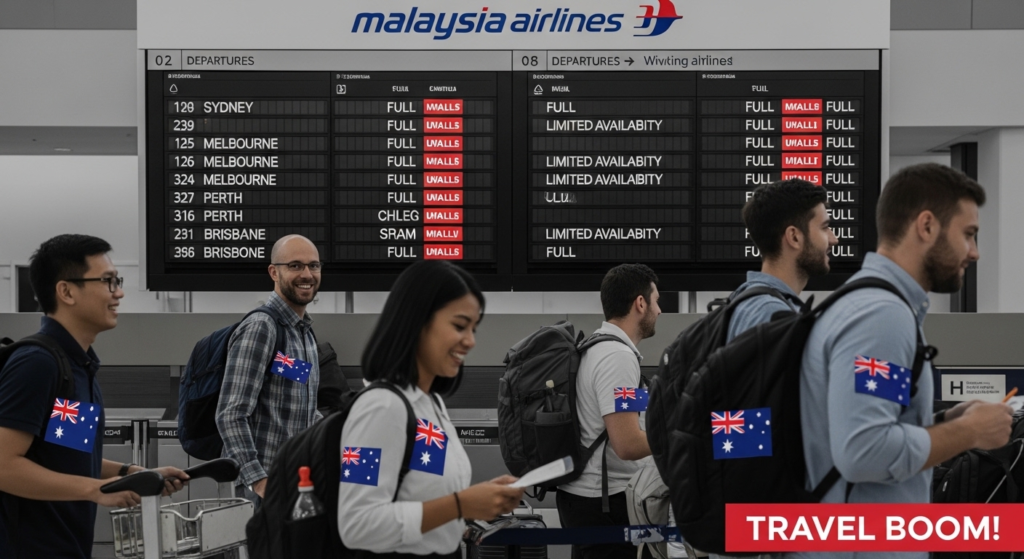
Malaysia Airlines just confirmed that its Australian services are running at over 90% capacity across all five gateway cities: Sydney, Melbourne, Perth, Adelaide, and Brisbane. That’s not a one-off peak season spike. It’s a sustained surge that’s forcing the airline to add flights, fast-track new jets, and rethink its entire Australian strategy.

But here’s the part nobody’s really talking about: this rush isn’t just about flying to Malaysia. Australians have figured out that Kuala Lumpur is one of the cheapest, most comfortable transit points on the planet and they’re using it to reach London, Paris, Tokyo, and beyond at prices competitors can’t match.
70+ Flights a Week And Still Not Enough
The scale of Malaysia Airlines Australian operation is staggering.
The carrier now operates more than 70 weekly flights into Australia, making it one of the airline’s most significant international markets (Australian Aviation). Here’s what that schedule looks like:
- Sydney: 3 flights daily
- Melbourne: 3 flights daily
- Perth: 2 flights daily
- Adelaide: 1 flight daily
- Brisbane: Currently 5x weekly, scaling to daily by October
Even with that frequency, flights are packed. And the response has been swift – Brisbane services will jump to six weekly flights from June and go daily from October 2026 (Travel Weekly Asia).
For context, running load factors above 90% is exceptionally high. Most airlines target 80–85% as healthy. Consistently hitting the low-to-mid 90s means the airline could sell out entirely on peak days.
What’s Driving the Stampede?
Three forces are colliding at once.
1. A New Open Skies Deal Blew the Doors Open
In late 2024, Australia and Malaysia expanded their bilateral air rights, hiking the seat cap for Malaysian carriers from 36,000 to 50,000 seats per week. Then in 2026, they went further – agreeing to unlimited passenger capacity between the two countries (Sydney Airport).
That’s a massive deal. It means Malaysia Airlines (and AirAsia X) can throw as many flights at Australia as demand will absorb, without regulatory bottlenecks. And demand, clearly, is absorbing everything they can throw at it.
2. Visit Malaysia Year 2026 Is Pulling Record Numbers
Malaysia is running its Visit Malaysia Year 2026 campaign under the theme “Surreal Experiences,” targeting 47 million international tourist arrivals for the year (MIDF Research).
The campaign is working. Australian visitor arrivals to Malaysia jumped 22.2% year-over-year as of March 2026, following a 16.6% increase through the first half of 2025 (Malay Mail, The Straits Times). Australians, it turns out, love the combination of a favourable exchange rate, world-class food, and accommodations that cost a fraction of comparable options in Bali or Thailand.
3. The KUL Hub Play Is Working
Here’s where it gets interesting for travelers beyond Malaysia.
Kuala Lumpur International Airport (KUL) has quietly emerged as one of Southeast Asia’s most competitive transit hubs. Malaysia Airlines operates onward connections from KUL to London, Paris, and across East Asia, and the routing is often cheaper than going through Singapore, Dubai, or Doha.
The airline just announced three new routes from KUL launching mid-2026:
| Destination | Start Date | Frequency |
|---|---|---|
| Shenzhen, China | July 1, 2026 | Daily |
| Changsha, China | July 8, 2026 | Daily |
| Fukuoka, Japan | September 2, 2026 | 5x weekly |
The Fukuoka service is a revival — Malaysia Airlines last flew there 20 years ago, in 2006 (Boarding Area). It signals the airline’s confidence that KUL is now competitive enough to pull connecting traffic from across the southern hemisphere.
For Australians specifically, this creates a compelling proposition: fly to KUL on a brand-new A330neo, clear transit in a modern terminal, and connect to Europe or East Asia – often for less than a direct fare on Qantas or Singapore Airlines.
The New Jets That Changed Everything
A big reason these flights are selling so well? The hardware.
Malaysia Airlines currently operates 10 Airbus A330-900neo aircraft, with a target of 20 by 2028 and a total order book of 40 jets stretching to 2031 (One Mile at a Time, Simple Flying).
The A330neo or “neo” for “new engine option” is the fuel-efficient successor to the older A330-300. It burns roughly 25% less fuel per seat, flies farther, and carries a completely redesigned cabin. For passengers, the difference is tangible:
Business Class:
- Collins Aerospace Elevation suites in a 1-2-1 layout
- Every seat gets direct aisle access and a closing privacy door
- 17.3-inch 4K screens with Bluetooth audio
- Wireless charging, USB-C, and AC power at every seat
- Complimentary Viasat high-speed WiFi — no login required
Economy Class:
- Wider seats than the outgoing A330-300
- Updated in-flight entertainment
- Improved cabin air quality and lower cabin altitude
Sydney and Melbourne already get frequent A330neo rotations. Other Australian cities are transitioning as Airbus deliveries allow — which, yes, are still constrained by the same production delays hitting every airline globally.
Malaysia Airlines’ executives have been blunt about their strategy: deploy the newest metal where demand is hottest. Right now, that’s Australia.
Should You Book Now Or Wait?
If you’re planning travel between Australia and Malaysia (or through KUL to anywhere), here’s the practical reality:
Book early. With 90%+ load factors, seats on popular dates like school holidays, long weekends, December/January will sell out fast. Three to six months ahead is typically the sweet spot for price.
Brisbane is the route to watch. The frequency increase means more seat availability and potentially sharper pricing through late 2026. If you’re flexible on departure city, BNE could be your best bet for finding value.
Consider the self-connect trick. Some savvy travelers book separate tickets – one to KUL, one from KUL to their final destination — and save significantly. Just build in a long buffer between flights; if your inbound is delayed, the second carrier won’t wait.
Factor in Visit Malaysia Year. A stopover in KUL is worth building into your itinerary. The tourism push means infrastructure, events, and hospitality are all operating at peak investment right now.
The Bigger Picture
What’s happening between Australia and Malaysia right now isn’t just an airline story. It’s a shift in how Australians travel.
For years, the default long-haul strategy for Australian travelers was simple: go through Singapore, go through Dubai, or grit your teeth and pay for a direct Qantas fare. Kuala Lumpur was an afterthought – a budget option for backpackers, not mainstream travelers.
That’s changed. The combination of new jets, open skies, a weaker ringgit, and aggressive hub development has repositioned KUL as a genuine alternative to Changi and Dubai for connecting traffic. The fact that flights are 90%+ full tells the story more clearly than any press release could.
Malaysia Airlines has spent the past few years rebuilding its brand and its fleet after a decade of turbulence. These numbers suggest the turnaround is sticking — at least on the Australia corridor.
For travelers, the takeaway is straightforward: the window to take advantage of aggressive capacity growth (and the competitive pricing that comes with it) is right now. Load factors this high lead to one thing – fare increases.
Why are Malaysia Airlines flights from Australia so full right now?
Demand has surged due to a combination of expanded “Open Skies” agreements allowing unlimited passenger capacity, highly competitive fares to Europe and Asia, and the massive Visit Malaysia Year 2026 tourism campaign. Because Kuala Lumpur (KUL) has become a premier transit hub, flights regularly operate at over 90% capacity.
Which Australian cities does Malaysia Airlines fly out of?
Malaysia Airlines currently operates more than 70 weekly flights out of five major Australian gateway cities: Sydney, Melbourne, Perth, Adelaide, and Brisbane. Frequencies range from daily flights to up to three times a day for larger hubs like Sydney and Melbourne.
What aircraft does Malaysia Airlines use for Australian flights?
Malaysia Airlines is actively deploying its new, highly fuel-efficient Airbus A330-900neo aircraft on key Australian routes, particularly Sydney and Melbourne. These upgraded jets feature a completely redesigned cabin, wider economy seats, and private suites with closing doors in Business Class.
Is Kuala Lumpur (KUL) a good transit hub for Australians flying to Europe?
Yes. Kuala Lumpur International Airport (KUL) has emerged as one of the most cost-effective and comfortable transit hubs in Southeast Asia. Savvy Australian travelers frequently use KUL to connect to major global destinations like London, Paris, and Tokyo, often at significantly lower prices than transiting through Singapore or Dubai.
Does Malaysia Airlines have free WiFi on flights from Australia?
Yes, if you are flying on their new A330neo aircraft, Malaysia Airlines offers complimentary Viasat high-speed WiFi for passengers. Unlike many competitors, this service does not require a login or premium subscription, allowing you to stay connected gate-to-gate.
Are Malaysia Airlines Business Class seats fully flat on Australian routes?
Yes. On the new Airbus A330-900neo flying Australian routes, Business Class features Collins Aerospace Elevation suites in a 1-2-1 layout. Every seat offers direct aisle access, a fully flat bed, wireless charging, a 17.3-inch 4K screen, and a privacy door.
Can I book a stopover in Kuala Lumpur when flying from Australia to Europe?
Absolutely. With the Visit Malaysia Year 2026 campaign in full swing, adding a stopover in Kuala Lumpur is highly recommended. You can enjoy world-class food, affordable luxury accommodations, and a great exchange rate before continuing your journey to Europe or East Asia.
Do Australians need a visa to transit through Kuala Lumpur?
Australian citizens do not need a visa to transit through Kuala Lumpur International Airport (KUL) if they remain in the international transit area. Furthermore, Australians can enter Malaysia visa-free for up to 90 days for tourism purposes, making a quick layover or extended stopover incredibly easy (note: travelers usually need to complete the Malaysia Digital Arrival Card or MDAC prior to arrival).
When is the best time to book Malaysia Airlines flights from Australia?
Because load factors are consistently hitting the low-to-mid 90s, travelers should aim to book three to six months in advance. Peak travel times, such as school holidays and the December/January summer break, sell out rapidly.
Is Malaysia Airlines increasing flights out of Brisbane?
Yes. To meet skyrocketing demand, Malaysia Airlines is scaling up its Brisbane (BNE) services. Operations will increase to six flights per week starting in June 2026, and will transition to daily flights by October 2026, offering more seat availability and better connections for Queensland travelers.