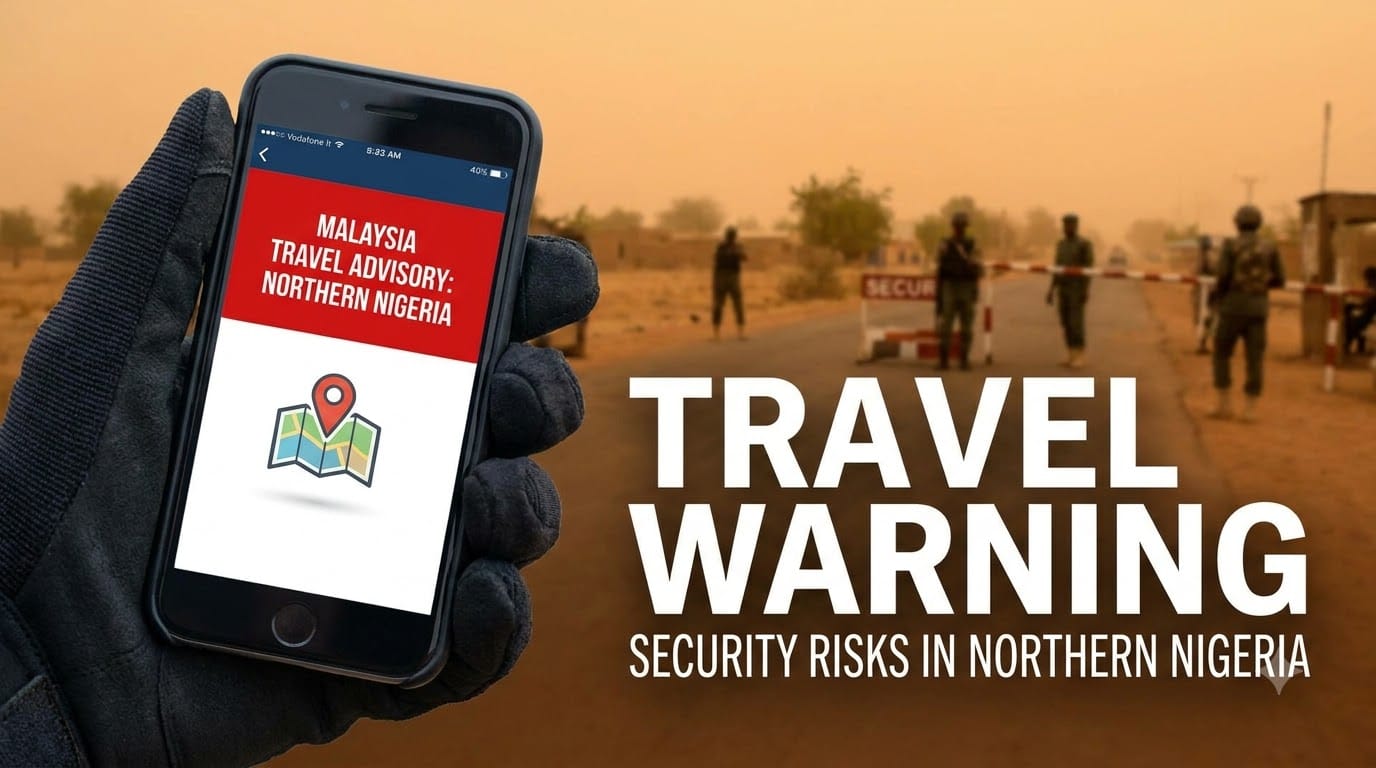
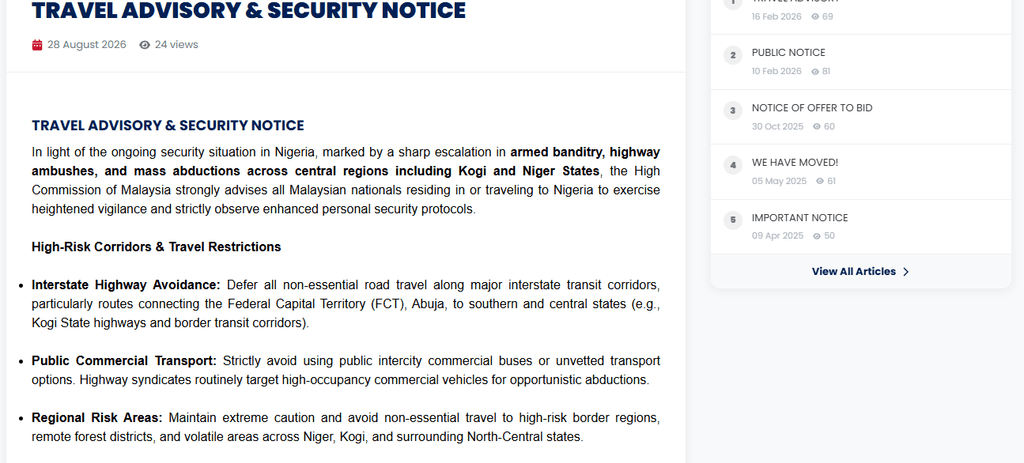
Malaysians in Nigeria and those planning a trip should reassess travel to northern and north-central areas after Malaysia’s High Commission in Abuja warned of escalating security incidents. The official travel advisory, dated 16 February 2026, specifically addresses worsening conditions in these parts of Nigeria.

This is not a warning travelers should treat as background reading. In parts of northern Nigeria, the practical risks include kidnapping, armed attacks, road insecurity and sudden outbreaks of violence, meaning an ordinary intercity journey can carry very different risks from a flight into Lagos or a stay within a well-managed business district.

What does Malaysia’s Nigeria travel advisory say?
The High Commission of Malaysia in Abuja issued the notice for Malaysians already in Nigeria and people intending to travel there following an escalation of security incidents in Northern and North-Central Nigeria.
The important point for travelers is geographical: Nigeria should not be treated as one uniform security environment.
Current UK government guidance, for example, advises against all travel to Borno, Yobe, Adamawa, Gombe, Katsina and Zamfara states, while several other northern and north-central states carry warnings against all but essential travel.
| Area | Practical concern for travelers |
|---|---|
| North East | Terrorism, kidnapping and armed attacks |
| North West | Banditry, kidnapping and road insecurity |
| North Central | Criminal activity, militant attacks and communal violence |
| Abuja | Greater caution needed, particularly outside familiar areas |
Is Nigeria safe to travel to now?
Travel is still possible in parts of Nigeria, but your exact route matters more than the country name on your ticket.
A traveler flying into Abuja for meetings, using vetted transport and remaining within a controlled itinerary faces a different situation from someone planning a road journey through several northern states.
That distinction matters because kidnappings can occur on highways. The UK Foreign Office specifically identifies kidnapping risks across Nigeria and notes that criminal groups have stopped vehicles on major routes, including the Abuja-Kaduna highway.
Also read – Malaysia Pushes Visa-Free Russia Travel and Direct Flights as It …
Before leaving your hotel, ask three questions
- Does today’s route pass through an area covered by a travel warning?
- Has a trusted local contact confirmed the route is currently usable?
- Can the journey be completed during daylight?
If one answer creates doubt, changing the journey is usually smarter than relying on an old itinerary.
What should travelers avoid in northern Nigeria?
Avoid unnecessary night driving, predictable routines and poorly planned long-distance road trips.
Security conditions can change faster than hotel bookings or flight schedules. Travelers should also be cautious around large gatherings, transport hubs and areas where local contacts report recent incidents.
A useful habit is to avoid becoming predictable. If a business traveler uses the same vehicle, departure time and route every day, that routine becomes unnecessary exposure. Current security guidance similarly recommends avoiding regular travel patterns and prioritising daylight movement.
Practical travel rule: keep the car doors locked, valuables out of sight and a charged phone accessible rather than buried inside luggage.
What should Malaysians in Nigeria do during an emergency?
Keep the Malaysian High Commission’s details saved offline before you need them.
The Malaysian mission in Abuja lists the following contacts:
- Office: +234 209 290 8488
- Emergency after office hours: +234 703 136 5197
- Consular email: abj.consular@kln.gov.my
The High Commission is located at Plot 5, Queen Idia Street, Asokoro, Abuja.
Nigeria’s general emergency number is 112, although emergency-response capacity can vary and travelers may sometimes need assistance from their hotel, employer or trusted local contact.
The smarter way to plan a Nigeria trip
Do not ask only, “Is Nigeria safe?” Ask, “Is my exact route safe today?”
Before every intercity journey, check the latest official advisory, confirm conditions with a reliable local contact and have an alternative route or cancellation plan.
For travelers already holding bookings, also check whether entering an area covered by official advice affects travel-insurance coverage. Government travel guidance warns that traveling against official advice can affect insurance validity.
That one check can matter far more than saving a non-refundable hotel night.