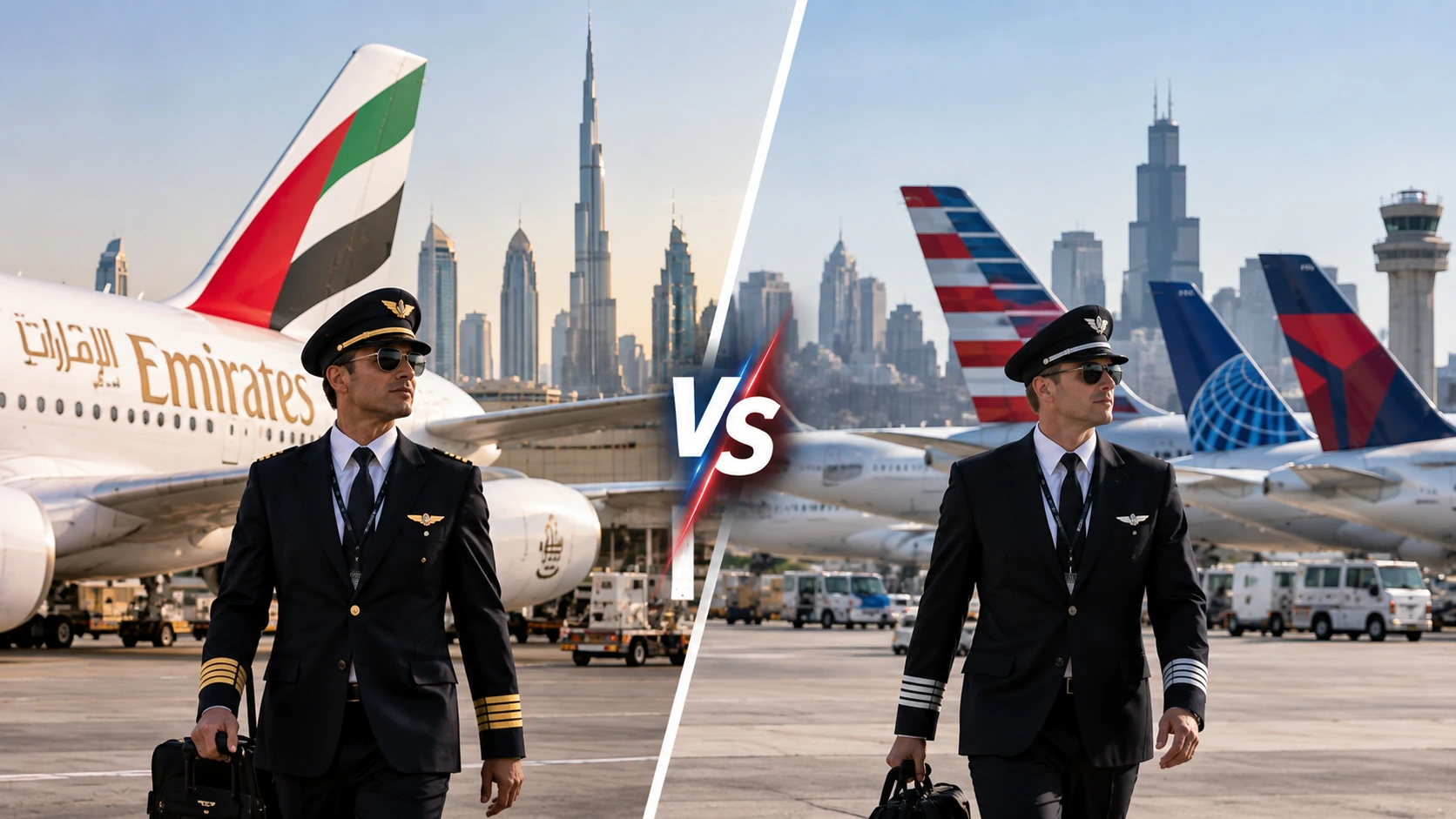
US legacy airline pilots earn significantly higher gross salaries than Emirates pilots, but the 100 percent tax-free compensation package in Dubai often yields a larger actual take-home paycheck for expatriates. Senior widebody captains at major US carriers like Delta Air Lines, United Airlines, and American Airlines currently top out around $465,000 in gross annual pay. In contrast, an Emirates Airbus A380 or Boeing 777 captain earns a baseline maximum of roughly $320,000.

While the American pilot loses nearly 40 percent of their income to federal and state taxes, the Dubai-based pilot keeps every single dollar. Choosing between these two lucrative aviation paths requires analyzing complex tax laws, housing allowances, and retirement fund structures rather than simply comparing base hourly rates.
Also read – Riyadh Air Pilot Salary: How to Apply, Fees and Benefits
How Do Base Salaries Compare Between Emirates and US Airlines?
Delta, United, and American Airlines pay their senior captains roughly $145,000 more in raw base salary than Emirates pays its top commanders. The US aviation market currently offers the absolute highest gross compensation in the world. According to the latest wage tracking data from the Bureau of Labor Statistics (BLS), US airline captains routinely sit in the highest income percentiles nationwide.
The Air Line Pilots Association (ALPA) successfully negotiated historic pay increases during recent contract cycles, pushing widebody captain rates past $450 per flight hour. Emirates calculates compensation completely differently, using a fixed monthly basic salary combined with an hourly flight pay component. A new First Officer at Emirates starts around $101,000 annually, while a first-year First Officer at a US legacy carrier grosses roughly $109,000.
| Airline Type | First Officer (Year 1) | Senior Widebody Captain | Tax Status |
| US Legacy (Delta/United) | $109,000 gross | $465,000+ gross | Fully Taxed (30-40%) |
| Emirates (UAE) | $101,000 net | $320,000+ net | 100% Tax-Free (Local) |
What Are the Hidden Housing and Expat Allowances in Dubai?
Emirates bridges the massive gross salary gap by providing senior pilots with a $52,000 annual housing allowance or a fully furnished luxury villa completely rent-free. This massive secondary benefit drastically reduces daily living expenses for expatriates moving to the Middle East. When an American pilot earns $465,000, they must pay their own mortgage, property taxes, and utility bills from their heavily taxed net income.
The Dubai-based package includes multiple family-friendly financial incentives that do not exist at US airlines. Aviation operations in the UAE fall strictly under the General Civil Aviation Authority (GCAA), which mandates specific licensing standards for expatriate hires. To secure these direct-entry roles and access the housing perks, foreign pilots must possess extensive heavy jet command time.
- Education Allowance: Emirates pays primary and secondary private school tuition for the pilot’s children.
- Global Medical: Comprehensive health, dental, and life insurance are provided with zero monthly paycheck deductions.
- Chauffeur Service: Pilots receive a company car or a dedicated chauffeur for all airport transit.
- Unlimited Travel: The package includes generous ID90 standby travel benefits and confirmed annual leave tickets.
Also read – Delta Air Lines Pilot Salary: First Officer vs Captain Pay Rates
How U.S. Taxes Destroy the Tax-Free Emirates Dream
American citizens flying for Emirates still owe income tax to the US federal government, which completely destroys the financial advantage of working in the tax-free Gulf region. The United States enforces citizenship-based taxation, meaning a US passport holder pays taxes on worldwide income regardless of their physical residence. Expatriates utilize the Foreign Earned Income Exclusion (FEIE) governed by the Internal Revenue Service (IRS) to shield a portion of their overseas pay.
For the 2026 tax year, the FEIE shields roughly the first $126,500 of foreign income from federal taxes. However, because an Emirates captain easily earns $250,000 to $320,000, the remaining $123,500 to $193,500 remains fully subject to standard US tax brackets. For European, Australian, or Asian pilots, their home countries typically drop all tax obligations once the individual establishes permanent residency in Dubai.

Retirement Benefits: 401(k) Match vs Provident Funds
US legacy carriers utterly dominate the Middle East operators in long-term retirement funding by depositing 16 to 17 percent of a pilot’s eligible earnings directly into a 401(k). This direct contribution does not require any matching funds from the employee. If a United Airlines captain earns $400,000, the airline deposits an extra $64,000 into their retirement account totally free of charge.
Emirates does not offer traditional pension plans or 401(k) structures. Instead, the airline provides a standard Provident Fund and an End of Service Gratuity. The company contributes roughly 12 to 15 percent of the pilot’s basic monthly salary into the Provident Fund. When a pilot retires or resigns after a long tenure, they receive a lump sum cash payment based on their years of service.
Flight Hours, Lifestyle, and Seniority Progression
US legacy carriers offer a significantly better quality of life and schedule predictability because strict union rules govern exactly how much a pilot can work. Under Federal Aviation Administration (FAA) regulations, commercial pilots cannot exceed 1,000 flight hours per calendar year. US airline contracts frequently enforce even stricter fatigue limits, allowing senior captains to drop flights and maximize their days off.
Emirates operates a predominantly long-haul, ultra-long-haul route network that stretches the human circadian rhythm to its absolute limit. Gulf carriers maximize their workforce, meaning pilots routinely fly right up to their legal regulatory limits.
- US Legacy Lifestyle: Senior pilots can bid for domestic daytime routes, avoiding jet lag entirely.
- Emirates Lifestyle: All flights are international, routinely requiring consecutive red-eye departures across multiple time zones.
- Seniority Protections: US pilots are protected by strict master seniority lists that dictate pay and schedules, whereas Emirates operates on company-directed rostering.
Also read – United Airlines vs Delta Air Lines Pilot Salary: Which Pays More …
How Upgrade Timelines Affect Lifetime Earning Potential
First Officers at US legacy carriers currently face much longer wait times to upgrade to widebody captain seats compared to expatriate pilots at Gulf carriers. Earning the absolute maximum salary requires occupying the left seat of a heavy international jet. At Delta or United, a pilot typically bids for a narrowbody captain seat after three to five years, and waits over a decade to hold a widebody command.
Emirates operates an exclusively widebody fleet consisting entirely of Airbus A380 and Boeing 777 aircraft. Once a First Officer completes their required hours and passes the command upgrade board, they transition instantly into a heavy jet captain role. This rapid progression allows Emirates pilots to lock in widebody captain pay rates years earlier than their American counterparts.
Highly experienced external pilots also have the rare opportunity to bypass the First Officer stage entirely in Dubai. Direct-entry captain programs exist at Emirates for aviators holding over 7,000 hours of heavy jet experience. US legacy carriers strictly forbid direct-entry captains; every new hire must start at the absolute bottom of the seniority list.