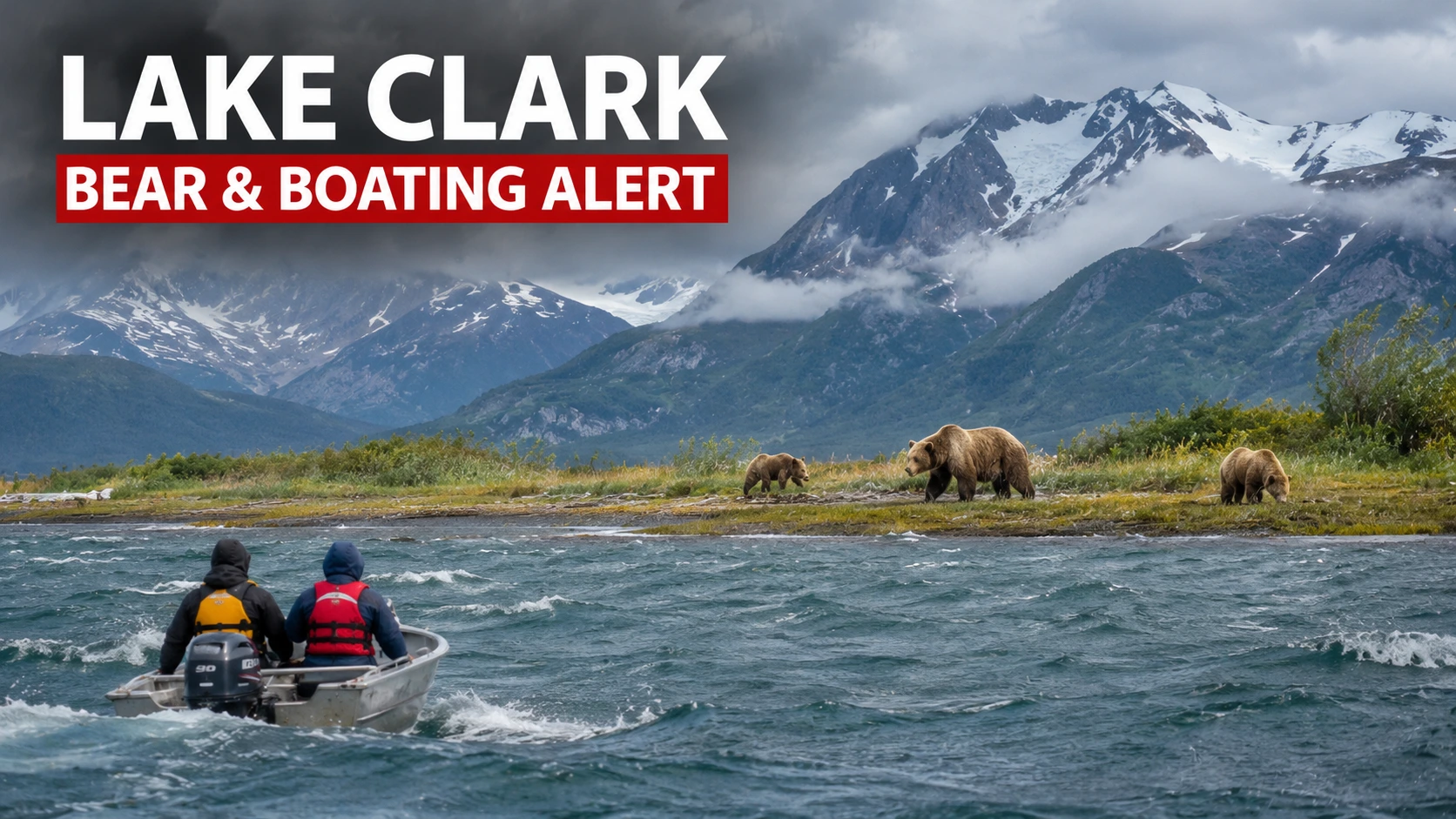
The National Park Service (NPS) recently issued urgent wilderness alerts for Lake Clark National Park due to peak coastal brown bear foraging and sudden, lethal gale-force winds whipping across freezing glacial lakes. Travelers planning a remote Alaskan backcountry trip must drastically update their safety protocols and gear checklists before boarding a floatplane into this entirely roadless federal wilderness.
Why Are Brown Bears Swarming Chinitna Bay and Crescent Lake?
Coastal brown bears are currently congregating in massive numbers around Chinitna Bay and Crescent Lake to aggressively gorge on late-season salmon runs and salt marsh sedges before winter hibernation. Because these specific geographic bottlenecks provide incredibly dense food sources, visitors routinely encounter groups of twenty or more massive predators actively feeding in a single concentrated area.
How close can tourists legally get to foraging brown bears in Lake Clark? Federal wildlife biologists mandate that visitors must maintain a strict, minimum physical distance of 50 yards from any single bear, extending to 100 yards if a sow is present with her cubs. The Alaska Department of Fish and Game emphasizes that surprising a bear hidden in tall sedge grass frequently triggers a defensive attack. Guides and independent hikers must deliberately make loud, human noises while approaching blind corners to ensure the wildlife knows exactly where people are walking.
Also read – 35 Off the Beaten Path Places to Visit in the USA

The Logistics of Flying into a Roadless Bear Territory
You cannot drive a rental car into Lake Clark National Park because absolutely no paved roads connect this remote federal wilderness to the broader Alaskan highway system. Reaching the high-density bear viewing zones requires booking a customized, one-to-two-hour flight on a small commercial floatplane departing from the coastal towns of Homer, Kenai, or Anchorage.
Because atmospheric weather patterns across the Cook Inlet change drastically within a single hour, bush pilots frequently delay or completely cancel scheduled drop-offs to prevent flying directly into a dangerous coastal fog bank. Travelers must build at least two buffer days into their vacation itineraries to account for these mandatory aviation weather delays.
Securing the Priest Rock and Joe Thompson Public Use Cabins
You can completely eliminate the severe danger of a collapsed nylon tent during a coastal squall by reserving the Priest Rock or Joe Thompson public use cabins. The federal government maintains these heavy wooden backcountry structures specifically to protect independent travelers from sudden weather emergencies and wandering predators. Both cabins sit deep inside the wilderness and require visitors to pack in all their own drinking water, sleeping bags, and emergency medical supplies.
Tourists must secure their exact dates through the official Recreation.gov portal months in advance. Local bush pilots will legally refuse to drop off passengers who lack a confirmed shelter reservation during extreme weather warnings, as leaving unprepared tourists on an exposed beach invites a massive rescue operation.
| Backcountry Shelter Option | Nightly Fee | Crucial Wilderness Protection Feature |
| Joe Thompson Cabin | $45.00 | Features a heavy solid-wood door and elevated foundation to deter bears. |
| Priest Rock Cabin | $45.00 | Equipped with a dedicated wood-burning stove to prevent overnight hypothermia. |
| Standard Ground Tent | Free | Offers zero physical protection against scavenging wildlife or gale winds. |
Navigating Sudden Gale Winds on Frigid Glacial Waters
Sudden, violent gale-force winds routinely funnel through the narrow valleys of the Chigmit Mountains, instantly transforming Lake Clark’s glassy surface into deadly, white-capped swells. Boaters caught in these abrupt atmospheric pressure drops face an immediate threat of capsizing into glacial waters that rarely exceed 45 degrees Fahrenheit (7 degrees Celsius) even during the warmest weeks of the Alaskan summer.
What happens if a kayaker flips into freezing Alaskan lake water? The human body instantly undergoes a physiological crisis known as “cold shock response,” triggering uncontrollable gasping and immediate hyperventilation.
The U.S. Coast Guardwarns that physical incapacitation occurs within the first ten minutes of cold water immersion. Without a secured life jacket keeping your head above the waves, drowning becomes an absolute certainty as your arm and leg muscles rapidly fail.
Experienced backcountry mariners strictly follow the “1-10-1” survival rule when navigating these hazardous lakes. You have exactly one minute to get your breathing under control, ten minutes of meaningful muscle movement to self-rescue back into your boat, and roughly one hour before severe hypothermia knocks you completely unconscious.
Critical Gear Fixes for Safe Lake Clark Navigation
Surviving an unexpected weather shift in a remote national park requires packing specialized maritime safety gear rather than relying on standard hiking equipment. Mobile phones possess zero cellular signal anywhere inside the park boundaries, meaning a standard 911 call is geographically impossible.
Before pushing your kayak or motorboat off the rocky shoreline, you must execute these specific safety checks:
- Don a dry suit: Wearing standard rain gear over a cotton sweatshirt guarantees hypothermia if you capsize. You must wear a fully sealed neoprene dry suit tightly secured around your wrists and neck to trap your body heat inside the garment.
- Activate a satellite messenger: Clip a waterproof GPS personal locator beacon directly to your life jacket harness. If the wind destroys your boat, pressing the SOS button sends your exact coordinates directly to the Alaska State Troopers rescue coordination center.
- Hug the shoreline: Never attempt to paddle directly across the massive center of Lake Clark. You must aggressively hug the shallow coastline so you can quickly beach your vessel onto the rocks the second the wind begins to howl.