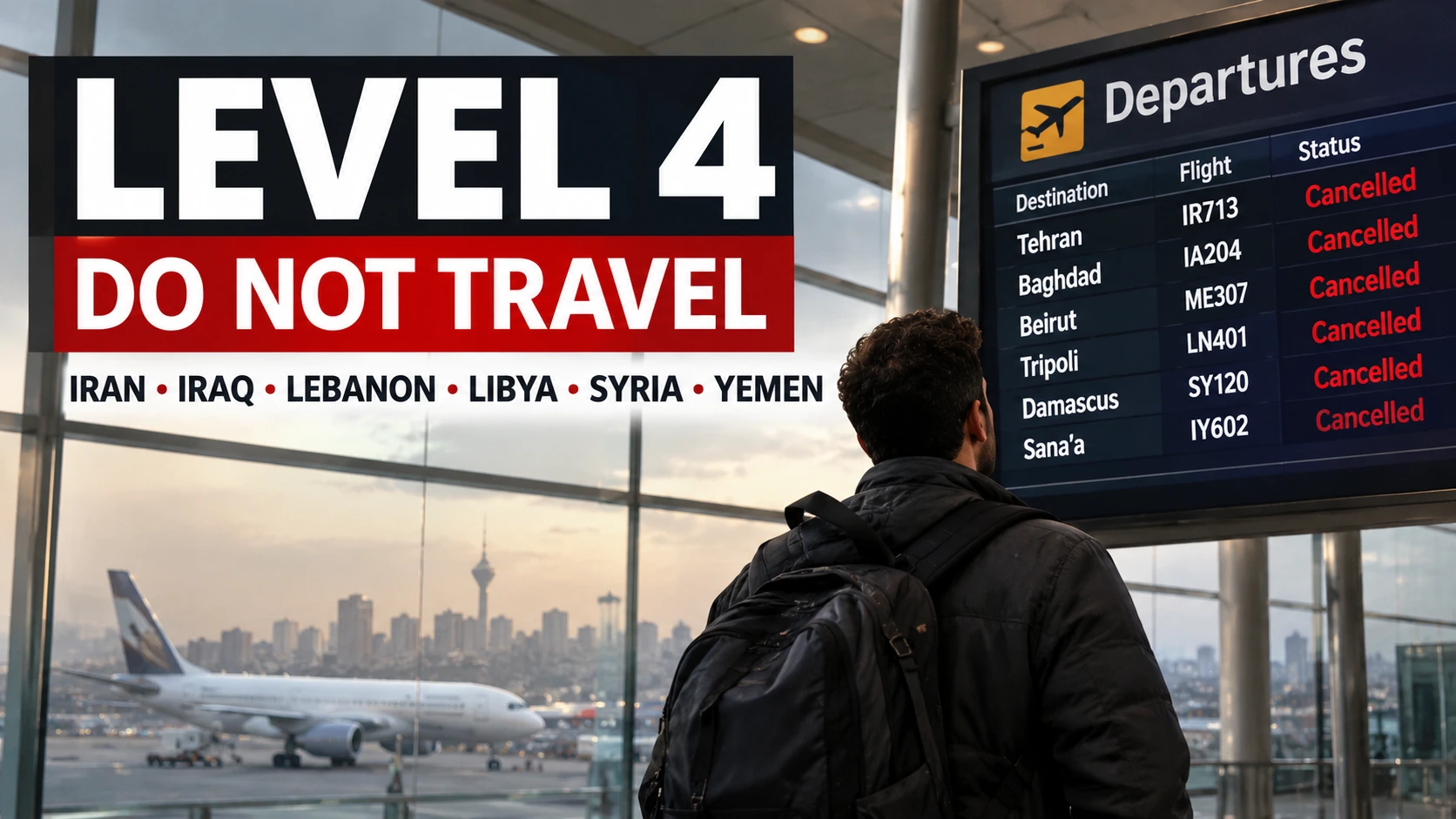
The United States Department of State issued a blanket Level 4 “Do Not Travel” advisory, covering six specific countries across the Middle East and North Africa. Federal officials published urgent warnings strictly forbidding American citizens from entering Iran, Iraq, Lebanon, Libya, Syria, and Yemen. If you hold an American passport and currently have layovers, business trips, or humanitarian visits planned for these regions, you must cancel your itinerary immediately.
What Exactly Triggers a Level 4 “Do Not Travel” Mandate?
A Level 4 advisory represents the highest possible security warning issued by the federal government. The State Department clarified in a public post on X that they assign this severe rating strictly based on lethal local conditions and a complete inability to rescue citizens in distress. “These places are dangerous. Do not go for any reason,” the department stated explicitly to the public.
Entering these nations exposes travelers to extreme risks of arbitrary arrest, kidnapping for ransom, terrorism, and sudden armed conflict. Unlike lower-tier advisories that suggest exercising caution, a Level 4 alert serves as a hard legal barrier. It warns citizens that they are entirely on their own regarding physical safety, medical emergencies, and legal disputes.

Security Threat Breakdown Across the Six Restricted Nations
Understanding the exact ground realities helps travelers realize why these borders are now functionally closed to American tourism. The U.S. Department of State tracks distinct geopolitical threats for each specific territory rather than issuing a generic regional warning.
| Restricted Nation | Primary Security Threat to US Citizens | Status of US Diplomatic Assistance |
| Iran | High risk of arbitrary arrest and unjust detention. | Zero official diplomatic relations; Swiss protecting power is extremely limited. |
| Iraq | Active terrorism, kidnapping, and armed militias. | Highly restricted; personnel movements are heavily guarded. |
| Lebanon | Unpredictable armed conflict and sudden border closures. | Limited; sudden embassy evacuations remain highly possible. |
| Libya | Widespread armed militia violence and zero central security. | U.S. Embassy in Tripoli suspended all operations in 2014. |
| Syria | Active civil war, terrorism, and chemical weapon risks. | U.S. Embassy in Damascus suspended all operations in 2012. |
| Yemen | Intense civil war, terrorism, and critical infrastructure collapse. | U.S. Embassy in Sana’a suspended operations in 2015. |
The Total Collapse of Standard Travel Insurance Coverage
Stepping foot inside a Level 4 country instantly voids almost every standard travel and medical insurance policy on the market. If you suffer a severe injury in a Damascus car crash or a Tripoli street skirmish, your insurance provider will outright refuse to pay the hospital bill or fund an emergency medical airlift.
Also read – Canada Warns of Scopolamine Drugging in Medellin Clubs
Because commercial airspace over these nations frequently shuts down without warning, travelers also lose their standard trip cancellation protections. If an airline permanently cancels your flight out of Beirut due to sudden airspace restrictions, you will have to pay out of pocket to secure a chartered escape route or a maritime ferry ticket. The Overseas Security Advisory Council (OSAC) heavily advises corporate risk managers to strictly ban all employee travel into these six zones to avoid catastrophic corporate liability.
What Happens if a Connecting Flight Diverts into a Restricted Zone?
Travelers transiting through neighboring safe hubs, such as Doha or Dubai, must pay close attention to their exact flight paths. If your commercial flight from Europe to Asia experiences a mechanical failure and diverts to an airport inside Iran or Syria, US citizens face an immediate risk of questioning and detention by local security forces.
To mitigate this exact threat, the Federal Aviation Administration (FAA) frequently issues Special Federal Aviation Regulations (SFARs) that legally prohibit American commercial carriers from flying through hostile airspace. Consequently, you will notice longer flight times on routes heading to the Middle East or India, as pilots must navigate completely around these massive restricted borders.
Mandatory Action Steps for Americans Already Inside the Warning Zones
If you are currently on the ground in Iran, Iraq, Lebanon, Libya, Syria, or Yemen, federal authorities urge you to depart immediately via commercial transportation while airports remain operational. The US military does not conduct civilian rescue operations or helicopter evacuations during civil emergencies.
Execute these strict security protocols to maximize your chances of a safe exit:
- Enroll your location instantly: Log into the Smart Traveler Enrollment Program (STEP) using a secure internet connection. This action puts your GPS coordinates directly on the radar of the nearest operational US consulate.
- Draft a will and medical directives: The State Department grimly advises anyone refusing to leave a Level 4 zone to establish a legal will and leave DNA samples with their medical provider back home.
- Maintain a low physical profile: Never speak loud English in public markets, avoid all large political gatherings, and stay away from government buildings or military checkpoints.
- Secure physical escape funds: Keep a substantial amount of physical US Dollars or Euros hidden on your person. ATM networks and international credit card processors frequently fail during regional conflicts, making cash the only viable way to buy a last-minute border bus ticket.