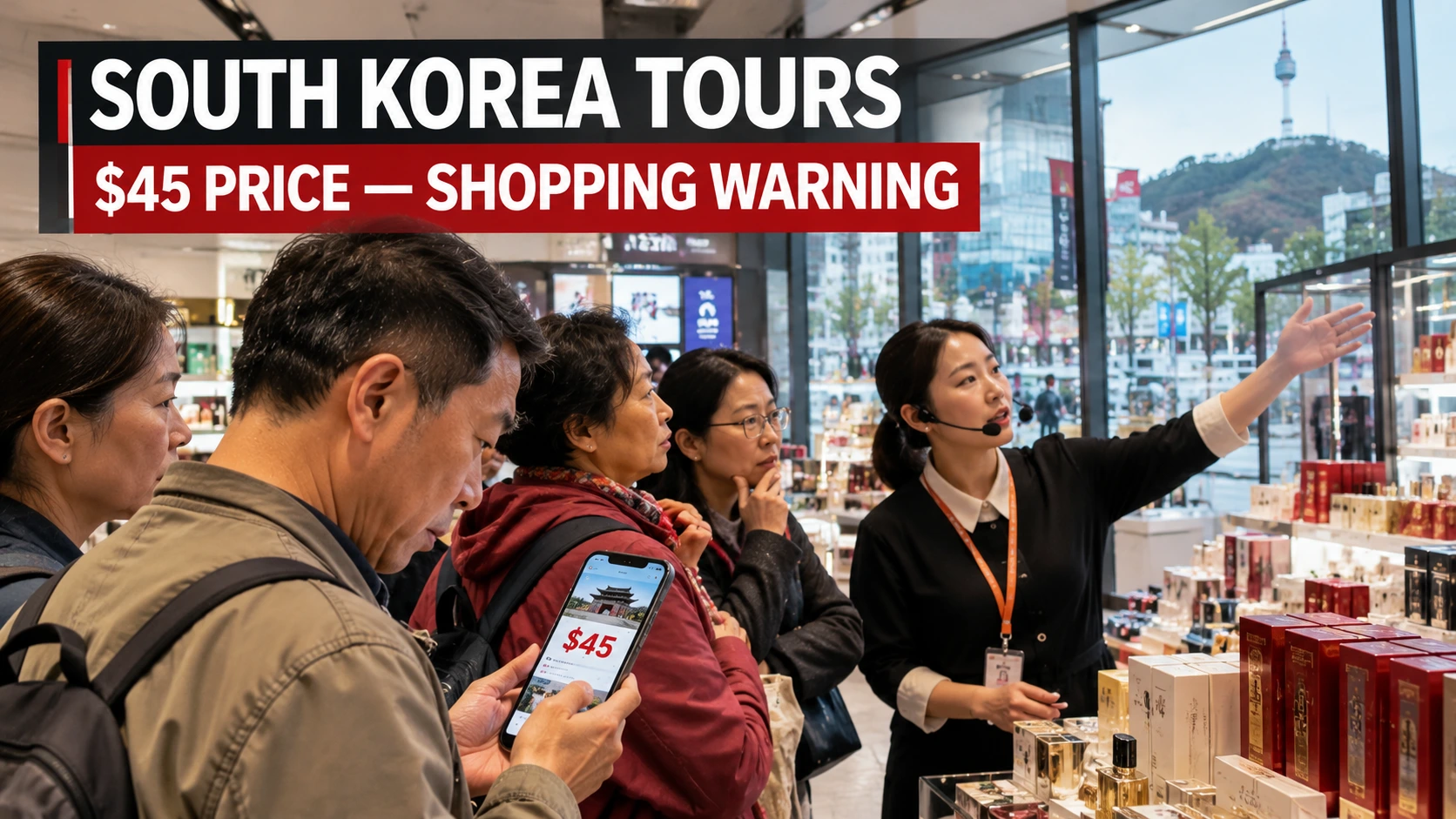
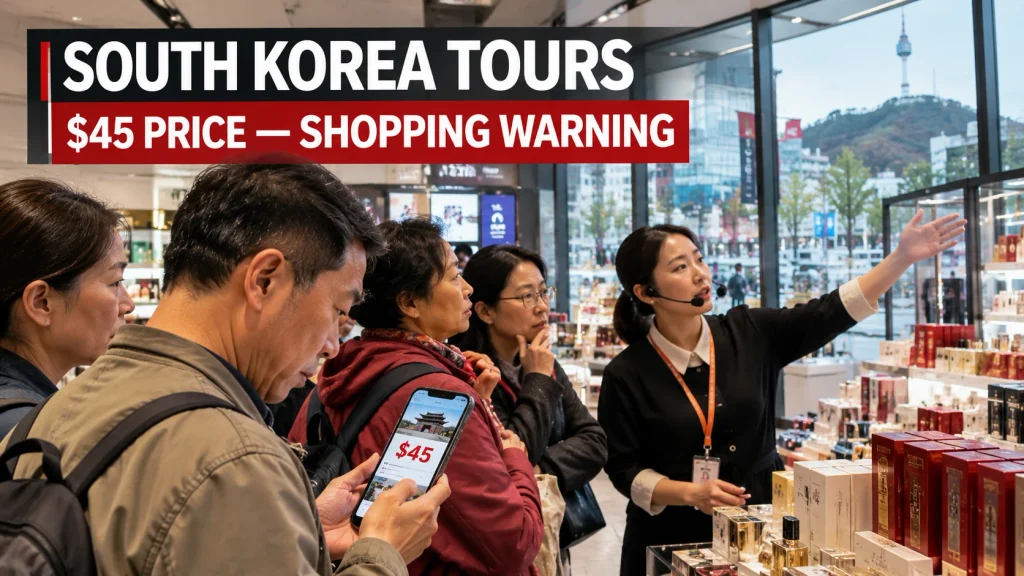
Travel agencies are currently flooding the market with multi-day group tours to South Korea for an unbelievably low price of just US$45. While a budget trip across the Yellow Sea sounds tempting, the Chinese Embassy and tourism authorities are actively warning citizens that these heavily discounted packages are highly organized forced shopping traps. If you book one of these aggressively priced trips, you will spend your vacation locked inside high-pressure retail showrooms instead of actually seeing the cultural landmarks of Seoul.
Why a $45 South Korea Tour Ultimately Costs You More
Tour operators simply cannot fly a tourist to South Korea, put them in a hotel, and feed them for 45 dollars without taking a massive financial loss. They recover this deficit by legally binding passengers into itineraries packed with mandatory shopping stops where the agency earns massive commissions on overpriced ginseng, cosmetics, and duty-free goods. Agencies bait travelers with initial deposits as low as RMB 199 (around US$30), but once the tourist arrives in South Korea, the hidden surcharges and required retail quotas completely destroy their travel budget.
Low-cost tour operators also cut corners on essential safety measures to maintain these rock-bottom prices. When you pay a fraction of the market rate, your ground transportation often shifts from a modern commercial bus to an older, unverified van, and the promised four-star hotel frequently downgrades to a budget motel on the city outskirts.
Spotting the Red Flags of a Forced Shopping Itinerary
You can identify a predatory tour package long before you hand over your credit card by carefully reading the fine print of the travel contract. Scammers rely on vague language to give themselves legal loopholes once you land in South Korea.
Always look for these specific differences when comparing quotes from travel agencies:
| Contract Element | The Scam Approach | The Legitimate Approach |
| Ground Transport | “Business vehicle” or “7-seat van” | Exact vehicle make, model, and year listed. |
| Daily Itinerary | “Local cultural workshop” or “Tea tasting” | Explicitly states “Zero shopping stops.” |
| Travel Insurance | “Paid separately” or entirely missing | Includes minimum RMB 500,000 coverage. |
| Hotel Standards | “Equivalent or better” | Specific hotel names locked upon confirmation. |

What to Do If Your Tour Guide Forces You into a Shop
If you accidentally book a low-to-mid-range group tour, you will likely find yourself parked outside a retail warehouse with a guide demanding you go inside. You must understand that Chinese tourism law Article 35 strictly prohibits forced shopping, and South Korean consumer protection laws do not allow guides to physically detain you or confiscate your passport.
If a guide attempts to pressure you inside a store, use these exact tactics to protect yourself:
- Stay on the bus if allowed: If the guide announces an “optional” 40-minute break, refuse to leave your seat. They cannot force you off the vehicle.
- Walk through without engaging: If the stop is mandatory, walk through the retail floor empty-handed. Do not make eye contact with the aggressive sales staff and firmly decline any offered cups of tea.
- Buy a token item: If the guide uses intense intimidation tactics and you feel genuinely unsafe, purchase the absolute cheapest item in the store, like a small pack of candy, to satisfy their quota and safely exit the situation.
- Document everything: Quietly take photos of the store’s name, record the guide’s badge number, and keep all receipts to file an official police report and consumer complaint once you return home.
Also read – 20 Best Solo Travel Destinations for Cultural Experiences
The Broader Damage to the South Korean Tourism Industry
This aggressive race to the bottom is severely damaging South Korea’s reputation as a premium travel destination. Legitimate travel agencies cannot compete with $45 price tags, causing high-quality cultural tours to lose business to predatory operators. Tourists who fall victim to these scams return home completely exhausted and financially drained, leaving terrible reviews for destinations like Myeongdong and Jeju Island.
To combat this reputational crisis, South Korean authorities and local police are actively stepping up random inspections of tour buses in popular shopping districts. However, because the initial transaction happens outside of South Korean jurisdiction, stopping the agencies at the source remains incredibly difficult.
Non-Negotiable Checks Before Booking a Group Tour
Protecting your holiday requires aggressive verification before you sign any travel documents. You must demand transparency from your booking agent and refuse to accept verbal promises over written guarantees.
Execute these four checks to secure a safe trip:
- Demand a double compensation clause: Ensure your contract explicitly states that the agency will pay double the price difference if they downgrade your hotel or swap your vehicle upon arrival.
- Verify the pricing structure: If an agency prices a “custom private tour” per person rather than per vehicle, they are likely secretly selling you a shared bus tour.
- Check the insurance amount: Never travel without explicit travel accident insurance. Verify the policy covers at least RMB 500,000, as medical costs in South Korea are expensive.
- Filter for “No Shopping”: Use trusted platforms like Klook or Trip.com and strictly apply the “shopping-free” filter. These tours cost significantly more upfront, but they guarantee you will not waste your vacation trapped in a mattress showroom.