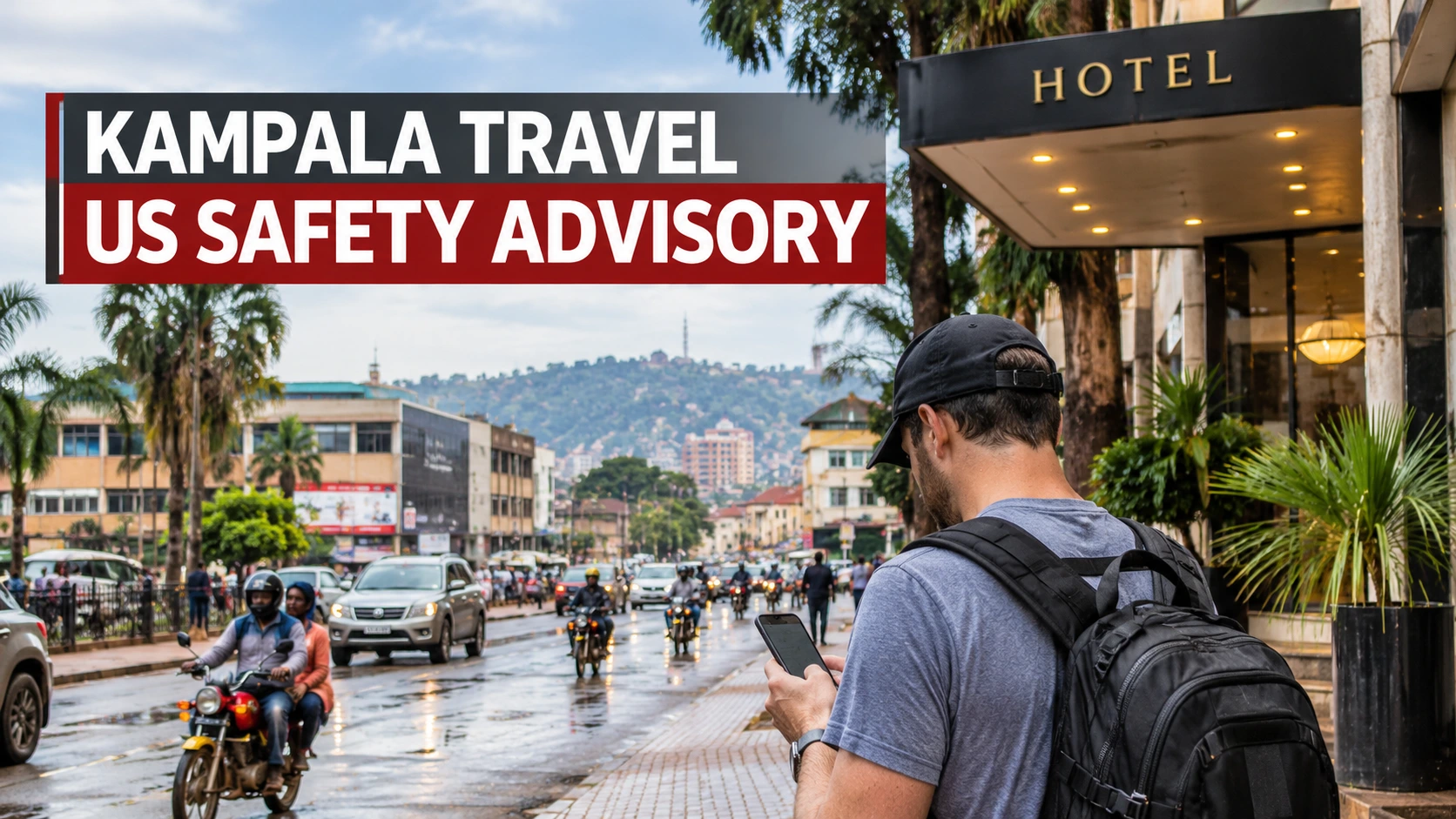
The United States Department of State updated its official travel advisory for Uganda, explicitly warning American citizens to exercise increased caution across the country. While the capital city of Kampala remains open for international business and tourism, federal security officials highlight a severe rise in localized crime, unpredictable public demonstrations, and active terrorism threats near the regional borders. If you plan to book a gorilla trekking safari or a corporate visit to East Africa, you must immediately review your physical security protocols and register your itinerary with the federal government.
Executive Security Briefing for Uganda Travel
Understanding the exact geographical layout of the security threats ensures you do not accidentally drive into a hostile environment.
| Geographic Zone | Primary Security Threat | Official Travel Advice |
| Kampala (Capital City) | Civil unrest and petty street crime | Avoid all political demonstrations and large public gatherings. |
| Western Border (DRC) | Armed combatants and terrorist cells | Completely avoid unguided overland travel near the frontier. |
| Northern Border | Highway banditry | Restrict travel to daylight hours and use verified convoy drivers. |
| National Parks | Unmarked hazards and limited rescue | Only use state-certified, highly reviewed safari operators. |
Why Did the US State Department Update the Uganda Advisory?
Diplomatic security officials issued this updated guidance because the threat environment in Uganda shifted toward targeted, unpredictable violence. The U.S. Department of State notes a severe increase in violent crime, including armed robbery and home invasions, occurring even within heavily populated urban centers.
Furthermore, international terrorist organizations maintain an active, highly lethal presence in the broader East African region. These groups specifically target crowded public spaces, including Western-branded hotels, shopping malls, and popular expatriate restaurants. The advisory strictly urges foreign nationals to maintain a low profile and completely avoid locations where they can be easily isolated from the general public.

What Are the Specific Civil and Crime Threats in Kampala?
While Kampala operates as a bustling economic hub, it also serves as the primary flashpoint for massive political demonstrations. Local police forces frequently deploy heavy riot control measures, including tear gas and rubber bullets, to rapidly disperse unauthorized protests. You must never attempt to walk through a protest line or take photographs of riot police, as peaceful gatherings regularly deteriorate into violent physical confrontations without any advance warning.
Also read – 20 Best Solo Travel Destinations for Cultural Experiences
Beyond civil unrest, standard street crime poses a daily threat to tourists walking outside their hotel compounds. Pickpocketing, purse snatching, and coordinated thefts from vehicles stalled in heavy city traffic happen constantly.
To protect your physical assets in Kampala, you must follow these exact protocols:
- Keep car doors locked: Always roll up your windows and lock your doors when sitting in stationary traffic to prevent smash-and-grab robberies.
- Never leave drinks unattended: Criminals frequently drug unattended food and beverages in public bars to facilitate robberies and sexual assaults.
- Verify your visa status: Working or volunteering without the correct paperwork will result in jail time. Always consult the Directorate of Citizenship and Immigration Control to secure the proper entry documents.
- Avoid unregulated motorcycle taxis: Riding on a “boda-boda” (motorcycle taxi) exposes you to extreme traffic accident risks and opportunistic muggings.
What to Do If You Encounter a Spontaneous Protest in Kampala
Political demonstrations frequently erupt in heavily trafficked areas like the central business district or near university campuses. An otherwise quiet afternoon can transform into a chaotic police barricade in a matter of minutes.
If you are eating lunch at a cafe in the Kololo or Nakasero neighborhoods and notice a large crowd gathering with signs, you must pay your bill immediately and leave the area. Do not wait to see if the police arrive. Local security forces routinely deploy tear gas into crowds without issuing verbal warnings. If you get caught in a cloud of tear gas, cover your mouth and nose with a damp cloth, keep your eyes closed as much as possible, and walk briskly away from the center of the commotion. Do not run, as running induces panic and increases your risk of getting trampled by fleeing locals.
Which Regional Border Zones Present the Highest Terrorism Risks?
The security environment deteriorates rapidly the further you travel from the capital, particularly when approaching the western border shared with the Democratic Republic of the Congo (DRC). Armed combatants and militant groups occasionally cross the porous border into Ugandan territory, posing a lethal threat to tourists visiting remote national parks.
In recent years, terrorist incidents inside these border conservation areas resulted in the tragic deaths of foreign nationals on safari. The federal advisory strongly warns against independent, self-driven tours through these isolated regions. You must rely on heavily vetted, state-approved safari operators who maintain direct radio contact with local park rangers and national security forces.
How to Utilize STEP and Access the US Embassy in an Emergency
Because local police struggle to respond to serious crimes due to limited municipal resources, your personal preparation is your only reliable safety net. You must immediately register your travel dates and hotel locations in the Smart Traveler Enrollment Program (STEP). This free federal service directly connects your smartphone to the local embassy, allowing diplomatic security officers to send you instant SMS text alerts if a riot erupts in your exact neighborhood.
If you lose your passport, suffer a violent crime, or face a medical emergency, the U.S. Embassy in Uganda, located on Ggaba Road in Kampala, remains fully operational and ready to assist American citizens. However, you must understand that consular officers cannot physically travel into remote border zones to rescue you during a crisis.
For severe medical injuries, local clinics outside Kampala lack advanced trauma equipment. You must secure a comprehensive travel insurance policy that explicitly funds emergency medical evacuations. The Centers for Disease Control and Prevention (CDC) mandates that all tourists verify their medical evacuation coverage before entering East Africa, as a helicopter airlift to Nairobi or Europe is often the only survival option during a catastrophic health emergency.