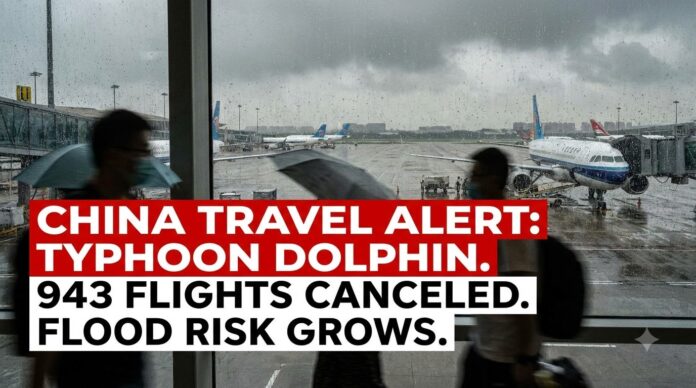
Travelers flying through Shanghai face major disruption on August 10, 2026, after Typhoon Dolphin forced 943 flight cancellations across the city’s two airports and left streets flooded in several districts. Shanghai Pudong International Airport and Shanghai Hongqiao International Airport are both affected, while continued heavy rain is creating a second problem for passengers: simply getting safely to or from the airport.
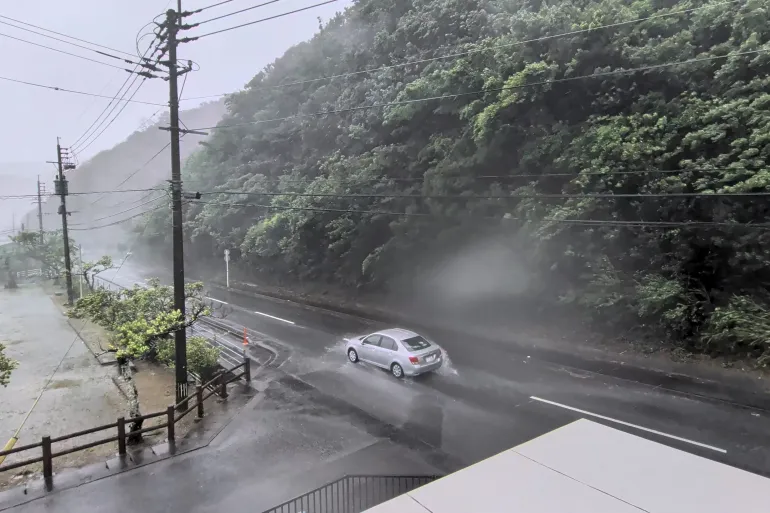
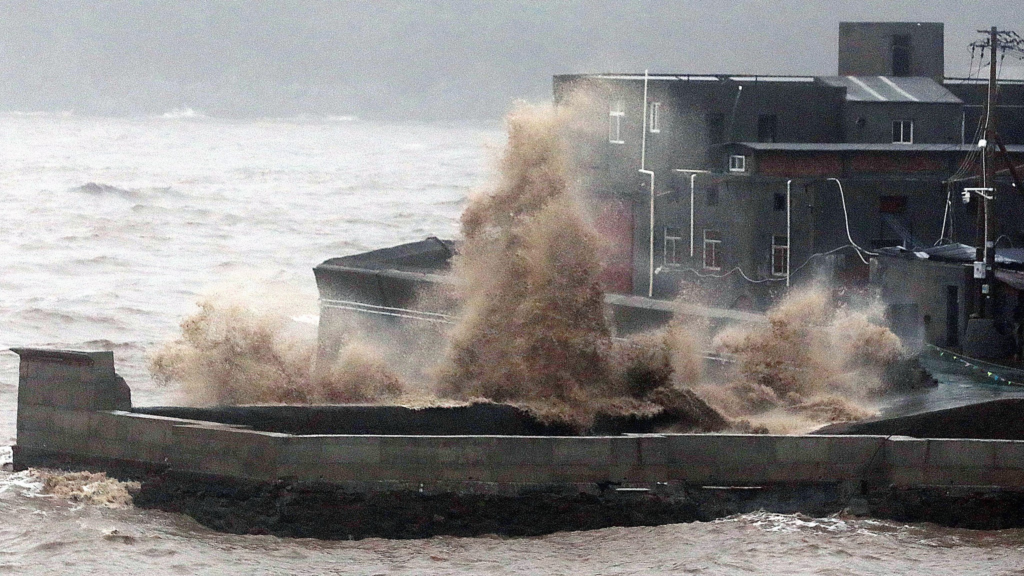
Dolphin made landfall in neighboring Zhejiang on Sunday evening with maximum sustained winds of 151 km/h (94 mph) before weakening into a tropical storm. The weaker classification does not mean the travel threat has ended. Its large rain system continues to soak eastern China and is moving farther inland.
Typhoon Dolphin Shanghai travel disruption: What travelers need to know
| Travel issue | Latest verified information |
|---|---|
| Shanghai flights cancelled | 943 flights cancelled across Shanghai’s two airports |
| Airport capacity affected | Capacity reduced by nearly 40% |
| Airports affected | Shanghai Pudong (PVG) and Shanghai Hongqiao (SHA) |
| Flooding reported | Jiading and Qingpu among areas with waterlogged streets |
| Storm landfall | Zhejiang province on Sunday evening |
| Landfall wind speed | Up to 151 km/h |
| Next areas at risk | Anhui, Jiangsu, Shandong, Hubei and Henan |
| Northern China risk | Heavy rain threat extending toward Beijing, Tianjin and Hebei |
The 943-flight figure was reported Monday as Dolphin disrupted operations at Shanghai’s airports.
Are Shanghai flights cancelled today because of Typhoon Dolphin?
Yes. Shanghai’s two airports cancelled a combined 943 flights because of Typhoon Dolphin, cutting available flight capacity by almost 40%. Travelers should therefore check their individual flight rather than assume that either airport is completely closed.
Both Pudong International Airport (PVG) and Hongqiao International Airport (SHA) are operating in a heavily disrupted environment.
Before leaving your hotel or home, check two places:
- Your airline’s app or official website.
- The Shanghai Airport official real-time flight information page.
Do not rely only on the departure time shown in an old booking email. During severe weather, a flight can move from delayed to cancelled, or receive a revised departure time, while passengers are already travelling to the airport.
Why are some reports saying 943 flights while others say more than 1,300?
The figures refer to different stages of the disruption, not necessarily conflicting counts.
Shanghai Airport had earlier planned 1,384 inbound and outbound flight cancellations for Sunday, August 9, representing nearly 60% of scheduled flights at the city’s two airports. That plan included 871 Pudong flights and 513 Hongqiao flights, according to information published by the Chinese government.
The 943 cancellations reported on Monday, August 10, are the newer figure cited as Typhoon Dolphin continued affecting Shanghai.
For travelers, the important lesson is simple: do not use a citywide cancellation number to decide whether your own flight is operating. Check the flight number itself.
Also read – Why USA, China & India Travelers Can’t Stop Booking Phu Quoc …
Is Shanghai Pudong Airport affected by Typhoon Dolphin?
Yes. Pudong Airport is affected, and travelers should expect cancellations, delays and schedule changes. Pudong was also expected to absorb the larger share of Sunday’s planned cancellations, with 871 flights originally listed for cancellation ahead of the typhoon.
Pudong handles a large amount of Shanghai’s international traffic, so disruption can also affect passengers who never planned to stay in China but were connecting through Shanghai.
Traveler tip: If you have a separate-ticket connection — for example, one airline into Shanghai and another airline onward — treat the situation more cautiously than a protected single-ticket connection. A weather delay on the first booking may not automatically protect the second booking.
Is Shanghai Hongqiao Airport affected?
Yes. Hongqiao Airport is also affected by the typhoon disruption. Authorities had planned 513 cancellations at Hongqiao on Sunday as the storm approached.
Hongqiao’s location closer to central Shanghai can make it look like the easier airport to reach, but road conditions matter more than normal journey times during flooding.
A taxi journey that normally looks straightforward on a map can become unpredictable when:
- underpasses collect water;
- local roads are temporarily restricted;
- drivers avoid flooded streets;
- traffic is diverted onto fewer usable routes;
- public transport services are shortened or suspended.
The safest decision is not necessarily “leave for the airport much earlier.” It is “confirm the flight first, then check whether the route to the airport is usable.”
Also read – 25 Best Cultural Travel Experiences Around the World
Which parts of Shanghai are flooding after Typhoon Dolphin?
Jiading and Qingpu were among the Shanghai districts experiencing waterlogged streets on Monday. Images and resident livestreams showed people moving through deep floodwater, although individual social-media videos could not all be independently verified.
Jinshan authorities also allowed non-essential businesses and organizations to halt operations temporarily as strong winds and heavy rain continued, with classes, outdoor activities and transport services among the activities facing disruption.
One detail gives travelers a better sense of conditions than rainfall statistics alone. A 39-year-old Jiading resident who had lived in Shanghai for 10 years described waking after overnight rain to widespread neighborhood flooding and said she had not previously experienced typhoon disruption on that scale.
That matters because airport disruption is only half the story. A flight may operate while the passenger’s route to the airport remains difficult.
Is it safe to travel to Shanghai during Typhoon Dolphin?
Travelers with confirmed operating flights can continue monitoring their journey, but unnecessary movement through flooded areas should be avoided.
Dolphin has weakened since landfall, but its rain clouds remain capable of producing significant disruption. Heavy rain continued across eastern provinces including Anhui, Jiangsu and Shandong on Monday.
Use the China Meteorological Service for weather warnings and the Shanghai government’s international services portal for local information.
What not to do during Shanghai flooding
- Do not walk through deep or fast-moving floodwater simply because other people are doing it.
- Do not tell a taxi or ride-hailing driver to force a flooded underpass or side street to save time.
- Do not travel to the airport before checking whether your flight has already been cancelled.
- Do not throw away hotel, meal or transport receipts if the disruption creates unexpected expenses.
- Do not assume the storm is over because Dolphin is now weaker than at landfall.
What should I do if my Shanghai flight is cancelled?
Contact the operating airline first rather than immediately joining a long airport service-desk queue.
A practical order is:
- Screenshot the cancellation or delay notice.
- Check whether the airline offers automatic rebooking online.
- Compare the replacement flight with your onward connections.
- Save receipts for additional hotel, food and ground-transport expenses.
- Check your travel-insurance policy before making expensive alternative arrangements.
- Confirm your new flight before starting another airport journey.
If you booked through an online travel agency, remember that the airline may direct ticket changes back to the agency that issued the ticket.
Useful trick: Keep screenshots showing both the original itinerary and the disruption notice. If you later need to explain a missed connection, insurance claim or hotel expense, those two images can be more useful than trying to reconstruct the timeline several days later.
Are trains and public transport in Shanghai affected?
Travelers should check rail services individually because Typhoon Dolphin has also disrupted ground transport.
Authorities announced ahead of the storm that some train services in the Yangtze River Delta would be suspended from Sunday. Shanghai’s Jinshan district also warned that transit services could be temporarily halted where conditions required it.
This creates an important problem for travelers considering a train as an automatic backup for a cancelled flight: the railway may be experiencing weather restrictions at the same time as aviation.
Check the specific train before cancelling your flight booking or committing to an alternative city.
Where is Typhoon Dolphin heading next?
Dolphin is moving deeper into China, with Hubei and Henan among the central provinces in its expected path, while the storm’s moisture is also being pushed north.
Beijing has raised warnings for torrential rain and was preparing to activate a flood-control response. Rain associated with the wider weather system could affect Beijing, Tianjin and Hebei through Thursday, according to the latest reporting.
Travelers connecting from Shanghai to northern or central Chinese cities therefore should not assume that leaving Shanghai solves the weather problem.
Check the destination airport and onward railway conditions as carefully as the Shanghai departure.
Why is Typhoon Dolphin causing disruption so far from landfall?
Dolphin has an unusually large and long-lived weather system. Before reaching China, the storm had already travelled around 6,000 km, and its lifecycle was reported to be roughly three times longer than that of an ordinary typhoon. Its cloud system covered a large portion of eastern China.
That explains why travelers should focus on the rain footprint, not simply the storm’s centre.
The center of a tropical system can move hundreds of kilometres away while rain, flooding and transport disruption continue behind it.
Shanghai Typhoon Dolphin travel checklist
Before travelling today, confirm these five things:
- Flight: Is your exact flight number operating?
- Airport: Are there airline-specific check-in or terminal changes?
- Road: Is your airport route affected by waterlogging?
- Connection: Is your next flight or train also operating?
- Weather: Is another period of heavy rain expected around your departure time?
The best source for Shanghai flight operations is the official Shanghai Airport flight information service, while weather alerts can be checked through the China Meteorological Service.
Bottom line for travelers
Typhoon Dolphin remains a serious China travel disruption even after weakening. The immediate impact in Shanghai includes 943 cancelled flights, nearly 40% less airport capacity and waterlogged streets in parts of the city, while the wider rain threat is shifting inland and north.
For passengers, the smartest approach is to make decisions in this order: confirm the flight, confirm the route to the airport, check the onward connection, then travel.
That prevents one of the most frustrating typhoon-travel mistakes: spending hours reaching an airport only to discover that the cancellation happened before you left.

