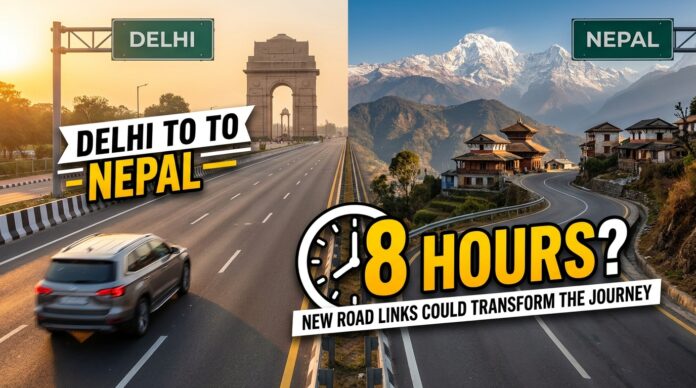
Delhi-NCR travellers may eventually be able to reach the Nepal border in about eight hours, but that faster journey is not available yet. The improvement depends on multiple road projects—not one newly opened Delhi-to-Nepal expressway—and travellers should continue planning for a considerably longer trip until the full corridor is operational.
The development matters most to people travelling from Delhi, Noida, Ghaziabad and Gurugram towards Nepal through Gorakhpur and the Sonauli border. It could make weekend road trips, pilgrimages, family visits and cross-border business travel significantly easier.
What Is Changing on the Delhi to Nepal Road Route?
The immediate improvement is the four-laning of the Gorakhpur–Sonauli highway, the final major Indian road section before travellers reach the Nepal border.
The project was reported to be about 89% complete, replacing a narrow two-lane road where local traffic, trucks, roadside markets and border-bound vehicles regularly slow movement. The National Highways Authority of India identifies the project as the four-laning of the Sonauli–Gorakhpur section of NH-24, covering roughly 80 kilometres.
India’s Ministry of Road Transport and Highways has said the Sonauli–Gorakhpur upgrade will improve connectivity and strengthen infrastructure near the international border.
What this means for Delhi-NCR drivers
Once the road is fully operational, travellers should experience:
- Fewer bottlenecks between Gorakhpur and Sonauli
- Safer overtaking than on the old two-lane road
- More predictable arrival times at the Nepal border
- Easier movement for buses, taxis and commercial vehicles
- Better access to Bhairahawa, Lumbini and onward destinations in Nepal
The biggest practical benefit may not be dramatic top-speed driving. It will be removing the unpredictable delays that can turn a manageable final stretch into several tiring hours.
Can You Really Drive From Delhi to Nepal in Eight Hours?
Eight hours is a future corridor estimate, not a dependable present-day driving time.
The figure is associated with the proposed Shamli–Gorakhpur Expressway, a roughly 742-kilometre corridor intended to improve east–west travel across Uttar Pradesh. Reports estimate that this project could bring Delhi-NCR much closer to the Nepal border by road.
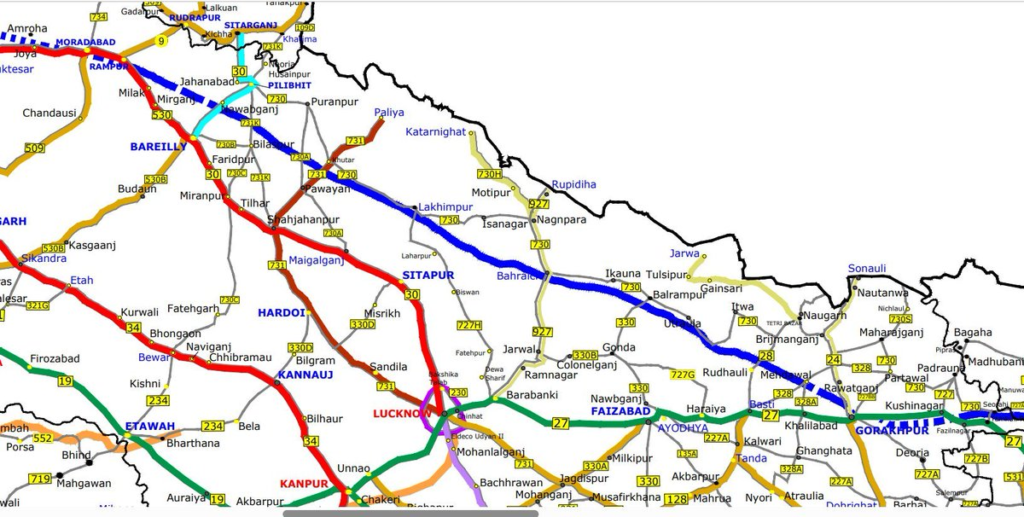
However, the Gorakhpur–Sonauli highway and the proposed Shamli–Gorakhpur Expressway are different projects.
| Road development | Current relevance | Expected benefit |
|---|---|---|
| Gorakhpur–Sonauli four-lane highway | Nearing completion | Faster final approach to the Nepal border |
| Gorakhpur Link Expressway | Improves connections towards the broader UP expressway network | Quicker movement between Gorakhpur and central Uttar Pradesh |
| Shamli–Gorakhpur Expressway | Proposed future corridor | Could sharply reduce Delhi-NCR to Gorakhpur travel time |
| Sonauli border crossing | Existing operational gateway | Entry towards Bhairahawa, Lumbini and Kathmandu |
The eight-hour estimate should therefore be read as Delhi-NCR to the Nepal border under future corridor conditions, not Delhi to Kathmandu in eight hours.
Kathmandu lies several hundred kilometres beyond the Sonauli crossing, and the Nepal-side journey includes hill roads, towns, weather-sensitive sections and possible congestion.
Which Delhi-NCR Areas Will Benefit Most?
Ghaziabad and eastern Delhi could receive the most direct road-travel advantage because drivers heading into Uttar Pradesh already begin the journey from this side of the National Capital Region.
The likely beneficiaries include:
- East Delhi and Ghaziabad: Better positioned for eastbound highway access.
- Noida and Greater Noida: Useful access through Uttar Pradesh’s expressway network.
- Central and South Delhi: Faster overall travel, although the city exit may remain time-consuming.
- Gurugram and Faridabad: Major long-distance benefit, but travellers must first cross or bypass congested parts of Delhi-NCR.
A useful planning rule is simple: do not count the journey from your home to the expressway as “normal highway time.” Leaving Gurugram at 8 am and leaving Ghaziabad at 8 am can produce very different border-arrival times.
What Is the Best Delhi-to-Nepal Road Route?
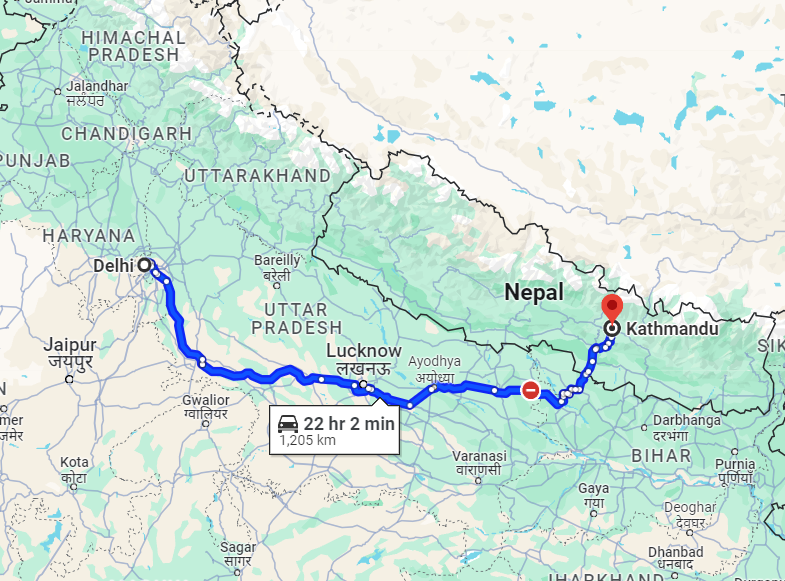
For travellers using the Sonauli border, the conventional corridor runs through Lucknow and Gorakhpur before reaching Sonauli.
The long-running Delhi–Kathmandu bus route follows the broad alignment of New Delhi–Lucknow–Gorakhpur–Sonauli–Bhairahawa–Kathmandu, confirming the importance of Sonauli as the principal gateway on this side.
A practical self-drive sequence is:
Delhi-NCR → Lucknow region → Gorakhpur → Sonauli → Bhairahawa → destination in Nepal
Choose Sonauli particularly for:
- Lumbini
- Bhairahawa
- Butwal
- Pokhara, depending on the onward route
- Kathmandu, when travelling through the central Nepal road network
Also read – UK Travelers Gets Swiss E-Gates and Free Mobile Roaming
Do Indians Need a Visa to Enter Nepal by Road?
Indian citizens do not need a visa to enter Nepal. Nepal’s Department of Immigration confirms visa-free entry for Indian nationals.
Travellers should still carry strong proof of Indian nationality.
Documents to carry
The safest options are:
- Valid Indian passport
- Election Commission-issued voter ID card
Nepal immigration guidance specifically identifies a passport or voter ID as proof of Indian nationality. For accompanied minors, a school identity card or birth certificate may be accepted under the stated conditions.
Do not rely only on Aadhaar, PAN or a driving licence as border identity documents. Nepal immigration guidance states that Aadhaar and a driving licence do not independently establish nationality for entry purposes.
A passport remains the least confusing document to present, even where a voter ID is accepted.
Can You Take an Indian Car Into Nepal?
Yes, but an Indian-registered vehicle requires Nepal Customs formalities.
Travellers entering temporarily must obtain the applicable vehicle permission, commonly referred to as a Bhansar permit. The Indian Embassy in Kathmandu states that a vehicle entering on a day pass must return to India the same day and surrender the pass while exiting. A longer stay requires the appropriate paid temporary vehicle facility.
Carry the originals of:
- Vehicle registration certificate
- Driving licence
- Valid motor insurance
- Pollution-under-control certificate
- Owner’s identity document
- Authorization letter when the driver is not the registered owner
- Rental-company permission when using a hired vehicle
Do not assume an Indian rental car can automatically cross the border. Many rental agreements prohibit international use, and border officials may ask for written authorization.
Delhi-NCR to Nepal Road Trip: What to Do Before Leaving
Treat Gorakhpur or the border region as a planned halt rather than forcing the entire drive in one stretch.
A realistic preparation checklist:
- Leave Delhi-NCR before dawn. The first two hours often determine the entire day’s progress.
- Keep fuel above half a tank near the border; do not wait for the final petrol station.
- Download offline maps for both India and Nepal.
- Carry cash in small denominations for parking, refreshments and local payments.
- Avoid reaching Sonauli late at night when first visiting the crossing.
- Photograph every vehicle permit and receipt before leaving the customs area.
- Check weather and road conditions in Nepal, especially during the monsoon.
- Buy appropriate Nepal vehicle insurance when required; Indian coverage may not automatically extend across the border.
A detail first-time drivers often miss
At busy border approaches, people may offer to “speed up” paperwork. Use official counters, ask for printed receipts and confirm the permit’s expiry time yourself. A five-minute check at the counter can prevent a costly argument while exiting Nepal.
Should Delhi Travellers Plan the Road Trip Now?
Plan the trip, but do not build the itinerary around the eight-hour promise yet.
The near-complete Gorakhpur–Sonauli upgrade should make the border approach smoother. The larger transformation will arrive only when the connected expressway network is fully ready and consistently operational.
Until then:
- Allow buffer time for Delhi-NCR traffic.
- Expect checks and queues at Sonauli.
- Separate “time to Nepal’s border” from “time to Kathmandu.”
- Confirm road openings before departure.
- Avoid attempting Delhi-to-Kathmandu as a single exhausting driving day.
The Bottom Line for Delhi-NCR Travellers
Nepal is becoming easier to reach from Delhi-NCR, but it is not yet a routine eight-hour international road trip.
The Gorakhpur–Sonauli four-lane highway will improve the most frustrating final Indian section. Future expressway connections could then reduce the much longer Delhi-to-Gorakhpur portion.
For travellers in Delhi, Noida, Ghaziabad and Gurugram, the real gain will be a more predictable journey: fewer slow town crossings, better-quality highways and easier access to Nepal’s most-used western border gateway.
The smart approach is to watch project completion dates, carry the correct identity and vehicle documents, and plan for the road conditions that exist—not only the travel time promised for the future.

