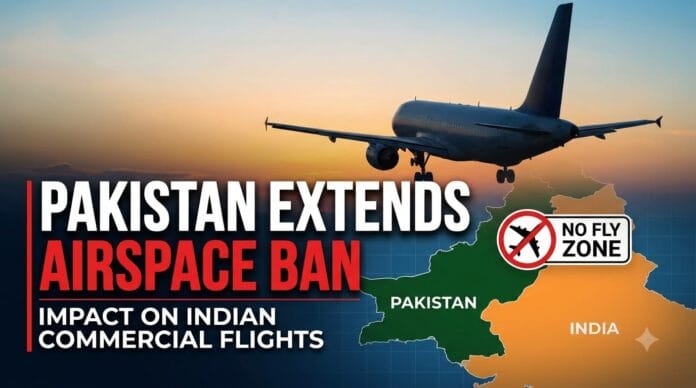
The Pakistan Airports Authority has officially extended its airspace ban on all Indian-registered commercial and military aircraft until September 24, 2026. This restriction forces major Indian airlines flying to western destinations to execute massive detours over the Arabian Sea. These necessary reroutes bypass Pakistani territory entirely, adding significant flying hours to passenger journeys and steeply increasing operational fuel costs. Here is exactly how this ongoing aviation blockade impacts upcoming international travel plans and ticket prices.
Why Did the Pakistan Airports Authority Extend the Ban?
The airspace closure is a direct diplomatic response to heightened tensions between the two nations following the April 2025 Pahalgam incident. Pakistan issued a formal Notice to Airmen (NOTAM) confirming that both the Karachi and Lahore Flight Information Regions (FIRs) remain strictly off-limits to Indian flights.
According to official updates from the Pakistan Civil Aviation Authority (PCAA), this latest extension takes effect on August 23 and will last until 4:59 a.m. on September 24, 2026. India also maintains a reciprocal ban on Pakistani airlines, meaning neither country can use the airspace of the other. Both nations have extended these restrictions monthly since the initial incident occurred.
Also read – 20 Best Solo Travel Destinations for Cultural Experiences
Which Airlines and Routes Are Actually Affected?
Indian-registered airlines bear the full weight of this restriction, while foreign carriers remain completely unaffected. If a passenger is flying Air India, Vistara, or IndiGo to western destinations, the pilot must physically bypass Pakistani airspace by flying far to the south.
This creates a highly uneven playing field for airlines operating out of Indian airports.
| Airline Type | Airspace Access | Real-World Passenger Impact |
| Indian Airlines (Air India, IndiGo) | Banned | Flights to Europe or the US delayed by 1 to 2 hours |
| Middle Eastern Carriers (Emirates, Qatar) | Permitted | Normal direct flight paths to the Gulf |
| European Carriers (Lufthansa, British) | Permitted | Standard travel times maintained |
| Pakistan International Airlines (PIA) | Banned (by India) | Cannot fly over Indian territory |
How Does This Rerouting Impact Ticket Prices and Travel Time?
Airlines pass the heavy burden of extra fuel directly onto the passenger. Rerouting a heavy Boeing 777 or Airbus A350 around Pakistan burns thousands of extra gallons of aviation fuel per trip. Air India, which operates the bulk of long-haul flights from India to North America and Europe, has faced massive operational losses over the past year due to these mandatory detours.
For passengers, this means higher base fares on westbound routes. It also means spending significantly more time sitting in an airplane seat. A typical flight from New Delhi to Frankfurt now takes noticeably longer, increasing fatigue and making tight international connections highly stressful. Crew members also face strict working hour limits. When a flight takes longer, airlines sometimes have to reduce passenger luggage capacity to carry more fuel, which occasionally leads to bags being left behind at the departure gate.
What Practical Steps Should Passengers Take Now?
Passengers cannot change international aviation rules, but they can protect their schedules and wallets. Follow these specific strategies when booking a trip to Europe, the Gulf, or North America this season:
- Book non-Indian carriers for faster travel: To minimize travel time, book flights with Middle Eastern carriers like Emirates or European airlines like Virgin Atlantic. They are legally allowed to fly directly through Pakistani airspace.
- Plan for longer layovers: When flying an Indian carrier to Europe to catch a connecting flight, leave at least a three-hour buffer. The longer detour route over the sea is highly sensitive to headwind delays.
- Check departure times twice: Indian airlines frequently adjust their departure schedules to account for the extra flying time needed to reach global hubs. Always check the live flight status 12 hours before leaving for the airport.
- Pack essential items in the carry-on: Since flights require maximum fuel loads to complete the detour, checked baggage occasionally gets bumped to later flights. Always pack medications, chargers, and a change of clothes in the cabin bag.

