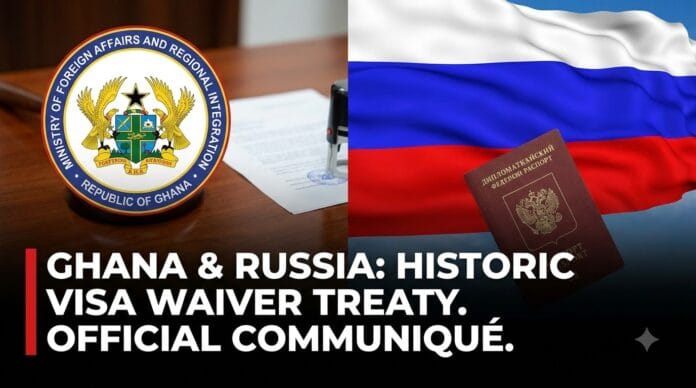
The Ghana Ministry of Foreign Affairs has officially announced a landmark visa waiver agreement with the Russian Federation, specifically targeting holders of Diplomatic and Service Passports. Signed in Moscow on August 17, 2026, this treaty marks the first major travel policy shift between the two nations since formal bilateral relations began in 1958. This strategic move eliminates bureaucratic hurdles for government officials, accelerating high-level cooperation across critical sectors like energy, agriculture, and regional security.
What Are the Immediate Changes for Passport Holders?
The new policy instantly removes the visa application requirement for specific Ghanaian and Russian state representatives. The agreement is restricted entirely to official government business and diplomatic missions. This prevents delays caused by standard consular processing times, which often hinder urgent international relations.
| Passport Type | Previous Requirement | New 2026 Policy |
| Diplomatic Passport | Visa Required | Visa-Free Entry |
| Service Passport | Visa Required | Visa-Free Entry |
| Regular National Passport | Visa Required | Visa Required |
Travelers carrying standard national passports must still apply for appropriate visas before boarding flights to Moscow or Accra. The elimination of visa processing times for diplomats allows faster emergency meetings, direct trade negotiations, and smoother intelligence sharing between the two capitals.
Why Is This Bilateral Agreement Happening Now?
The agreement follows high-level bilateral talks between Ghanaian Foreign Minister Samuel Okudzeto Ablakwa and Russian Foreign Minister Sergey Lavrov. The leadership in Accra is aggressively pushing for heavy industrialization and massive job creation. By clearing the path for diplomatic travel, the government expects faster approvals for foreign direct investment from Russian industrial firms.
The timing perfectly aligns with Ghana’s ambitious goal to retain more value from its domestic gold industry. The country requires advanced technical partnerships to refine raw minerals locally. Russian expertise offers a direct path to achieving that industrial shift without relying entirely on western partners.
Will Regular Travelers Get Visa-Free Access Soon?
The Ghana Ministry of Foreign Affairs confirmed this current treaty is merely the foundational step. Both nations plan to open official negotiations for enhanced travel privileges for all passenger categories. The goal is to boost trade, foreign investment, and people-to-people exchanges over the coming decade.
While a full tourist visa waiver is not yet active, the successful implementation of this diplomatic treaty sets the stage for broader civilian travel agreements. Frequent business travelers should ensure their current passports remain valid for at least six months, as sudden policy shifts often require up-to-date documentation.
3 Key Topics Discussed During the Moscow Visit
The visa waiver was only one part of a much larger strategic discussion. The three-day diplomatic visit prioritized major geopolitical and economic issues currently affecting both regions.
- Economic and Industrial Cooperation: Both nations pledged to expand investments in agriculture, energy infrastructure, and joint mineral exploration projects.
- Security and Defense: Talks heavily focused on combating violent extremism across the volatile Sahel region. Both sides agreed on the necessity of establishing secure intelligence pipelines to track militant movements.
- Citizen Protection: Ghanaian officials directly addressed serious concerns regarding the recruitment of their citizens into the ongoing Ukraine conflict. Russian representatives formally pledged support to halt these unauthorized enlistment practices.
Travelers and business investors should closely monitor updates from official embassy channels. As trade partnerships expand rapidly, commercial visa policies are highly likely to evolve over the next year.

