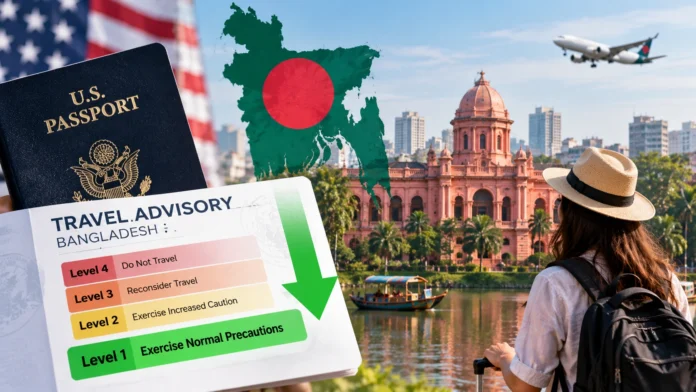
The United States has lowered its overall travel advisory for Bangladesh from Level 3 (“Reconsider Travel”) to Level 2 (“Exercise Increased Caution”). The change reflects the U.S. assessment that conditions on the ground have become more stable and that the country is safer for travel than before.

The update was announced following a bilateral meeting in Dhaka between Bangladesh Foreign Minister Khalilur Rahman and U.S. Special Envoy Sergio Gor. Immediately after the meeting, Gor informed the foreign minister of the decision by text message.
For travelers, the shift matters. A Level 2 advisory still calls for increased caution, but it removes Bangladesh from the higher-risk category that previously advised people to reconsider the entire trip.
What a Level 2 Advisory Actually Means for Visitors
A Level 2 rating means the U.S. State Department believes travelers should exercise increased caution due to risks that include unrest, crime, terrorism, and kidnapping. It does not mean the country is risk-free. It does mean the overall assessment has improved enough that the previous “reconsider travel” recommendation no longer applies nationwide.
The official advisory continues to list specific areas that carry higher risk. Travelers should still read the full document before booking.
Key points from the current guidance:
- Protests can occur and turn violent with little notice. Avoid all gatherings, even those that appear peaceful.
- Common crimes in major cities include muggings, burglaries, assaults, and drug-related activity.
- Terrorist violence remains a risk, though the overall environment is viewed as more stable.
- Kidnapping risk exists in certain regions.
Areas That Still Carry the Highest Warning
The overall downgrade does not apply everywhere. Two areas remain under Level 4 (“Do Not Travel”):
| Area | Advisory Level | Main Reasons |
|---|---|---|
| Chittagong Hill Tracts Region (including Khagrachari, Rangamati, and Bandarban districts) | Level 4 – Do Not Travel | Unrest, crime, terrorism, kidnapping |
| Areas near the border with Burma (Myanmar) and refugee camps near Cox’s Bazar | Level 4 – Do Not Travel | Unrest, crime, kidnapping |
These regions continue to carry the strongest warning. Travelers planning itineraries that include the Hill Tracts or the Cox’s Bazar border zone should treat those destinations as off-limits under current U.S. guidance.
Also read – 10 Top Countries for Cultural Experiences in Less Budget
Why the Advisory Changed Now
The timing followed high-level talks in Dhaka. U.S. Special Envoy Sergio Gor met Foreign Minister Khalilur Rahman and later confirmed that the State Department had taken stable conditions into account.
Bangladesh’s foreign ministry described the change as recognition of sustained efforts to strengthen security, maintain stability, and create better conditions for international travel, trade, investment, and people-to-people contact. The government linked the improvement to visible progress in law and order over the preceding months.
From a traveler’s perspective, the practical result is a more favorable overall rating while localized high-risk zones remain clearly marked.
Practical Tips for Planning a Trip Under the New Advisory
Treat the Level 2 rating as a signal to proceed with normal smart-travel habits rather than as a green light for carelessness.
Helpful steps include:
- Read the full current advisory on the U.S. State Department website before you book.
- Register with the Smart Traveler Enrollment Program (STEP) so the embassy can contact you in an emergency.
- Avoid demonstrations and large crowds entirely.
- Use hotel or reputable transport rather than walking alone at night in unfamiliar neighborhoods.
- Keep valuables secure and limit what you carry in public.
- Stay informed of local news during your stay, especially around political events or holidays.
- If your plans include the Chittagong Hill Tracts or areas near the Myanmar border, change them. Those zones remain under the strongest “Do Not Travel” warning.
Many visitors who stick to major cities such as Dhaka, Chittagong (outside the Hill Tracts), and established tourist areas find the experience manageable when they follow basic precautions. The advisory change reduces the institutional barrier for business travelers, family visits, and tourism while still requiring awareness.
What This Means for Different Types of Travelers
Business visitors and those meeting family often view a Level 2 rating as more workable than Level 3. Insurance policies and company travel policies sometimes treat Level 3 destinations more restrictively. The downgrade can make approvals easier.
Tourists should still plan conservatively. Stick to well-known areas, use trusted operators for any excursions, and avoid spontaneous travel into remote or border regions.
Long-term residents and dual nationals already familiar with local conditions may notice less day-to-day change, but the formal rating shift is still useful when dealing with banks, insurers, or employers.
Bottom Line for Travelers
The United States has lowered its travel advisory for Bangladesh from Level 3 to Level 2, citing more stable conditions and greater confidence in the overall security environment. The change followed diplomatic talks in Dhaka and is viewed by Bangladesh as recognition of improved law-and-order efforts.
Travelers should still exercise increased caution. Avoid the Chittagong Hill Tracts and areas near the Myanmar border and Cox’s Bazar refugee camps, which remain under Level 4 “Do Not Travel” guidance. For the rest of the country, normal careful travel practices apply.
Always check the latest official advisory before departure. Conditions can change, and the full text provides the most current details.
For the official U.S. advisory, visit the U.S. Embassy in Bangladesh travel advisory page and the State Department Bangladesh page.

