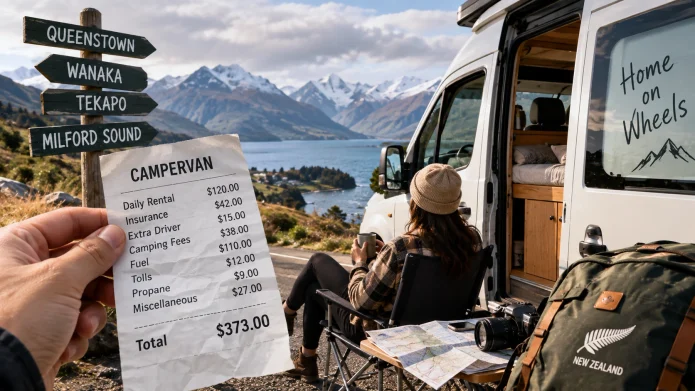
The advertised campervan rate is rarely the real cost of a New Zealand road trip. Road user charges, insurance upgrades, campsites, Cook Strait ferry fares, one-way fees and even the length of your motorhome can push the final bill far above the booking-page price.
The useful number is therefore not “$120 a day.” It is the total trip cost after every unavoidable charge is added.
A cheap van can become an expensive rental surprisingly quickly, especially on a 2,000 to 3,000 km South Island itinerary.
How Much Does a New Zealand Campervan Really Cost?
Add at least six cost categories to the rental rate before comparing campervan companies.
| Hidden cost | What travellers often miss |
|---|---|
| Diesel Road User Charges | Charged according to distance for applicable vehicles |
| Insurance or liability reduction | Can add NZ$30 to NZ$90 per day |
| Campsites | Freedom camping is restricted, not available everywhere |
| Cook Strait ferry | Campervan size affects the booking |
| One-way rental fee | Can cost hundreds of dollars |
| Tolls and administration | Small tolls can attract extra processing costs |
| LPG, cleaning and dumping | Return conditions differ by company |
| Credit card and holiday fees | Often buried in rental conditions |
The best comparison is the final checkout price plus expected road costs, not the daily rental rate shown in search results.
Diesel Campervans Have a Road User Charge Most Tourists Miss
Diesel fuel is not the full driving cost because applicable diesel vehicles also attract Road User Charges, known as RUC.
The current NZ Transport Agency RUC schedule lists NZ$76 per 1,000 km for a standard two-axle vehicle weighing up to 3,500 kg. Rental companies usually recover this cost from customers according to their own rental terms.
That means a 2,000 km trip represents NZ$152 at the underlying government RUC rate before fuel is considered.
This is the classic budget surprise: a traveller sees relatively attractive diesel prices at the pump and assumes the motorhome is cheaper to run. The per-kilometre charge is sitting elsewhere in the bill.
Before booking, search the rental terms for “RUC”, “Road User Charge” or “Road User Charge Recovery Fee”.
Campervan Insurance Can Cost More Than Expected
Liability reduction is one of the biggest costs missing from headline rental prices.
As a current real-world example, Britz’s 2026/27 rates price its “High Road” liability option at NZ$55 to NZ$65 per day, depending on vehicle, while its broader Platinum package costs NZ$80 to NZ$90 per day. These are operator-specific figures, but they show how quickly a cheap-looking rental can change at checkout.
A 14-day trip at NZ$55 per day adds NZ$770.
Check four details rather than simply asking whether “insurance is included”:
- Damage excess
- Security bond
- Windscreen and tyre cover
- Underbody, roof and awning exclusions
Photograph every side of the campervan at pickup, including the roofline, wheels, windscreen and existing scratches. A two-minute phone video can be more useful at return than trying to remember whether a small mark was already present.
Also read – 10 Ethereal Places That Look Like a Fairytale & How to Visit
Freedom Camping Is Not Automatically Free Accommodation
Renting a self-contained campervan does not mean you can legally sleep anywhere.
New Zealand has tightened freedom-camping rules significantly. Rental vehicles used for qualifying freedom camping have been required to meet the new self-containment system since December 2024. The official regulator maintains a national register, and certified vehicles need the required facilities, including a permanently fixed toilet.
Check the government’s current freedom-camping rules and the official self-contained vehicle system before assuming a cheaper camper can use free sites.
Councils and the Department of Conservation can still restrict where camping is permitted.
Paid Campsites Can Change the Trip Budget Fast
Several nights at paid campsites can wipe out much of the accommodation saving that justified renting a campervan.
The Department of Conservation’s campsite fee guide currently lists standard unpowered campsites commonly at NZ$10 to NZ$20 per adult per night, while better-equipped sites cost more.
DOC also warns that many bookable campsites require advance reservations. Simply owning a campsite pass does not guarantee a space.
A useful strategy is to mix:
- Legal freedom-camping nights
- Basic DOC campsites
- Occasional powered holiday parks for showers, laundry and battery charging
This usually produces a better budget than relying entirely on either commercial parks or freedom camping.
Cook Strait Ferry Costs More for a Campervan
Driving both islands introduces a major cost that a South Island-only or North Island-only trip avoids.
Interislander requires motorhomes to be booked according to their actual length. Even a bike rack or other equipment extending behind the vehicle must be included. If the campervan is longer than declared, the operator can charge for the extra length or move the vehicle to another sailing if space is unavailable.
Ferry prices vary with vehicle, sailing and fare type, so a fixed generic price is less useful than checking the exact van before booking.
Compare the ferry cost with a one-way rental fee before deciding to take the same campervan across both islands. Sometimes returning one vehicle and collecting another after crossing is worth investigating.
One-Way Fees and Public Holiday Fees Hide in the Terms
Auckland pickup and Christchurch drop-off may save driving time but can trigger a substantial relocation charge.
For perspective, one current 2026/27 rental operator lists a NZ$349 southbound one-way fee. Another major operator lists NZ$125 surcharges for pickup or drop-off on specified public holidays. These fees vary by company, direction, date and vehicle.
Before paying, compare:
Return rental + extra fuel + extra nights + ferry versus one-way fee + different departure airport.
The route that looks more expensive on the rental page can be cheaper for the trip as a whole.
New Zealand Toll Roads Are Cheap but Still Worth Checking
New Zealand currently has three operating toll roads, all on the North Island.
NZTA lists light-vehicle tolls of NZ$2.10 to NZ$2.60 and higher rates for vehicles over 3.5 tonnes.
See the official NZTA toll-road prices before travelling.
The toll itself is rarely the budget problem. Missing the payment and triggering administration costs is the avoidable expense. NZTA allows recent toll trips to be paid online through Pay & Go, although travellers should also check how their rental company handles toll liability.
A 14-Day Campervan Can Cost NZ$1,000 Extra Before Fuel
A simple example shows why headline prices are misleading.
Take a 14-day diesel campervan trip covering 2,000 km:
| Extra | Example cost |
|---|---|
| Government RUC rate for 2,000 km | NZ$152 |
| 14 days of NZ$55 liability reduction | NZ$770 |
| 5 DOC standard nights for two adults | About NZ$100 to NZ$200 |
| Subtotal before fuel, ferry or extras | NZ$1,022 to NZ$1,122 |
The insurance figure is a current Britz example and campsite costs vary, so this is not a universal quotation. It demonstrates the budgeting problem clearly: more than NZ$1,000 can sit outside the advertised campervan rate before buying diesel or crossing Cook Strait.
What to Check Before Renting a Campervan in New Zealand
Request the full rental terms before paying a non-refundable deposit.
Check these eight items:
- Road User Charge policy
- Insurance excess and daily reduction price
- Security bond
- One-way relocation fee
- Included kilometres
- Cleaning, toilet and LPG return rules
- Self-contained certification
- Credit-card and public-holiday surcharges
The reference guide from The Roaming Renegades correctly highlights insurance, bonds, RUC, campsites, ferry crossings, cleaning and one-way rentals as expenses travellers routinely underestimate. The important 2026 update is that rental campervans advertised for self-contained freedom camping should now comply with New Zealand’s newer regulated green-warrant system, rather than the older portable-toilet arrangements found in outdated advice.
Final Verdict: Is Renting a Campervan in New Zealand Expensive?
A campervan can still be excellent value, but only when the full road-trip cost is compared with a rental car plus accommodation.
The smartest booking is not automatically the cheapest van. A slightly higher daily price can win if it includes liability reduction, unlimited kilometres, RUC, useful equipment or a cheaper one-way arrangement.
The most effective budgeting rule is simple:
Rental quote + insurance + RUC + fuel + campsites + ferry + one-way fee + return charges = the real campervan price.
That is the figure worth comparing before handing over a card.

