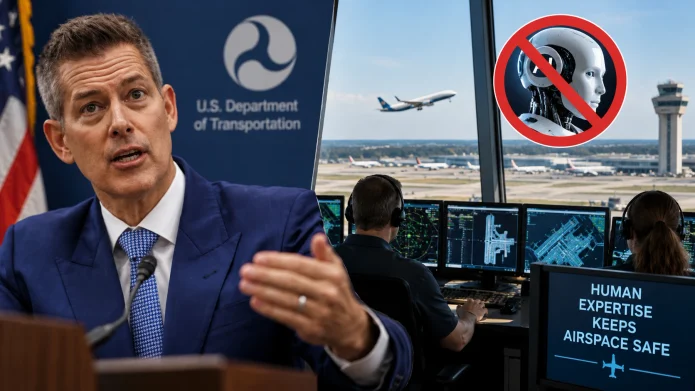
DOT Secretary Sean Duffy confirmed that artificial intelligence will absolutely not replace human air traffic controllers in United States airport towers. The federal government recently deployed a massive new AI traffic management system, but humans retain total authority over all flight decisions. Duffy issued these direct reassurances to stop industry rumors about computers taking over the skies and endangering public safety.

What is the FAA SMART Air Traffic Control System?
The Strategic Management of Airspace, Routes, and Trajectories (SMART) system acts as a highly advanced weather and scheduling predictor for aviation officials. This software instantly processes 200 unique data streams, including real-time weather patterns, runway capacity, and airline flight schedules. The system generates visual predictions to show controllers exactly where congestion will happen before planes even leave the boarding gates.
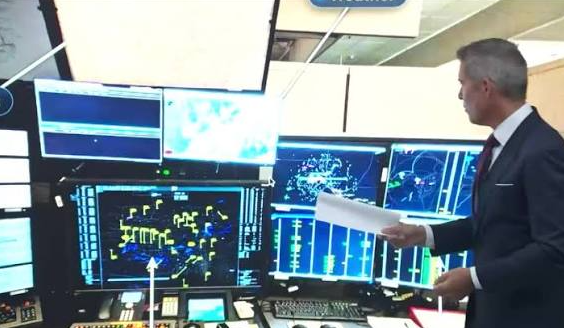
By anticipating bottlenecks up to 45 days in advance, the Department of Transportation (DOT) uses SMART to suggest minor, invisible schedule adjustments. Shifting a specific departure time by just five to ten minutes prevents a massive chain reaction of delays across the entire country. The AI solely provides this predictive data, leaving the final operational choices entirely to the human operators in the control tower.
Why Human Controllers Will Never Lose Their Jobs to AI
Human beings will permanently remain in charge of directing airplanes because managing live airspace requires complex moral and safety judgments that computers cannot replicate. Secretary Duffy explicitly addressed fears of automation by stating, “Am I gonna replace a controller and have AI manage the airspace? The answer to that is hell no, that’s not gonna happen.”
The federal aviation strategy treats artificial intelligence purely as a high-powered calculator, not a robotic decision-maker. Controllers face an incredibly stressful environment when unexpected emergencies happen, such as severe mechanical failures or sudden microbursts. Giving these workers an AI tool provides them with better foresight to handle those emergencies calmly.
Airlines initially panicked that the SMART system would automatically cancel flights without a human verifying the logic. The Federal Aviation Administration (FAA) resolved these exact industry concerns by proving that the software only suggests alternative routing options during severe traffic backups. Humans must manually approve or reject every single suggestion generated by the machine.
Also read – Routes World Awards 2026 Shortlist Announced Following …
Which Airports Will Test the AI Technology First?
Washington, D.C. area airports serve as the primary testing ground for the initial rollout of this massive technology upgrade. The FAA activated the SMART system at Ronald Reagan Washington National Airport, Washington Dulles International Airport, and Baltimore/Washington International Thurgood Marshall Airport starting in late September 2026.
Regulators chose this specific region because the Washington airspace ranks among the most complicated and highly restricted sectors in the entire nation. The area requires constant coordination between commercial flights, heavy military traffic, and strict governmental no-fly zones. Testing the software here ensures that it can handle the highest possible levels of aviation stress.
The government accelerated this specific rollout following a tragic early 2025 mid-air collision near Reagan National Airport involving an American Airlines passenger flight and an Army Black Hawk helicopter. Following the official investigation by the National Transportation Safety Board (NTSB), modernizing control tower communication and situational awareness became an absolute national priority.
| Rollout Phase | Airport Locations | Primary Objective |
| Phase 1 (Active) | Reagan (DCA), Dulles (IAD), Baltimore (BWI) | Test weather predictions and spacing in dense airspace. |
| Phase 2 (Planned) | New York Tracon (JFK, LGA, EWR) | Manage international capacity and severe weather diversions. |
| Phase 3 (Nationwide) | All major US commercial airports | Integrate 45-day advance schedule adjustments. |
How Predictive Software Stops Hours-Long Tarmac Delays
Passengers will spend significantly less time trapped inside parked airplanes because the SMART system alerts controllers to destination congestion before a plane ever leaves the gate. Historically, an airplane would depart from Miami, fly for two hours, and then circle above New York because the arrival runways were full.
This outdated method burned massive amounts of expensive jet fuel and resulted in miserable holding patterns for passengers. The new artificial intelligence engine completely stops this practice by forcing airplanes to wait at their origin airport until a clear arrival slot opens. Waiting inside an air-conditioned terminal is always a safer and more comfortable option than sitting on a crowded, delayed aircraft.
The $875 Million Contract Funding the Aviation Upgrade
Air Space Intelligence holds the official 12-year, $875.6 million federal contract to build and implement the SMART software engine. This massive technology purchase represents just a fraction of the broader $12 billion modernization package dedicated to fixing the aging American airspace infrastructure.
The FAA is systematically ripping out decades-old technology that frequently causes nationwide ground stops. The government has already replaced nearly 50 percent of all obsolete copper wiring inside control towers. They are also installing brand-new surface awareness tracking systems at 54 different airports to prevent deadly runway incursions between taxing aircraft.
Funding these upgrades requires constant congressional approval, and aviation leaders continue to push lawmakers for the remaining necessary budgets. Tracking domestic aviation improvements via the Bureau of Transportation Statistics (BTS) proves that investing in preventive technology directly correlates with a massive drop in canceled holiday flights.
Practical Steps for Travelers Facing Air Traffic Delays
Air traffic control delays still happen frequently while the FAA slowly modernizes its systems. Passengers must take proactive steps to protect their travel plans when the control tower issues a nationwide ground stop due to severe weather or staffing shortages.
Waiting in a physical line for an airline gate agent to rebook a canceled flight guarantees a miserable airport experience. When the departure board turns red, travelers must use alternative methods to secure the last remaining seats on outbound planes.
Follow these specific fixes to navigate an air traffic control delay:
- Call the international hotline: If the US customer service line has a three-hour wait, call the airline’s international desk using Skype. Foreign agents have the exact same computer access and answer instantly.
- Check alternative regional airports: If a major hub like Chicago O’Hare closes, immediately search for rental cars and book a flight out of Milwaukee or Indianapolis.
- Book a backup refundable ticket: During severe thunderstorm seasons, purchase a fully refundable ticket on a competing airline departing three hours later. Cancel it for a full refund right before boarding if your original flight departs safely.
- Monitor FAA operational maps: Check the official FAA Air Traffic Control System Command Center website to see live status updates and ground stop alerts before leaving for the airport.
By understanding exactly how and why planes get delayed, travelers can easily outsmart the stranded crowds. While AI helps air traffic controllers predict the weather, human preparation remains the absolute best tool for an individual passenger.

