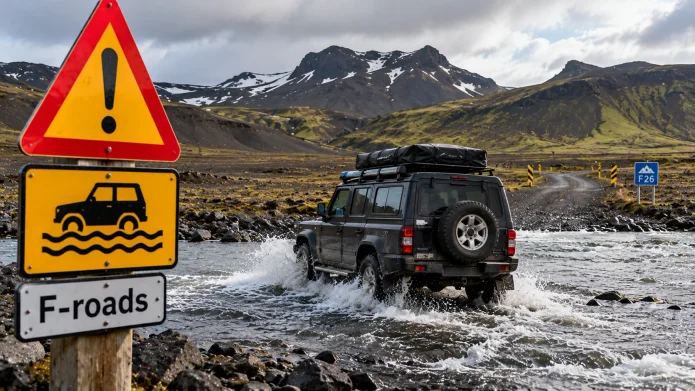
You must rent a certified 4×4 vehicle to legally drive Iceland’s interior mountain routes, known as F-roads. Driving a standard two-wheel-drive (2WD) car on these tracks is strictly illegal, immediately voids all rental insurance, and results in heavy police fines. To safely navigate unbridged glacial rivers and sharp volcanic terrain, travelers must understand specific local traffic laws and unique insurance exclusions before leaving the rental desk.
The Strict Legal Requirement for F-Road Vehicles
Icelandic traffic law explicitly restricts all mountain tracks—marked with an “F” for Fjallvegur—to 4×4 vehicles equipped with adequate ground clearance. Rental agencies utilize GPS trackers to monitor their fleet and will charge massive penalty fees if they catch a 2WD car entering an F-road. Standard compact cars completely lack the reinforced suspension and clearance necessary to handle deep ruts, steep inclines, and jagged rocks.
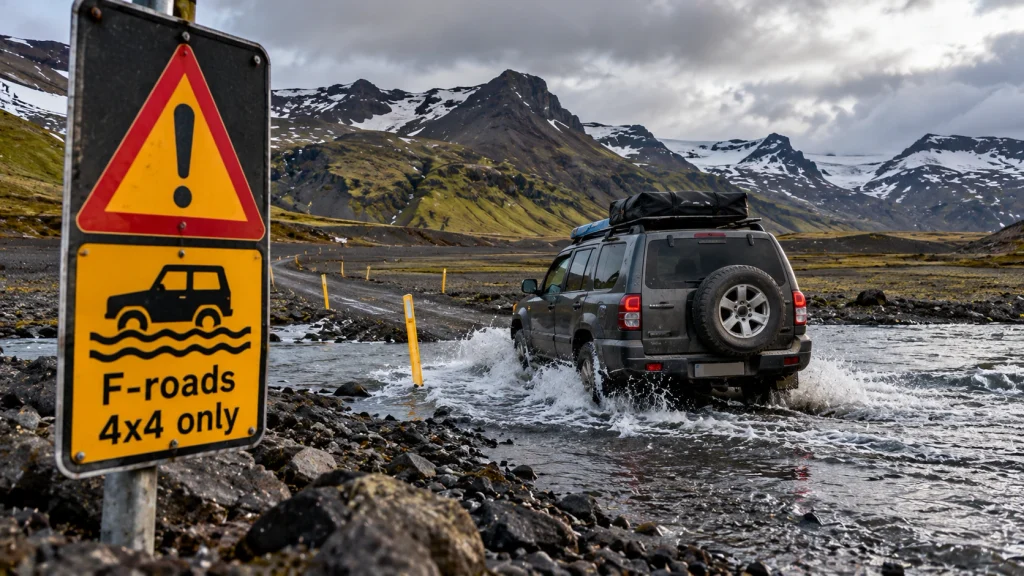
Before signing a contract, check your specific rental agreement carefully. Even some crossover SUVs marketed globally as “4WD” are strictly prohibited by Icelandic agencies from entering the deeper, more technical Highlands routes.
The Hidden Rental Insurance Traps for Tourists
Standard Collision Damage Waiver (CDW) policies in Iceland exclude the country’s most common and expensive natural hazards. You must purchase specific add-on waivers to avoid paying out of pocket for severe environmental damage.
Water damage remains the biggest financial trap for foreign drivers. No rental insurance policy in Iceland covers a flooded engine resulting from a river crossing, even if you rent a top-tier premium 4×4 vehicle. If you drown the engine in a river, you owe the rental company the full replacement cost of the vehicle.
| Environmental Hazard | Standard Coverage Status | Required Add-on Policy |
| Glacial River Crossings | Excluded | None (Always at driver’s financial risk) |
| Volcanic Sand and Ash | Excluded | Sand and Ash Protection (SAAP) |
| Gravel Road Chips | Excluded | Gravel Protection |
| Wind-Damaged Doors | Excluded | None (Driver responsibility to hold doors) |
How to Safely Ford Unbridged Glacial Rivers
True F-roads feature unbridged glacial rivers that fluctuate in depth constantly based on daily rainfall and afternoon glacial melt. If the water looks murky, excessively deep, or the current runs too fast, turn around immediately.
Follow these strict protocols when crossing Highland rivers:
- Time it right: Cross early in the morning between 08:00 and 10:00 when cold night temperatures drastically reduce the glacial meltwater flow.
- Engage low gear: Shift into 4WD Low (4L) before your tires touch the water to ensure maximum torque and vehicle control.
- Follow the current: Enter on a slight diagonal angle heading downstream with the water flow. Driving straight across or fighting the current pushes dangerous water directly into the engine bay.
- Maintain steady momentum: Drive at a slow, walking pace to push a small bow wave ahead of the front bumper. Never stop, reverse, or change gears mid-river.
Also read – 7 Ethereal Places in Scotland That Look Like a Fairytale
How to Cross Single-Lane Bridges and Avoid Livestock
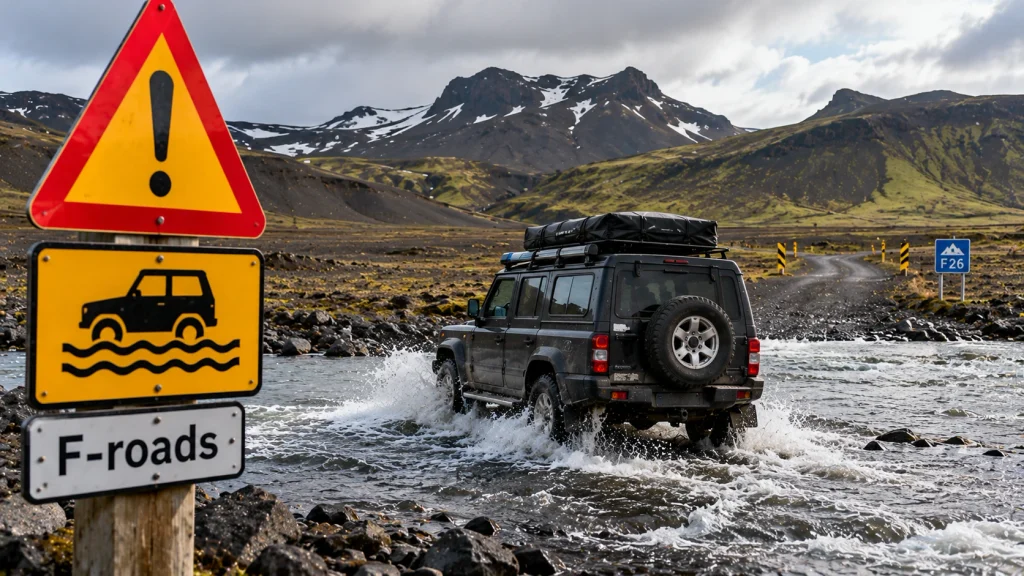
Icelandic highway infrastructure features dozens of single-lane bridges marked clearly with signs reading “einbreið brú”. The legal right-of-way rule dictates that whichever vehicle arrives at the bridge first crosses first, while oncoming traffic must wait at the designated holding line. Always approach these narrow bridges at a reduced speed and prepare to brake suddenly.
During the spring and summer months, thousands of Icelandic sheep roam completely free across the countryside. These animals frequently sleep on the warm asphalt or dart out unpredictably in front of approaching cars. If you hit and kill livestock due to speeding, the local farmer has the legal right to demand direct financial compensation for the lost animal. The official Smartraveller Iceland Advisory explicitly warns foreign drivers to remain highly vigilant in rural agricultural zones to avoid these costly collisions.
Off-Road Driving Bans and Speed Limit Enforcement
Driving completely off marked trails to bypass a difficult obstacle or take a closer photo is strictly illegal across the entire country. Off-road driving destroys fragile sub-Arctic moss that takes decades to recover naturally. The Environment Agency of Iceland and local police issue instant, multi-thousand-dollar fines to tourists caught crushing protected vegetation.
Speed limits change drastically depending on the exact road surface. Police heavily enforce a 90 km/h limit on paved rural highways like the Ring Road (Route 1) and an 80 km/h limit on unpaved gravel roads. The national Blood Alcohol Concentration (BAC) limit sits at an incredibly strict 0.02%, meaning drinking a single beer makes it highly illegal to drive.
Mandatory Safety Protocols and Emergency Contacts
Highland weather switches from clear blue skies to blinding sandstorms or blizzards in a matter of minutes. The SafeTravel Iceland platform operates as the central safety hub for all foreign drivers. You must download the official app and log your travel itinerary before heading into remote areas with zero cellular reception.
If you get trapped in a sudden storm or stall your vehicle in a river, the Icelandic Search and Rescue Association (ICE-SAR) will use this digital log to find your exact coordinates. Always call the national emergency number, 112, if you face immediate physical danger. Furthermore, monitor live weather warnings through the Icelandic Met Office and check real-time road closures via the Icelandic Road and Coastal Administration (Vegagerdin) before starting the ignition each morning.

