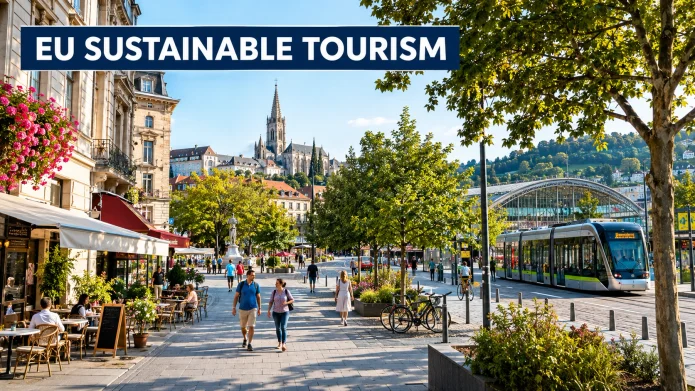
The European Commission officially launched its first comprehensive EU Sustainable Tourism Strategy on November 4, 2026, to protect Europe’s status as the most visited region on earth. This massive policy framework completely shifts the focus away from simply counting international arrivals. Instead, it aggressively targets chronic industry labor shortages, funds the digital transition for small businesses, and establishes strict guidelines to disperse heavy tourist crowds away from overcrowded summer hotspots.
What Are the Main Pillars of the 2026 EU Sustainable Tourism Strategy?
The strategy relies on a multi-level governance approach to ensure tourism directly benefits local communities rather than just generating revenue for large multinational corporations. The European Commission structured the entire initiative around four highly specific foundational pillars designed to modernize the industry from the ground up.
To execute this massive shift, the Commission announced the creation of a brand new EU Tourism Alliance. This specialized coalition will physically bring together national authorities, local regional mayors, and private tourism businesses to ensure everyone follows the same regulatory playbook.
| Strategic Pillar | Core Objective | Primary Action Plan |
| Competitiveness | Solve the massive labor shortage | Launching a continent-wide Tourism Academy to train workers. |
| Sustainability & Resilience | Combat regional overtourism | Promoting off-season travel and developing rural infrastructure. |
| International Cooperation | Maintain global travel dominance | Streamlining border management and updating visa policies. |
| Investment & Governance | Fund the green transition | Establishing a new EU Tourism Alliance to coordinate federal funding. |
How the New EU Tourism Academy Fixes the Labor Crisis
The European tourism sector currently struggles to find enough qualified workers to keep hotels, restaurants, and tour companies operating at full capacity. To solve this immediate crisis, the strategy mandates the creation of a centralized “European Academy of Tourism”. This dedicated institution will actively provide essential training, help regional businesses develop specific skills, and attract younger talent to the hospitality professions.
Also read – 7 Ethereal Places in Scotland That Look Like a Fairytale
Labor shortages stem from poor working conditions and low wages, not just a lack of basic skills. Acknowledging this reality, the European Parliament and the Commission are currently conducting a massive study on transport and tourism working conditions, with legally binding recommendations expected in 2028. The Academy will utilize a vast network of national universities and vocational schools to distribute standardized training materials across all member states.
Financial Support and the EU Tourism Observatory for SMEs
Small and medium-sized enterprises (SMEs) make up 99 percent of all European tourism companies, and they will receive direct financial assistance to implement greener business practices. The strategy promises to significantly reduce bureaucratic red tape, creating a much more business-friendly environment that allows microenterprises to apply for federal transition funding faster.
To help these small businesses track their actual performance, the government is launching the “EU Tourism Observatory”. This digital data hub will collect and distribute real-time statistics regarding regional visitor trends, energy consumption, and local economic impact. Having instant access to this verified data allows a small coastal hotel to adjust its pricing and marketing strategies based on actual regional metrics rather than guessing.
Tourism directly contributes over 10 percent of the total EU gross value added when factoring in indirect expenditures, making the financial survival of these small businesses absolutely critical to the broader European economy.
Will This Strategy Change How Tourists Visit Europe?
The strategy actively pushes tourists to visit Europe during the winter and autumn months, rather than cramming into the same Mediterranean coastal cities every July. The European Travel Commission (ETC) strongly supports this initiative, noting that a longer tourism season delivers highly balanced financial benefits across rural and peripheral regions.
You will likely see more government-funded marketing campaigns promoting lesser-known destinations like Slovakia, Romania, and Poland, which already experienced massive double-digit arrival growth this past year. Furthermore, the Eurostat data collection agency will closely monitor these crowd dispersion efforts to ensure local communities do not suffer from sudden infrastructure collapse when new tourists arrive.
Here is exactly how the strategy impacts your future European holidays:
- More off-season options: You will find far more hotels, museums, and national parks remaining fully open during the traditional winter off-season.
- Smoother border crossings: The strategy promises continuous efforts to streamline digital visa processing and automate physical border management systems.
- Higher prices for sustainability: As local businesses invest heavily in clean energy and better worker wages, you should expect to pay slightly more for standardized hospitality services.
- Dispersed crowds: You will encounter stronger crowd control measures and tighter ticketing caps at ultra-popular historic monuments.

