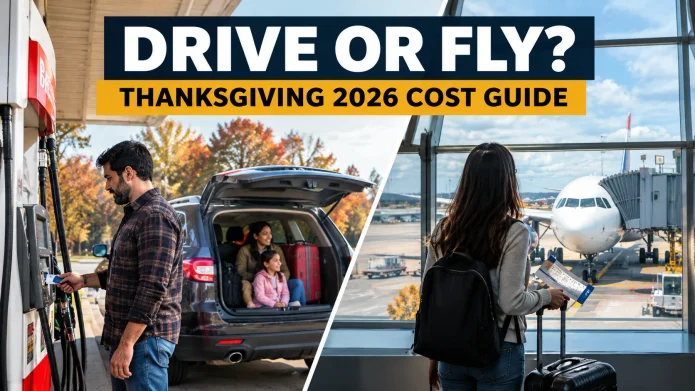
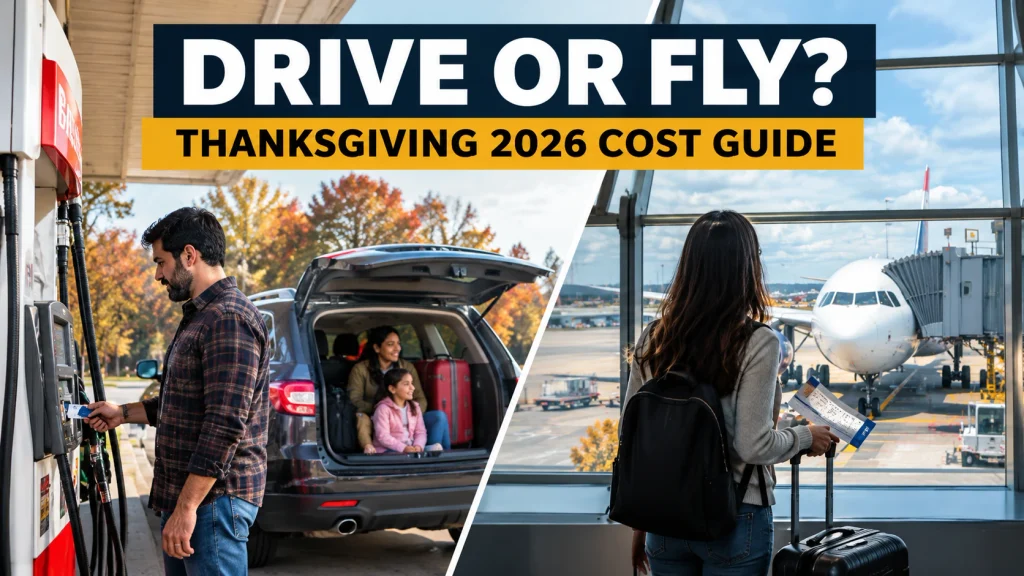
Choosing between driving and flying for Thanksgiving 2026 depends entirely on your party size and distance, but driving easily wins the financial battle this year. Domestic flight prices surged to an average of $400 per round-trip ticket, while national gas prices finally dropped below $4.00 per gallon just weeks before the holiday. Families traveling less than 500 miles will save hundreds of dollars by packing their cars instead of heading to the crowded airport terminals.
The True Cost of Flying for Thanksgiving 2026
Commercial airlines dramatically increased their base fares for the 2026 holiday season. A standard domestic round-trip ticket currently averages $402, representing a massive 30 percent price spike compared to last year. If a family of four attempts to fly from New York to Orlando, the baseline ticket cost easily exceeds $1,600 before adding any basic luggage fees.
Travelers must also account for rigid pricing tiers managed by airline computer algorithms. Flights departing on the Wednesday before Thanksgiving or returning on Sunday, November 29, regularly top $600 per person. The Federal Aviation Administration (FAA) notes that tight route capacity and higher commercial jet fuel costs directly contribute to these expensive holiday tickets. Passengers should book departures on Monday, November 23, or fly on Thanksgiving morning to slash ticket costs by nearly half.
Also read this – 21 Best Seasonal Holidays Around the World Worth Visiting
How National Gas Prices Impact Driving in 2026
Road-trippers received excellent financial news as gasoline costs steadily declined throughout early November. The national average for a gallon of regular unleaded fuel officially dropped to $3.90, falling below the dreaded four-dollar mark for the first time since July. This price drop drastically lowers the overall cash expense of a long-distance family road trip.
The U.S. Energy Information Administration (EIA) confirms that regional fuel supplies stabilized, preventing the sudden price shocks seen earlier in the year. A vehicle getting 25 miles per gallon will only require about $156 in gasoline to complete a 1,000-mile round trip. When you divide that exact fuel cost across four passengers, driving costs less than $40 per person. Drivers can stretch their fuel budget even further by utilizing cruise control on flat interstates.
The 300-Mile Rule: When Driving Beats Flying
Travel experts rely on the 300-mile rule to determine the absolute cheapest transit method. If your Thanksgiving destination sits less than 300 miles away, driving is mathematically faster and significantly cheaper than purchasing a flight. Flying short distances wastes hours of your time in security lines, boarding zones, and baggage carousels.
When travel distances stretch beyond 500 miles, the calculation shifts based on exactly how many people are traveling in your group. Solo travelers often break even by booking a cheap flight, but families multiply their savings with every additional passenger packed into the backseat.
| Transit Distance | Solo Traveler Recommendation | Family of Four Recommendation | Primary Financial Factor |
| Under 300 Miles | Drive | Drive | Door-to-door time is physically faster by car. |
| 300 to 500 Miles | Compare Flight Deals | Drive | Gas split four ways easily beats multiple airline tickets. |
| Over 500 Miles | Fly | Drive | Driving requires paying for overnight hotel stops. |
| Over 1,000 Miles | Fly | Fly | Extreme driving fatigue outweighs the financial savings. |
Also read – AAA Predicts 81.5 Million Americans Will Travel for Thanksgiving …
Hidden Airport Expenses That Ruin Flight Deals
Budget airlines frequently lure travelers with $99 base fares, but hidden operational costs quickly destroy those apparent savings. Checking a single suitcase now costs roughly $40 each way on major domestic carriers. A family checking three bags will spend an additional $240 just to transport their winter clothing.
Airport parking garages also charge up to $40 per day during peak holiday weeks. Leaving your vehicle at the terminal from Wednesday through Sunday adds an instant $200 penalty to your final travel budget. The Transportation Security Administration (TSA) expects record-breaking foot traffic this Thanksgiving, meaning you will spend hours trapped inside the terminal. Captive passengers easily spend $30 per person on overpriced airport meals and bottled water while waiting for delayed flights.
Highway Tolls and Route Planning Tricks
Driving remains the most economical choice, provided you actively avoid expensive regional toll traps. States across the Northeast and Midwest utilize electronic tolling systems that heavily penalize out-of-state drivers lacking a registered transponder. A simple drive across Pennsylvania or New York can secretly add $50 in administrative toll-by-plate fees to your vacation budget.
You must manually configure your digital map application to calculate toll costs before putting your car in drive. The U.S. Department of Transportation (DOT) advises motorists to update their physical EZ-Pass or SunPass transponders to ensure smooth highway travel. Furthermore, the National Highway Traffic Safety Administration (NHTSA) recommends checking your tire pressure before departure. Properly inflated tires improve gas mileage by up to 3 percent, maximizing your fuel savings for the entire journey.

