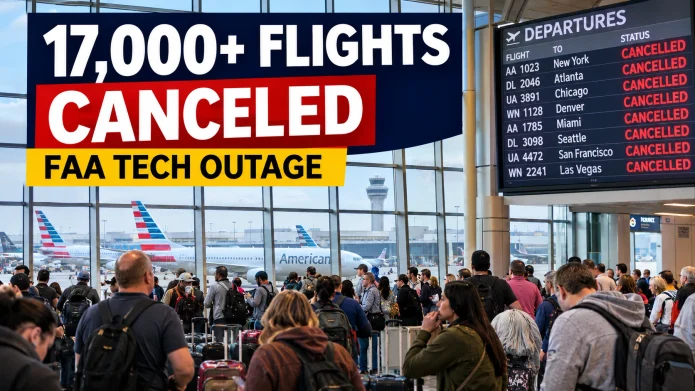
A faulty router and a botched copper wire replacement in a remote Arkansas facility directly triggered the massive November 2026 aviation blackout. This critical hardware failure flooded the central Federal Aviation Administration (FAA) air traffic control system with an overwhelming number of connection attempts. The resulting network crash forced federal authorities to issue a nationwide ground stop for four hours on Friday, November 13, paralyzing the entire domestic aviation grid. By Sunday night, total scrapped flights exceeded 17,000 across the United States, leaving hundreds of thousands of passengers stranded in airport terminals.
What Triggered the November Nationwide Ground Stop?
The federal government spends roughly $1 billion annually to maintain the national air traffic control network, yet a single rural telecom node brought the entire system down. Investigators from the FAA and defense contractor L3Harris are actively analyzing why an outdated copper wire replacement at a remote site bypassed multiple safety redundancies.
While the National Transportation Safety Board (NTSB) usually investigates physical aviation accidents, federal technical teams are treating this specific telecom failure with the same severity. Nationwide ground stops are incredibly rare; the only previous instances followed the September 11 terror attacks and a brief computer failure in January 2023.
How the Outage Eclipsed Previous Airline Meltdowns
This weekend event officially ranks as the worst technology-related flight disruption in 35 years. Aviation analytics firm Cirium confirms the 17,000 cancellations easily surpassed the 16,900 flights grounded during the infamous Southwest Airlines winter meltdown in 2022. Furthermore, the November 2026 event caused significantly more domestic damage than the massive CrowdStrike global IT failure earlier in 2024.
Airlines simply cannot instantly recover when federal authorities freeze all air traffic for four consecutive hours. Because pilots and flight attendants are strictly bound by federal rest requirements, carriers rapidly ran out of legal crews to operate the rescheduled weekend flights. By Sunday night, over 10,100 additional flights faced severe rolling delays.
Also read – 4 New Visa Rules Enacted by USA, Japan, Australia, and …
Which U.S. Airlines Suffered the Most Cancellations?
American Airlines and JetBlue absorbed the heaviest operational hits during this ongoing crisis. Data providers confirm American scrapped more than 5,300 total flights over the three-day weekend, making it the most severely impacted carrier by raw volume.
| Airline | Primary Operational Impact | Current Recovery Status |
| American Airlines | 5,300+ total flights canceled | Slow recovery through Monday |
| JetBlue Airways | Highest percentage of network canceled | Rolling delays expected |
| Delta Air Lines | Severe initial ground stop delays | Returning to normal schedules |
| Alaska Airlines | Moderate weekend disruptions | Vastly reduced cancellations Monday |
Securing Your Full Cash Refund for a Scrapped Flight
You are legally entitled to a full cash refund if your airline cancels your flight and you choose not to travel. The U.S. Department of Transportation (DOT) explicitly mandates that airlines must return your money directly to your original payment method, rather than forcing you to accept an expiring digital travel voucher. You do not have to negotiate with customer service; this federal consumer protection law applies universally, regardless of what caused the cancellation.
Do not accept the airline’s first offer of a meal voucher or a rebooking three days later if you prefer to drive or cancel the trip entirely. Simply request your cash refund through the airline’s digital portal or baggage desk, and book alternative ground transportation.
Immediate Fixes for Stranded Airport Passengers
Sitting in a chaotic terminal drastically reduces your chances of getting home. You must take aggressive, independent action the moment your departure screen flashes red. The Transportation Security Administration (TSA) lines remain packed with confused travelers trying to exit and re-enter, so you must secure your new itinerary before leaving the secure boarding area.
Execute these specific tactics immediately to bypass the gridlock:
- Call the international hotline: While everyone else waits in the physical customer service line, dial the airline’s foreign support desk (such as their Canadian or UK toll-free number). You will connect to a specialized agent instantly without waiting on hold.
- Check telecom limits: Because this outage involves national telecommunications infrastructure, the Federal Communications Commission (FCC) monitors broader network stability. Ensure your phone is connected directly to cellular data, as free airport Wi-Fi frequently collapses during mass delays.
- Demand meal and hotel vouchers: If the delay stretches overnight, ask the gate agent directly for food and lodging vouchers. Legacy carriers publicly commit to providing these accommodations during controllable delays.
- Book a backup refundable ticket: If you see your airline struggling to reset its crew schedules, immediately book a fully refundable ticket on a competing carrier. You can easily cancel the backup flight for a full refund if your original airline finally gets you a seat.
Using these strategies ensures you protect your money and your time as the travel industry recovers from the U.S. flight cancellations top 17,000 incident.

