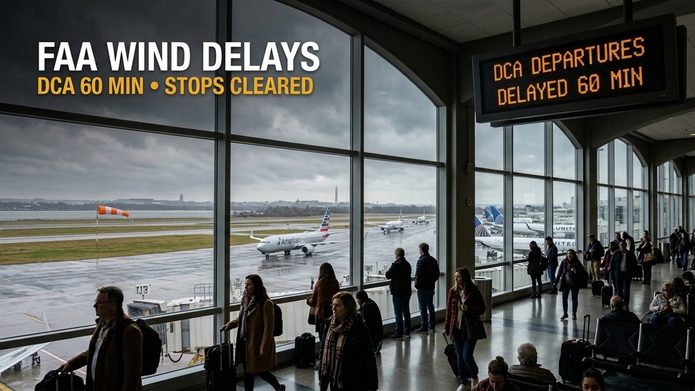
The Federal Aviation Administration has cleared earlier hub ground stops across the East Coast, but Ronald Reagan Washington National Airport (DCA) is still posting 60-minute departure delays due to persistent high winds. Travelers flying in or out of Washington, D.C. during the busy Thanksgiving travel period should expect rolling gate holds, tight connections, and shifting departure boards throughout the day.
A strong coastal storm system brought heavy rain, thunderstorms, and gusty winds across the U.S. Northeast, initially forcing ground stops for DCA-bound flights coming from New York, Cleveland, Boston, and several Canadian airports. While planes are moving again at major hubs, lingering crosswinds along the Potomac River continue to squeeze DCA’s takeoff and landing slots.
Why High Winds Trigger 60-Minute Delays at Reagan National Airport (DCA)
Reagan National Airport’s compact waterfront layout and intersecting runways make it far more sensitive to crosswinds than larger hubs. When wind gusts exceed safe crosswind limits on DCA’s shorter intersecting runways, air traffic controllers must funnel all arrivals and departures onto a single primary runway.
Cutting runway capacity in half during peak Thanksgiving travel immediately creates a backlog. Incoming flights from regional hubs slow down, aircraft arrive late to DCA gates, and departing jets wait longer in taxiway queues—pushing average delays to 60 minutes and climbing even after skies clear. Travelers can track live surface wind advisories and storm fronts through the National Weather Service Aviation Weather Center.
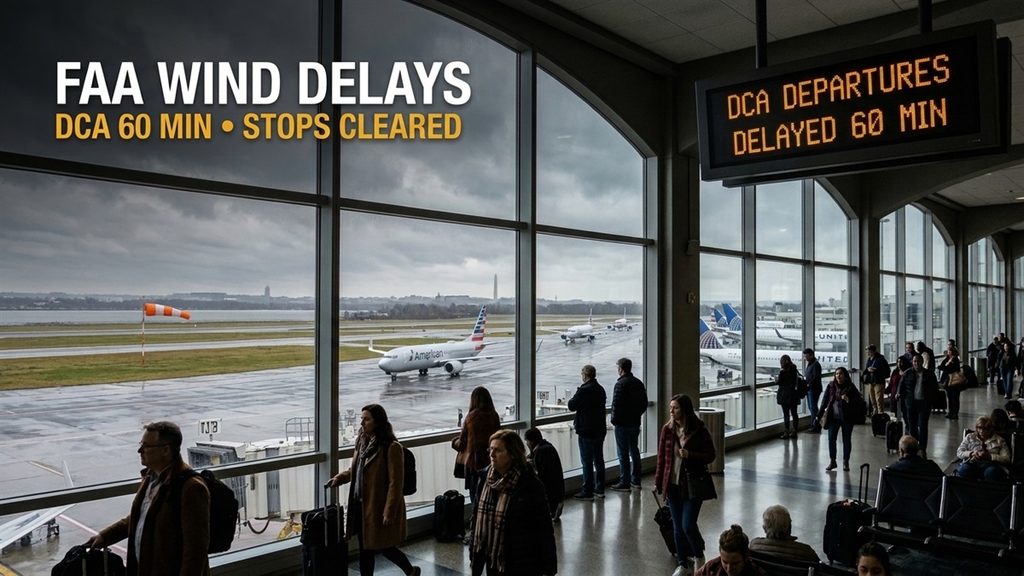
What FAA “Ground Stop Cleared” vs. “60-Minute Wind Delay” Means for DCA Flyers
A cleared ground stop means flights are allowed to take off again, whereas an active 60-minute wind delay means planes are being metered at slower intervals. Understanding the difference keeps passengers from abandoning a flight that is actually about to board—or sitting passively while a connection collapses.
| FAA Airspace Alert Type | What Is Happening on the Ground | What DCA Passengers Should Do Right Now |
|---|---|---|
| Ground Stop (Now Cleared) | Inbound flights from affected regions (such as New York, Boston, Cleveland, and Canada) are held at their origin gates. | Stay near the departure gate; do not leave the secure area because stops can lift suddenly. |
| 60-Minute Wind Delay (Active at DCA) | Flights are still departing and landing, but controllers space aircraft further apart due to high gusts (wx:wind). | Check connecting flight times immediately and verify whether your incoming aircraft has left its previous city. |
| Hub Ground Stops Cleared | Major East Coast hubs are resuming normal departures, though residual crew and aircraft rotations remain behind schedule. | Monitor airline apps for quiet gate swaps and late-arriving inbound crews. |
Also read – US Flight Cancellations Top 17000 in 35-Year Tech Outage
How to Escape DCA Wind Delays Using Dulles (IAD), BWI, or Amtrak
Switching to Washington Dulles International Airport (IAD) or Baltimore/Washington International (BWI) is often the fastest rescue move when DCA wind delays stretch past two hours. Because Dulles operates wide, separated parallel runways, it handles gusty crosswinds far more smoothly than DCA’s tight Potomac River footprint.
- Ask for a free co-terminal rebooking: Most major U.S. airlines treat DCA, IAD, and BWI as co-terminal airports during active weather advisories, allowing stranded passengers to switch airports without paying a fare difference.
- Use Metrorail to switch airports cheaply: Travelers can ride the Blue and Silver lines via the Washington Metropolitan Area Transit Authority (WMATA) directly between Reagan National and Dulles without paying surge-priced rideshare fares across Northern Virginia traffic.
- Jump on Northeast Corridor rail for regional trips: If flying from DCA to Philadelphia, New York, or Boston, taking Amtrak from Washington Union Station eliminates runway wind holds completely.
- Factor in security wait times at a new airport: Switching airports means clearing security again—check live checkpoint waits with the Transportation Security Administration (TSA) before committing to a tight departure at IAD or BWI.
What Airlines Owe DCA Passengers During FAA Wind Delays
Federal rules classify high winds and coastal storms as uncontrollable weather events, meaning airlines are not legally required to provide free hotel rooms or meal vouchers. However, passengers still hold strong refund rights enforced by the U.S. Department of Transportation (DOT) Airline Customer Service Dashboard and operational guidance from the Federal Aviation Administration (FAA).
- Know the cash-refund trigger: Under DOT rules, if an airline cancels your flight or delays a domestic departure by 3 hours or more (or 6 hours or more for international flights) and you choose not to travel, the airline must issue a prompt, automatic cash refund—not just a travel credit.
- Track the inbound aircraft tail number: Use your airline’s app to see where your plane is coming from. If the inbound aircraft hasn’t left its previous city yet, your 60-minute delay will almost certainly grow.
- Call while standing in the gate line: Never rely solely on the physical customer service desk at DCA. Dial the airline’s reservation line or start an in-app chat while waiting—phone agents often grab the last open seats on Dulles or evening flights minutes before gate queues move.
- Stay inside the terminal even during a 60-minute hold: FAA wind delays can shorten quickly if gusts ease or controllers reopen a secondary runway. Leaving the terminal risks missing an early boarding call.
- Check credit card trip-delay coverage: Many travel credit cards reimburse meals and overnight hotels after a 6-hour or 12-hour weather delay—even when the airline will not—as long as you save itemized receipts and a screenshot of the airline’s official delay reason.

