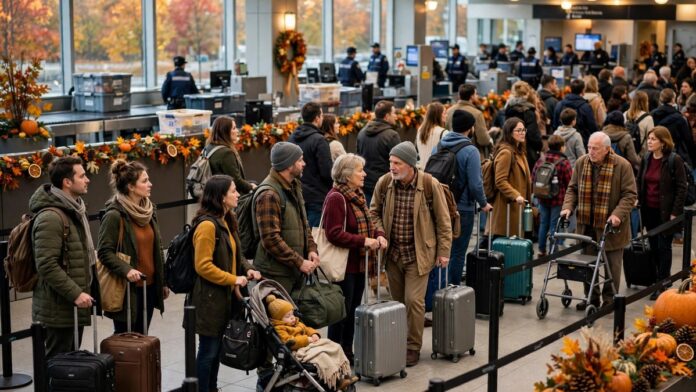
Thanksgiving travel reaches its peak on Sunday, Nov 29, with more than 3 million passengers expected to pass through TSA screening in a single day. That is the first time the daily total has passed 3 million this year, and it makes Nov 29 the busiest travel day of the year.
We checked the FAA notice ourselves, and the change is a staffing rule, not a ban on a runway procedure. That distinction is what travellers need to get right before they plan around it.
The peak arrives with a new FAA staffing rule already in effect. The rule changes how some towers handle departures, and it matters most at airports where staffing is already tight.
What is the new FAA rule for Thanksgiving travel?
The new rule is a staffing requirement, not a ban on a runway procedure. FAA Notice JO 7210.979 took effect on Nov 24, 2026. It requires a dedicated watch supervisor, also called a controller-in-charge, to be on duty during Line Up and Wait operations.
Before Nov 24, that restriction applied only during mid-watch hours, the overnight period when traffic is lightest and staffing is lowest. The rule now applies all day. A tower that cannot staff the supervisor seat cannot use Line Up and Wait, even during busy daytime hours.
The FAA says the change will not affect airport operations. Controllers warn that it could slow departure rates at towers that are short-staffed. Both views are part of the picture for Thanksgiving travellers, because the rule lands in the busiest travel week of the year.
What does Line Up and Wait mean?
Line Up and Wait is a plain instruction from air traffic control. A plane moves onto the runway and waits there for takeoff clearance. The aircraft is lined up, ready to depart, but it does not take off until the controller gives the next instruction.
Controllers use the procedure to keep departures moving in an orderly sequence. A plane can be positioned on the runway while another aircraft lands, clears, or moves out of the way. When the runway is clear, the waiting plane can depart without delay.
The procedure itself is unchanged by FAA Notice JO 7210.979. What has changed is the staffing condition for using it. Without a dedicated watch supervisor on duty, a tower must hold departures at the taxiway instead of lining them up on the runway.
How busy will Thanksgiving travel be?
Thanksgiving travel in 2026 is set to be the busiest in 16 years. The FAA expects about 418,000 flights between Nov 23 and Dec 1. On Nov 24 alone, 52,345 flights were expected.
The TSA forecast, issued Nov 24, puts the number of passengers screened between Nov 24 and Nov 30 at 17.6 million. Sunday, Nov 29, accounts for more than 3 million of those screenings. That figure is the highest daily total of the year so far.
AAA expects 81.5 million Americans to travel 50 miles or more for Thanksgiving. Of that total, 5.96 million are expected to travel by domestic air. The air total is part of a much larger movement of people across the country, and it explains why airports, security lines, and departure queues are under pressure.
Storms on both US coasts disrupted flights earlier in the week. The weather added pressure to a system that was already handling record Thanksgiving demand. Travellers should check the status of their own flight, rather than assume conditions at one airport apply at another.
Thanksgiving travel numbers at a glance
| TSA screenings, Nov 24–30 | 17.6 million |
| TSA screenings, Sunday Nov 29 | Over 3 million |
| FAA flights, Nov 23–Dec 1 | About 418,000 |
| Flights expected on Nov 24 | 52,345 |
| AAA travellers, 50 miles or more | 81.5 million |
| AAA travellers by domestic air | 5.96 million |
| FAA rule effective date | Nov 24, 2026 |
The table shows why Sunday, Nov 29, needs extra planning. It is the peak day inside a peak week. The busiest day of the year is not the day to arrive at the airport with no margin for a queue, a held departure, or a change at the gate.
Why could departures slow down under the new FAA rule?
Departures could slow down where a tower cannot staff the supervisor seat. The chain is short and direct. No dedicated watch supervisor on duty means no Line Up and Wait. No Line Up and Wait means departures wait at the taxiway instead of lining up on the runway.
That change does not stop departures. It changes where planes wait and how quickly they can be positioned for takeoff. At a well-staffed tower, the effect may be limited. At a short-staffed tower, the same rule could reduce the departure rate during busy periods.
No official delay figure has been published for this rule. The FAA gave no estimate of delay minutes, so no number should be treated as the expected wait.
What happened on Nov 13?
The new rule arrives after a difficult start to November for US aviation. On Nov 13, a nationwide ground stop of nearly five hours caused more than 18,000 cancellations after a router upgrade. That event is background, not a forecast for Thanksgiving. It explains why staffing, supervision, and safety procedures are under close attention this month.
What does the new FAA rule mean for Sunday, Nov 29?
Sunday, Nov 29, combines the highest passenger total of the year with the new staffing rule. More than 3 million TSA screenings are expected in one day, which means longer lines at security, fuller terminals, and fuller flights.
The FAA rule adds a second pressure point. If a tower is short-staffed on Sunday, departures from that airport may move more slowly. A flight can still depart, but the sequence that gets it onto the runway may take longer than travellers expect.
The effect will not be the same everywhere. A tower with a full supervisor roster can use Line Up and Wait as before. A tower with a gap must hold departures at the taxiway.
Sunday survival checklist for Thanksgiving travel
- Check flight status before leaving home. Look for the latest departure time, gate, and any change to the aircraft or schedule.
- Allow extra time at the airport. Security lines, terminal crowds, and departure queues are all heavier on the busiest day of the year.
- Keep travel documents and essentials within reach. A long queue is easier to manage when the items needed at security are not buried in a bag.
- Watch for gate and departure updates after arrival. A departure held at the taxiway can still change the boarding and takeoff sequence.
- Plan the onward journey with the same margin. A later arrival can affect a connection, a pickup, or a drive home.
- Stay with the information for your own flight. Conditions vary by airport, airline, and time of day, so a delay at one airport does not predict a delay at another.
We have seen Sunday queues build fast on peak days, so the extra hour at the airport is the cheapest insurance on this trip.
How to read FAA and TSA updates during Thanksgiving travel
The FAA runway safety rules are reported by USA Today, including the staffing change and the views of the FAA and controllers. A second report on the FAA rules and the busiest Thanksgiving in 16 years sets the rule in the context of the holiday week, including the flight totals and the storms on both coasts.
What if your flight is held at the taxiway?
A hold at the taxiway is not a cancellation. The plane is waiting for its place in the departure sequence. The new rule can make that wait longer at some airports, because the aircraft cannot be lined up on the runway while it waits. Stay in the aircraft, follow crew instructions, and wait for the next update from the flight deck. Travellers with a connection should check with the airline after landing.
Why the staffing rule matters beyond Thanksgiving
The staffing rule is not limited to Thanksgiving week. It applies all day, every day, from Nov 24, 2026. The holiday week is the first major test, because it brings the highest passenger totals of the year and the largest number of flights in 16 years.
For travellers who want to understand how flight disruption can spread across a network, the Gulf flights suspended into 2027 report shows how a suspension can affect routes and schedules over a long period. For a different kind of journey planning, the Heathrow Express vs Elizabeth Line guide compares two airport rail options in London.
Thanksgiving travel in 2026 is a record week with a new rule in force. The rule does not ban Line Up and Wait. It requires a dedicated supervisor on duty to use it. That distinction matters, because it tells travellers where the risk sits: not in the procedure, but in staffing at the tower.

