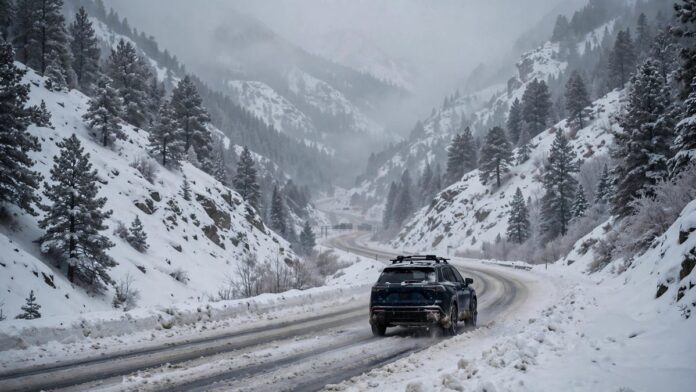
Colorado traction rules are enforced on Interstate 70 every winter, and the penalty for getting it wrong starts at $133. The rule applies on the I-70 Mountain Corridor between Dotsero and Morrison, from September 1 through May 31, whether it is snowing on the day of travel or not. Ski visitors heading to Vail, Breckenridge or Aspen need to check the vehicle before leaving Denver, not at the first steep grade.
We checked the fines against CDOT and the State Patrol — $133, or $657 if you block a lane, is right.
What is the Colorado traction law?
The Passenger Vehicle Traction Law, known in Colorado as Code 15, sets a minimum standard for tires and traction devices on passenger vehicles when the law is active. A compliant vehicle needs winter, all-weather or mud-and-snow tires with at least 3/16-inch tread depth, or chains, or an approved alternative traction device.
Three-sixteenths of an inch is deeper than the legal minimum for ordinary driving, so tires that feel fine for city use can still fail on Vail Pass. Look for the mountain-snowflake symbol for winter tires, an M+S marking for mud-and-snow tires, or a manufacturer rating as all-weather tires.
All-wheel drive helps a vehicle move forward on snow. It does not, by itself, satisfy the law. An all-wheel-drive or four-wheel-drive vehicle still needs rated tires with at least 3/16-inch tread on all four tires. All-wheel drive also does nothing to shorten stopping distance on ice.
| Corridor | I-70 between Dotsero and Morrison |
| Mile markers | About mile 133 to mile 259 |
| Season | September 1 to May 31 |
| Minimum tread | 3/16 inch on every tire |
| Accepted tires | Winter (mountain-snowflake), M+S, or all-weather |
| Alternative | Chains or an approved traction device |
| Base penalty | $133 ($100 fine + $33 surcharge) |
| Lane-blocking penalty | $657 ($500 fine + $157 surcharge) |
How much is the fine for breaking the I-70 Traction Law?
A non-compliant passenger vehicle faces a $100 fine plus a $33 surcharge, a total of $133. If an unprepared vehicle spins out, cannot climb a grade, or otherwise closes a travel lane, the fine can rise to $500 plus a $157 surcharge, a total of $657.
Troopers enforce the rule through the Colorado State Patrol, working with CDOT. Conditions on the corridor can change within an hour. Overhead message signs along I-70 show the active status, and COtrip lists restrictions by highway segment, with live cameras.
Can a two-wheel-drive car comply with the Traction Law?
A two-wheel-drive car cannot comply on tires alone. That is the rule change most visitors miss. Under Colorado Senate Bill 25-069, a two-wheel-drive vehicle must carry chains or an approved alternative traction device from September 1 through May 31, and must install them on at least two drive tires when the Traction Law is active.
Winter tires do not substitute for chains on a two-wheel-drive vehicle. All-season tires do not substitute either. The chains or device must be fitted, not sitting unused in the trunk. A driver who has never fitted chains should not plan to learn on the shoulder of I-70 in a storm, in the dark, at altitude.
The same law requires rental car companies to notify renters about the chain law and the penalties. The disclosure does not come with chains, and it does not make the car compliant. Check the actual vehicle before leaving the lot.
What is the difference between the Traction Law and the Chain Law?
Colorado runs two levels of winter restriction. The Traction Law is the lower level and the one most drivers meet first. The Passenger Vehicle Chain Law, known as Code 16, is the escalation for severe conditions. When Code 16 is active, every passenger vehicle must have chains or an approved traction device fitted, including all-wheel-drive and four-wheel-drive vehicles.
| Law | Code | Requirement |
|---|---|---|
| Passenger Vehicle Traction Law | Code 15 | Rated tires with 3/16-inch tread, or chains / approved device; 2WD needs chains or a device |
| Passenger Vehicle Chain Law | Code 16 | Chains or an approved traction device fitted, including AWD and 4WD |
| Road closure | No vehicle may proceed |
The Chain Law is the strictest level short of a closure. When CDOT closes the road entirely, no compliant vehicle gets through. That means waiting, rescheduling or staying overnight rather than trying another route through the same storm.
Where does the I-70 Traction Law apply?
The enforced corridor runs from Dotsero, around mile marker 133, to Morrison, around mile marker 259. That stretch covers the full Denver-to-ski-country drive: Floyd Hill, Georgetown, the Eisenhower-Johnson Tunnel and Vail Pass. It is the main route to Vail and Breckenridge, and the starting point for onward travel toward Aspen.
Outside that corridor, CDOT can activate the Traction Law or Chain Law on any state highway when weather or road conditions require it. That includes routes such as US 285 toward Fairplay, US 40 over Berthoud Pass toward Winter Park, US 6 over Loveland Pass, and I-25 during a Front Range storm. A clear morning in Denver does not guarantee clear conditions over a pass two hours later.
Why do so many rental cars fail the Traction Law?
The standard rental car is built for year-round national demand, not for Vail Pass in February. Many economy and midsize rentals are two-wheel-drive cars on all-season tires, often with tread below 3/16 inch. That combination satisfies no part of the Traction Law.
Three checks at the rental desk prevent most problems. First, ask for the drive type and choose all-wheel drive or four-wheel drive for a mountain trip. Second, check the tire sidewalls for a mountain-snowflake symbol, an M+S marking or an all-weather rating. Third, measure the tread on all four tires and ask for a different vehicle if any tire is below 3/16 inch.
Chains are a poor backup plan for most visitors. Fitting them correctly takes practice, the right size and a safe place to stop. An approved tire sock is easier for some drivers, but it still needs to be the correct size and fitted before the vehicle loses grip.
How to check your tires before driving I-70 in winter
A five-minute check before leaving Denver covers the main failure points. Measure tread depth with a gauge, not by eye. Check all four tires, look for uneven wear, cracks and bulges, and check tire pressure, because cold mountain air lowers pressure and changes grip.
- Tread: at least 3/16 inch on every tire.
- Rating: mountain-snowflake, M+S or all-weather marking on the sidewall.
- Drive type: all-wheel drive or four-wheel drive for a tire-only pass; two-wheel drive needs chains or an approved device.
- Chains or device: correct size, in the vehicle, and fitted on at least two drive tires when the law is active.
- Route check: COtrip and CDOT updates before departure, plus overhead signs on the road.
How to plan a Colorado ski trip around the Traction Law
Plan the drive as part of the ski trip, not as an afterthought. Book a compliant vehicle early in peak season, because all-wheel-drive SUVs with winter tires are the first rentals to sell out. Allow extra time for the mountain drive, especially for a return to Denver International Airport. Add 60 to 90 minutes of buffer when a traction or chain restriction is active.
Check the forecast for the passes, not just for Denver or the resort town. Snow at the tunnel can be heavy while Denver is dry. Check CDOT updates the morning of travel and again before the return drive. If a Chain Law is active, expect slower traffic even in a compliant vehicle.
The same habit applies to other mountain drives. A vehicle limit can change a route completely, as with the 22-foot RV limit on Generals Highway in California, covered in Generals Highway: 22-Foot RV Limit and the Highway 180 Alternative. Check the rule, check the vehicle, then drive. Meet the Colorado traction standard before leaving Denver, and the trip to Vail, Breckenridge or Aspen stays a ski trip, not a $657 lesson in mountain weather.

