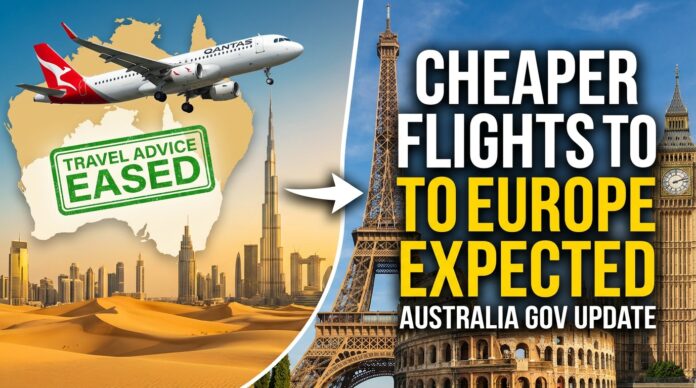
The Australian Government has officially downgraded its travel advice for key Middle Eastern transit hubs, a major policy shift expected to lower airfares to Europe and restore travel insurance coverage for transiting passengers.
The Department of Foreign Affairs and Trade (DFAT) has lowered the warning level for the United Arab Emirates (UAE), Qatar, Bahrain, Kuwait, and Israel from Level 4 (“Do Not Travel”) to Level 3 (“Reconsider your need to travel”). While the change does not represent a return to normal, it eliminates the strict transit barriers that have forced travellers to take expensive detours through Asia for the past several months.

Quick Summary: The Middle East Travel Advice Shift
- The Big Change: UAE, Qatar, Bahrain, and Kuwait downgraded from Level 4 (“Do Not Travel”) to Level 3 (“Reconsider your need to travel”).
- The Economic Impact: Cheaper flights to Europe are expected as Gulf airlines scale up passenger numbers and re-introduce competitive pricing.
- Insurance Status: Most travel insurers will now cover transits through Dubai, Abu Dhabi, and Doha.
- The Underlying Cause: A diplomatic breakthrough and an interim agreement between the US and Iran aimed at stabilizing the region.
Also read – Etihad’s Biggest Summer: 10% More Seats & 300 Daily Routes
What Are the New Australia Middle East Travel Advice Levels?
DFAT has downgraded its travel warnings to Level 3 (“Reconsider your need to travel”) for major transit hubs like the UAE and Qatar, while maintaining a strict Level 4 (“Do Not Travel”) warning for high-risk zones like Iran and Lebanon.
This distinction is crucial for flyers. As long as you remain within the international transit terminals of downgraded countries, your journey is no longer flagged under the highest government warning tier.
The table below details the updated advice levels for key Middle Eastern countries:
| Country / Region | Key Transit Hubs | Previous Warning Level | Current Warning Level | Travel & Transit Status |
|---|---|---|---|---|
| United Arab Emirates (UAE) | Dubai (DXB), Abu Dhabi (AUH) | Level 4: Do Not Travel | Level 3: Reconsider your need to travel | Approved for transit; insurance coverage restored. |
| Qatar | Doha (DOH) | Level 4: Do Not Travel | Level 3: Reconsider your need to travel | Approved for transit; insurance coverage restored. |
| Bahrain | Manama (BAH) | Level 4: Do Not Travel | Level 3: Reconsider your need to travel | Transit allowed; exercise high caution. |
| Kuwait | Kuwait City (KWI) | Level 4: Do Not Travel | Level 3: Reconsider your need to travel | Transit allowed; exercise high caution. |
| Israel | Tel Aviv (TLV) | Level 4: Do Not Travel | Level 3: Reconsider your need to travel | High caution advised; check regional updates. |
| Iran | Tehran (IKA) | Level 4: Do Not Travel | Level 4: Do Not Travel | Strictly avoid all travel and entry. |
| Lebanon | Beirut (BEY) | Level 4: Do Not Travel | Level 4: Do Not Travel | Strictly avoid all travel and entry. |
Note: Level 4 advisories also remain in place for Iraq, Syria, Yemen, Palestine, and specific high-risk border regions within Israel.
Why Does Easing Transit Advice Lead to Cheaper Flights to Europe?
Lowering the transit warnings allows major Gulf airlines—such as Emirates, Qatar Airways, and Etihad—to re-enter the Australian market with full passenger capacity, driving down airfares through increased competition.
Traditionally, Gulf carriers transport more than half of all passengers flying from Australia to Europe. When the transit hubs were designated as “Do Not Travel,” airlines faced operational restrictions, and demand collapsed due to insurance cancellations. This forced Australians to route their European trips through Asian gateways like Singapore, Hong Kong, and Tokyo.
This detour created a massive supply bottleneck. Seats on Qantas, Singapore Airlines, and Cathay Pacific became scarce, causing airfares to surge by as much as 40% on key routes. Restoring the Middle Eastern flight paths injects thousands of transit seats back into the market daily, which travel industry analysts expect will trigger aggressive fare wars and lower booking costs.
Will Travel Insurance Cover Transiting Through the Middle East Now?
Yes, most Australian travel insurance policies will now cover layovers and transits through Gulf airports, as insurers typically only enforce blanket coverage exclusions for Level 4 “Do Not Travel” destinations.
When a country is placed on a Level 4 warning, standard insurance policies immediately void coverage for any events occurring in that country, including flight delays, missed connections, lost baggage, or medical emergencies during a layover. Downgrading the UAE and Qatar to Level 3 resolves this massive headache.
However, you must follow these transit rules to keep your coverage valid:
- Do not leave the airport terminal: Stepping past customs or immigration into a Level 3 country carries different insurance implications than a simple airside transit. Keep your stay within the transit gate area.
- Verify your Product Disclosure Statement (PDS): Some boutique insurers have specific clauses regarding Level 3 countries. Always call your provider to confirm that “transit through a Level 3 zone” is fully covered.
- Ensure no codeshare routes fly over Level 4 airspaces: Although flights are routed safely, check that your airline does not make unscheduled stops in adjacent Level 4 airspaces.
Read more – How to Use Google Earth Flight Simulator Online for Free?
What Caused the Australian Government to Lower the Advice Level?
The downgrade in travel warnings follows a significant easing of geopolitical tensions, highlighted by an interim diplomatic agreement between the United States and Iran.
This agreement has reduced the immediate threat of conflict escalation that previously threatened civil aviation routes across the Persian Gulf. Foreign Minister Penny Wong stated that the security environment, while still requiring caution, has stabilized enough to permit a reduction in transit warnings for key hubs.
However, Minister Wong warned that the regional situation remains highly volatile. DFAT has emphasized that advice levels can be upgraded with zero notice if military tensions spike, and travellers must maintain flexible itineraries.
Personal Experience: My Experience with Gulf Transits
As a frequent flyer who routes between Melbourne and London multiple times a year, I felt the pain of the Level 4 transit warnings firsthand. Last season, I had to pay an extra $1,150 to fly via Singapore because my insurer flatly refused to cover a 3-hour layover in Dubai. The airport felt empty, and the stress of travelling without medical transit coverage was not worth the risk.
With the advice now downgraded to Level 3, the difference is immediate. Booking portals are already showing increased seat availability, and my regular insurance provider confirmed over the phone that transiting through Doha is once again fully covered under their standard policy. If you have been delaying a trip to Europe due to high costs, now is the time to start setting up fare alerts.
5 Essential Steps to Take Before Booking Your Next Flight
If you are planning to book a flight to Europe via a Middle Eastern hub, follow these five steps to protect your finances and safety:
- Check the Live Status: Monitor updates directly on the official Smartraveller website before making any deposits.
- Get Written Insurance Confirmation: Send an email to your travel insurer asking: “Will my policy cover medical emergencies and travel disruptions during a 4-hour transit at Dubai International Airport under the current Level 3 advisory?” Keep their reply.
- Keep Transit Windows Short: Try to book layovers that are under 4 hours to minimize the time spent in the transit zone.
- Download the Airline App: Ensure push notifications are turned on so you are alerted instantly to any airspace diversions or schedule changes.
- Review Fare Flexibility: Only book tickets that offer free changes or voucher refunds, just in case the regional security situation shifts and warnings are upgraded again.

