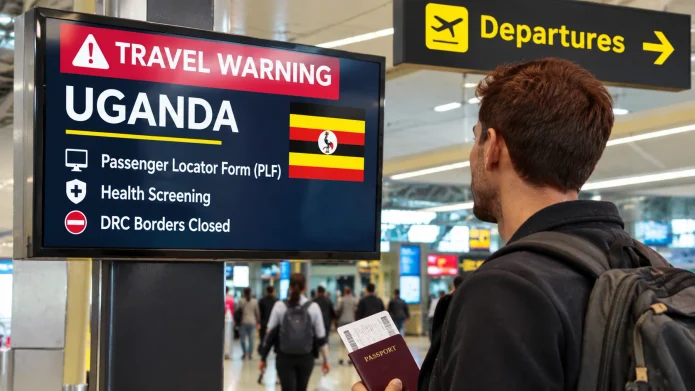
Australia’s official advice for Uganda is now exercise a high degree of caution, with closed crossings on the Democratic Republic of the Congo border, mandatory online Passenger Locator Forms for every international arrival and departure, and health screening at all ports of entry.
The warning reflects ongoing risks from crime, civil unrest and terrorism, plus stricter border and health controls. Smart preparation before you fly prevents denied boarding, long delays at Entebbe, or getting stranded near a closed land border.
What Is Australia’s Current Uganda Travel Warning Level?
Australia’s Uganda warning level is the second-highest: exercise a high degree of caution Smartraveller Uganda Advice.
It sits just below “reconsider your need to travel” and “do not travel.” The level applies nationwide, including Kampala, Entebbe, and popular tourism hubs like Queen Elizabeth and Murchison Falls National Parks.
Smartraveller, run by the Australian Department of Foreign Affairs and Trade, updates the advice when security, health, or border conditions change. The current advice flags higher risk at night, near the DRC and South Sudan borders, and at crowded public places.
What that means for you: Travel is still possible, but insurance, registration, and pre-departure checks are essential. Many Australian travel insurers base coverage exclusions directly on Smartraveller levels.
Also read – Heading to Abu Dhabi for F1 Race? UK Govt Issue Big Alert …
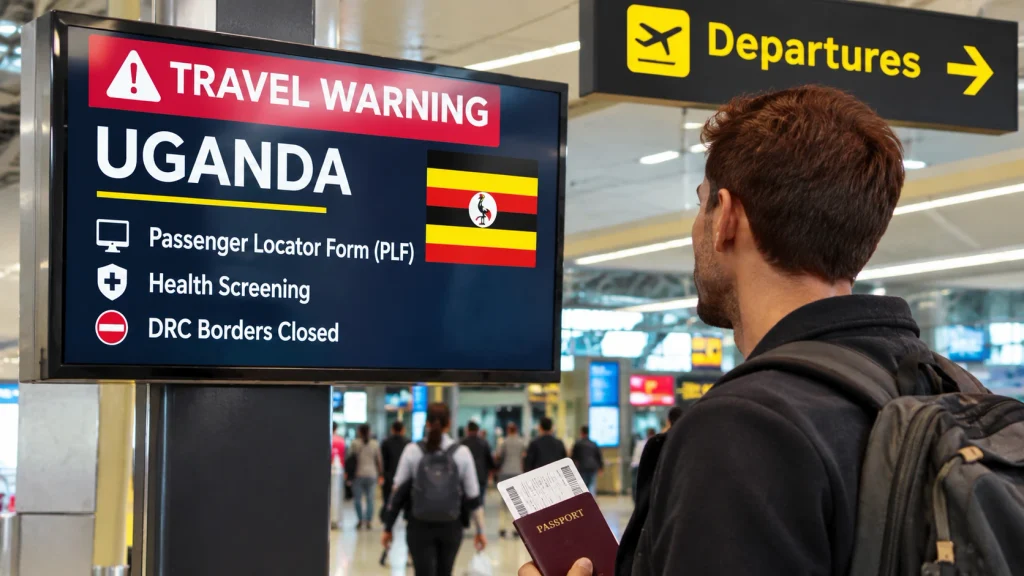
Why Does Australia Urge High Caution For Uganda Travel Right Now?
Australia urges high caution because the risk profile combines personal safety threats and border disruption. Smartraveller notes violent crime, including armed robbery and carjacking, plus the ongoing threat of terrorism and protests that can turn violent with little warning.
Two specific factors are highlighted for current travelers:
- Closed border crossings with the Democratic Republic of the Congo. Several DRC-Uganda land borders are closed or subject to sudden closure, limiting cross-border movement and evacuation options.
- Regional instability spilling over. Conflict in eastern DRC has increased military presence and ad-hoc checkpoints on the Ugandan side, especially in the west.
Daytime travel in central Kampala feels busy and manageable, with traffic, markets, and hotel security checks. After dark, the experience shifts — unlit roads, police checkpoints, and opportunistic crime rise sharply, so pre-booked transport is far safer than hailing taxis on the street.
Is Uganda’s Online Passenger Locator Form Mandatory For All Flights?
Yes. Every arriving and departing international passenger must complete Uganda’s online Passenger Locator Form and undergo health screening, according to Australia’s travel advice for Uganda.
There are no exemptions for nationality, age, or transit status if you formally enter Uganda. Airlines at check-in and immigration at Entebbe International Airport (EBB) both check for completion.
Quick facts for the Uganda Passenger Locator Form:
| Question About Uganda Passenger Locator Form | Clear Answer For Australia-Uganda Travelers |
|---|---|
| Who must complete the Uganda Passenger Locator Form? | All arriving and departing passengers on international flights |
| When to complete the Uganda Passenger Locator Form? | Before travel — ideally 24 hours before departure, and before return |
| What information is required? | Passport details, flight, seat, Ugandan address, contact number, health declaration |
| What happens on arrival? | QR code scanned, temperature and symptom screening, possible secondary health check |
Keep the QR code as a PDF and a screenshot. Border Wi-Fi at Entebbe can be slow, and immigration desks do not offer paper forms as a backup.
How To Complete Uganda’s Passenger Locator Form Without Delays: 5 Steps
Completing the form correctly prevents boarding denial and long queues on arrival. Use the link referenced in Smartraveller’s Uganda health and entry section and follow this sequence.
- Apply 24-48 hours before departure. Use a laptop, not a phone, for easier uploads. Enter names exactly as printed in the passport.
- Add a reachable Ugandan address and phone number. Use the first hotel, lodge, or host. Field officers do call to verify locations.
- Declare recent travel and health status honestly. Include any DRC transit or recent fever. False declarations can lead to entry refusal.
- Save the QR code two ways. Download the PDF and email it to yourself. Keep data roaming off but have the code accessible offline.
- Re-apply for the departure leg. The return Passenger Locator Form is also mandatory when leaving Uganda. Complete it before heading to the airport.
Helpful tip: If traveling as a family, each traveler needs a separate submission, including children. Group or family batch submissions are not accepted at check-in counters for Australian passports.
What Are Uganda’s Entry, Health Screening And Border Rules For Australians?
Australians need a visa, a valid Passenger Locator Form, and must pass health screening. Uganda’s visa is obtained online via the official e-Visa portal, and airlines will verify it alongside the locator form at boarding.
- Visa: Apply for an e-Visa at least 5-7 days before travel. Carry a printed approval letter.
- Passport: Must be valid for at least 6 months from arrival with one blank page.
- Health screening: Mandatory temperature and symptom checks for all international arrivals and departures. Yellow fever vaccination certificate is required if arriving from a yellow fever risk country, and is recommended for all travelers per the Australian Department of Health and Aged Care.
- Land borders with DRC: Assume crossings are closed. Do not plan overland travel to or from DRC, even for gorilla trekking circuits that cross borders. Check the latest crossing status with Ugandan immigration or the Uganda Civil Aviation Authority before booking any itinerary that relies on a land border.
For consular help inside Uganda, Australians can contact the Australian High Commission in Nairobi, Kenya, which has accreditation for Uganda, listed on the Department of Foreign Affairs and Trade website. Register on Smartraveller Registration so the government can contact you in a crisis.
How To Avoid Getting Stranded By Closed DRC Borders And Health Checks In Uganda?
Avoid getting stranded by treating the border closure and health form as non-negotiable parts of the booking, not add-ons at the airport.
- Build buffer days. Avoid booking a same-day connection from Entebbe to a DRC destination. If a border closes, entire road convoys are turned back.
- Choose Entebbe (EBB) as the only reliable entry point. International flights from the Middle East and Africa all land here; land entry from DRC is not a dependable option right now.
- Buy flexible tickets and comprehensive insurance. Confirm the policy covers Smartraveller “high degree of caution” destinations. The Services Australia and Smartraveller sites both note that travelling against advice can void claims.
- Carry proof of everything. Print visa, locator QR codes, hotel vouchers, return ticket, and yellow fever card. Keep copies in separate bags.
- Plan gorilla permits carefully. If trekking in Bwindi or Mgahinga, book permits for Uganda only. Permits for Virunga in DRC are not usable if the border is shut.
In real trips, travelers who complete the locator form late often face 45-90 minute holds at health desks while others move through in minutes. The screened queue is fast; the incomplete-paperwork queue is not.

