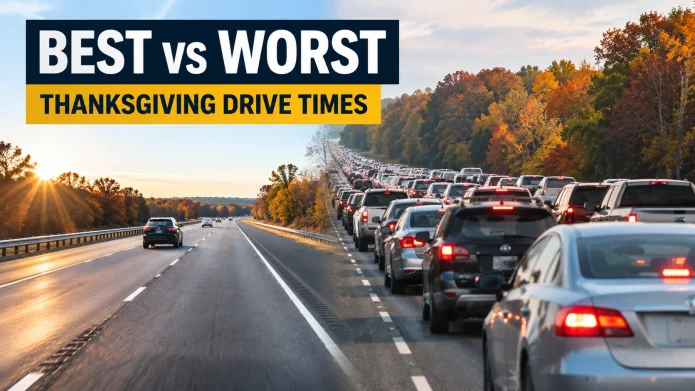
Your departure time dictates whether your Thanksgiving drive takes four hours or eight. If you want to bypass the worst holiday gridlock this year, you must put your car in drive before noon on Tuesday or Wednesday. Waiting until the late afternoon guarantees you will sit in standstill traffic alongside millions of other frustrated drivers.
What Are the Best and Worst Times to Drive During Thanksgiving Week 2026?
Leaving early in the morning solves almost every holiday traffic problem. The American Automobile Association (AAA) and transportation analytics firm INRIX analyzed live traffic patterns to pinpoint exactly when highways will reach maximum capacity. Their 2026 data proves that afternoon travel is universally a terrible idea across every single day of the holiday week.
| Travel Date (2026) | The Absolute Worst Time to Drive | The Safest Time to Drive |
| Tuesday, Nov 24 | 2:00 PM to 8:00 PM | Before 1:00 PM |
| Wednesday, Nov 25 | 12:00 PM to 7:00 PM | Before 12:00 PM |
| Thursday, Nov 26 | Minimal Traffic Expected | All Day |
| Friday, Nov 27 | 1:00 PM to 7:00 PM | Before 12:00 PM |
| Saturday, Nov 28 | 12:00 PM to 9:00 PM | Before 11:00 AM |
| Sunday, Nov 29 | 12:00 PM to 8:00 PM | Before 11:00 AM |
| Monday, Nov 30 | 2:00 PM to 7:00 PM | Before 1:00 PM |
Interesting read – AAA Predicts 81.5 Million Americans Will Travel for Thanksgiving …
Why Wednesday Afternoon Causes the Most Severe Traffic Jams
You will face the absolute heaviest outbound congestion between noon and 7:00 PM on Wednesday, November 25. Local commuters leaving their offices early merge directly into regional road-trippers during this specific window. This collision of daily work traffic and holiday travel creates immediate bottlenecks on major interstates.
The Federal Highway Administration (FHWA) warns that urban corridors experience massive spikes in vehicle volume on Wednesday afternoon. If you cannot leave before lunch on Wednesday, wait until after 8:00 PM. Driving late in the evening carries a higher risk of driver fatigue, but it completely removes the gridlock factor.
Is Driving on Thanksgiving Morning a Smart Strategy?
Driving on Thanksgiving Day itself guarantees the lightest traffic of the entire week. Most travelers arrive at their destinations by Wednesday night. This leaves the highways entirely empty on Thursday morning.
If your family schedules the traditional turkey dinner for 4:00 PM and you live within a three-hour driving radius, leaving on Thursday morning is your smartest strategic move. You avoid the Wednesday stress completely. You also save money on Wednesday night hotel rooms if you are splitting a longer journey into two days. Local town roads remain incredibly quiet until the late afternoon when families finally drive over to their relatives’ houses.
How to Avoid the Sunday Return Gridlock
Sunday, November 29, presents the most dangerous return window of the year. Everyone attempts to return home for work and school on Monday morning at the exact same time. The highways clog heavily starting right at noon and remain locked up until 8:00 PM. Traffic bottlenecks are especially brutal near massive metropolitan centers and major interstate interchanges.
To avoid staring at red brake lights for hours, you must wake up early. Pack your car on Saturday night and hit the road by 9:00 AM on Sunday. Alternatively, shift your entire return trip to Saturday morning or Monday morning. The U.S. Department of Transportation (DOT) notes that spreading the return traffic across multiple days significantly reduces rear-end collisions caused by sudden highway stops.
3 Mechanical Checks to Perform Before You Hit the Interstate
Dead batteries and flat tires trigger hundreds of thousands of roadside assistance calls during the Thanksgiving window. You must manually verify your car is ready for freezing November weather before you merge onto the highway. Sitting on a dark highway shoulder is extremely dangerous during peak holiday traffic.
Execute these three simple mechanical checks in your driveway:
- Test your tire tread: Use a standard penny to check your tread depth. The National Highway Traffic Safety Administration (NHTSA) states that worn tires lose complete traction on wet or icy roads, causing severe hydroplaning.
- Verify your battery voltage: Cold nights instantly kill weak car batteries. Have a local mechanic run a quick voltage test if your battery is more than three years old.
- Top off wiper fluid: Buy a gallon of winter-grade windshield washer fluid that resists freezing. Heavy highway traffic kicks up massive amounts of dirty road salt, instantly blinding your windshield.
The video below walks through the exact physical steps required to winterize your vehicle before a major cold-weather road trip.

