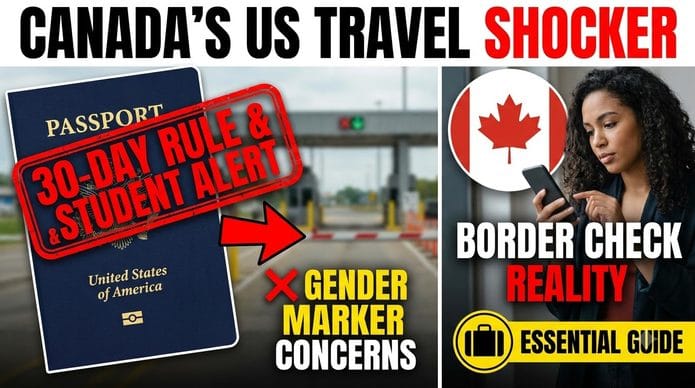
Canadians can still travel normally to the United States, but longer stays, student travel and passports with an “X” gender marker now deserve extra attention before crossing the border. Canada has not told citizens to avoid the U.S. Its official risk level remains “Take normal security precautions.”
What has changed is the paperwork travellers may face. Registration requirements for longer visits, stricter student-status checks and changes involving gender information can turn an otherwise routine trip into a border problem when documents are not prepared correctly.
Do Canadians Staying in the U.S. More Than 30 Days Need to Register?
Yes, Canadians visiting the United States for longer than 30 days must make sure they are properly registered with the U.S. government.
The important detail many travellers miss is that some visitors are automatically registered when they enter while others may need to take additional action.
Canada recommends checking your I-94 admission record after entering the United States. This is particularly useful for:
- Snowbirds spending several months in the U.S.
- Canadians staying with relatives for extended periods
- Long road-trip travellers
- Students remaining in the country for a semester or longer
Failure to meet the registration requirement can lead to penalties, fines or misdemeanor prosecution, according to Canada’s current U.S. travel guidance.
A simple check that could prevent problems
After crossing the border, don’t simply assume everything was recorded correctly.
Check your I-94 admission information and confirm your status while the trip is still fresh. It is much easier to investigate a missing record from your hotel or apartment than weeks later when another immigration issue appears.
Also read – Canada Cruise Sewage Ban Could Slash Ticket Prices
Do Canadian Students Need a Visa to Study in the United States?
Canadian citizens generally do not need a U.S. visa simply to study in the United States, but they must have valid student status and the correct paperwork.
Canada specifically says Canadian students need to be registered in SEVIS, the U.S. system used to track international students, and must present the appropriate registration documentation to U.S. Customs and Border Protection when entering.
That distinction matters.
“I don’t need a visa” does not mean “I don’t need student documents.”
Before travelling, students should have easy access to:
| Document or check | Why it matters |
|---|---|
| Valid passport | Establishes identity and citizenship |
| Form I-20 | Shows the approved U.S. study program |
| Active SEVIS status | Confirms student registration |
| School information | Helps explain the purpose and length of the stay |
| Financial evidence | May help demonstrate ability to support the stay |
| I-94 after entry | Shows how the traveller was admitted |
Keep essential documents in your carry-on or personal bag rather than checked luggage. A document sitting underneath an aircraft is useless when a border officer asks to see it.
Is There a One-Year U.S. Ban Affecting Canadian Students?
No blanket one-year ban preventing Canadian students from studying in the United States appears in Canada’s current official travel advice.
That clarification is important because dramatic headlines can make immigration changes sound broader than they really are.
Canadian students can still enter the United States when they meet the applicable requirements. The more useful question for a student is not “Am I banned?” but:
“Does my current documentation correctly prove why I am entering and how I am permitted to stay?”
That is what should be checked before buying a non-refundable ticket or arriving at the land border with a car full of belongings.
Can Canadians With an X Gender Marker Travel to the U.S.?
A Canadian passport containing an “X” gender identifier remains a valid Canadian passport, but Canada cannot guarantee that another country’s border or travel systems will accept that identifier without complications.
Canada warns that travellers with an X marker may encounter systems that only accept male or female information.
The United States has also changed federal practices surrounding sex markers. The U.S. State Department currently issues U.S. passports using an M or F marker matching sex at birth, rather than issuing new X-marker passports.
For U.S. visa applications, State Department guidance says applicants whose passport contains an X or unspecified marker should select their sex at birth when completing the relevant sex field.
What should an X-marker traveller do before departure?
Check requirements before reaching the airport or border rather than expecting the issue to be resolved at inspection.
Pay particular attention to:
- Passport information
- Airline passenger information
- U.S. entry documentation
- Visa information, when applicable
- Name differences between documents
- Gender or sex fields requested by booking systems
Canada specifically advises travellers with X-marker passports to verify requirements with the appropriate foreign authorities before departure.
What Can U.S. Border Officers Ask Canadians?
Entry into the United States is ultimately decided by U.S. border officials, and travellers may be asked to prove that their visit is temporary and matches the reason they gave for entering.
Someone heading to Florida for ten days may face straightforward questions.
Someone arriving with four suitcases and planning to stay for five months should be ready to explain:
- Where they are staying
- How long they intend to remain
- Why they are visiting
- How the trip will be funded
- What ties they maintain to Canada
Canada warns that U.S. immigration rules are strictly enforced and overstaying an authorized period can have serious consequences, including detention or deportation.
What Canadians Should Do Before Traveling to the U.S.
The best preparation is a five-minute document check before leaving Canada.
Confirm these five things:
- Your passport or accepted travel document is valid.
- Your stated reason for entering matches your documentation.
- Students have their SEVIS and school paperwork ready.
- Long-stay visitors understand the 30-day registration requirement.
- Travellers with an X gender marker have checked current entry and carrier requirements.
One additional habit is worth adopting: check Canada’s U.S. travel advisory once while planning and again shortly before departure. Canada itself recommends checking official travel advice both during trip planning and immediately before travel.
Bottom Line
Canada is not warning citizens to stop travelling to the United States. It is warning them to understand the rules before they arrive.
For most Canadian tourists, a U.S. trip remains straightforward. The people who should pay closer attention are long-stay visitors, students and travellers whose documents contain an X gender marker or conflicting personal information.
The most useful rule is simple: never rely on what happened during your previous U.S. trip to predict what will happen on the next one.
Check the current requirements, carry documents that clearly support the purpose of your visit and verify your admission record when necessary.

