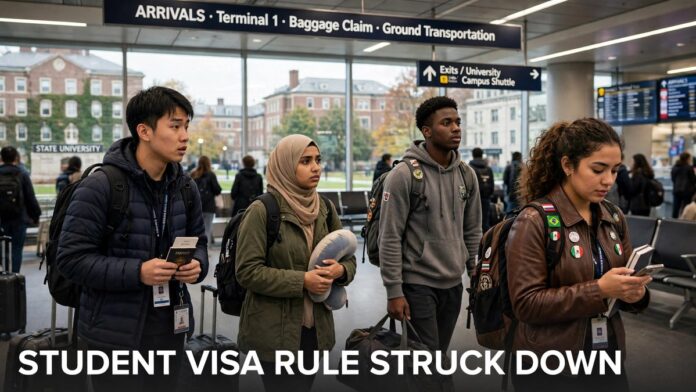
Duration of Status ruling on November 16, 2026, struck down the US government rule that would have ended Duration of Status for international students and exchange visitors, and nothing changes for F-1 and J-1 travellers today. The US District Court for the District of Massachusetts vacated the Department of Homeland Security’s final rule in its entirety, which means the longstanding Duration of Status framework stays in place, no fixed four-year admission limit takes effect, and no new extension-of-stay application is required. The government is expected to appeal, so the ruling is a win that still needs watching.
| Duration of Status: Before and After the Ruling | What Applies Now |
|---|---|
| Admission period for F-1 and J-1 | Duration of Status (D/S), for as long as the programme lasts and status is maintained |
| Fixed four-year cap | Vacated. No four-year maximum admission period applies |
| Extension of stay with USCIS | Not required. I-20 and DS-2019 extensions continue as before |
| OPT and STEM OPT | Unchanged. No new process or restriction from this rule |
| J-1 Academic Training | Unchanged |
| Risk of reversal | DHS is expected to appeal, and an appellate court could stay or overturn the ruling |
Duration of Status Ruling: What the Court Decided on November 16, 2026
Duration of Status ruling came from Judge F. Dennis Saylor IV, who granted summary judgment to a coalition of higher education and labour organisations and vacated the DHS final rule under the Administrative Procedure Act. The case, Presidents’ Alliance on Higher Education and Immigration v. US Department of Homeland Security, challenged the July 17, 2026, final rule titled “Establishing a Fixed Time Period of Admission and an Extension of Stay Procedure for Nonimmigrant Academic Students, Exchange Visitors, and Representatives of Foreign Information Media”. The court found the rule unlawful on two independent grounds: it was arbitrary and capricious, and its restrictions on F-1 academic mobility exceeded the department’s statutory authority.
The court also faulted the department for failing to consider whether better use of SEVIS, the student tracking system, could have addressed its stated concerns without replacing the whole framework. It rejected the government’s request to send the rule back to the agency without vacating it, noting that vacatur is the standard remedy under the Administrative Procedure Act and that the rule had never taken effect. The Yale Office of International Students and Scholars summary of the ruling and the MIT International Students Office notice both confirm the same bottom line: Duration of Status remains the current standard unless an appellate court intervenes.
What the Vacated DHS Rule Would Have Changed for F-1 and J-1 Students
The vacated DHS rule would have replaced Duration of Status with fixed admission periods of no more than four years, or the length of the academic programme if shorter, for F, J and I nonimmigrants. Students whose programmes ran longer would have needed to apply to US Citizenship and Immigration Services for an extension of stay, a process that did not exist under Duration of Status. The rule would also have imposed new limits on F-1 academic mobility, including restrictions on changing programmes and schools, and created additional extension requirements for J-1 exchange visitors and I media representatives.
For a PhD student in year five, or an undergraduate who changed major and needed an extra semester, the rule would have turned a routine academic decision into an immigration application with a deadline and a possible denial. That is why universities fought it so hard: the coalition that brought the case included NAFSA, the Presidents’ Alliance on Higher Education and Immigration, and several higher education and labour organisations, and the court had already blocked the rule with a nationwide preliminary injunction on September 14, one day before it was due to take effect on September 15.
Duration of Status Timeline: July Rule, September Injunction, November Vacatur
- July 17, 2026: DHS publishes the final rule replacing Duration of Status with fixed admission periods, scheduled to take effect September 15, 2026.
- September 14, 2026: The District Court for the District of Massachusetts issues a nationwide preliminary injunction blocking the rule one day before it takes effect.
- November 16, 2026: The court grants summary judgment and vacates the rule in its entirety under the Administrative Procedure Act. Duration of Status stays in place.
- November 17, 2026: A separate federal court order stays two August 2026 SEVP policy broadcasts restricting Curricular Practical Training, a second win for F-1 students in two days.
- Next: DHS is expected to appeal the November 16 judgment and may ask an appellate court to stay it while the appeal is heard.
Who the Duration of Status Ruling Affects: F-1 Students, J-1 Exchange Visitors and Their Families
Duration of Status ruling affects every F-1 student, J-1 exchange visitor and I media representative in the United States, plus their F-2, J-2 and I dependants. New and returning travellers in these categories continue to be admitted for Duration of Status rather than for a fixed date, and the processes for extending an I-20 or DS-2019, for OPT and STEM OPT, and for J-1 Academic Training all remain exactly as they were before the rule was published. Universities nationwide may continue to admit, enrol and advise F-1 and J-1 students under the regulations that applied before the final rule, whether or not they were plaintiffs in the case.
Also read – US Level 4 Travel Alert for Iran, Iraq, Lebanon and Syria: What Travellers Must Know
Travelling on an F-1 or J-1 Visa After the Duration of Status Ruling: 5 Checks Before the Next Trip
Travelling on an F-1 or J-1 visa after the Duration of Status ruling is business as usual, but the usual checks still matter, because an appeal could change the picture. Work through these five checks before the next trip abroad.
- Keep a valid travel signature: The I-20 or DS-2019 needs a valid travel signature from the international student office, generally valid for one year for continuing students and six months for students on OPT. Get it signed before leaving, not at the airport.
- Check the visa stamp, not just the I-20: Duration of Status governs the stay inside the United States, but re-entry needs a valid visa stamp. A student with an expired visa stamp must get a new one at a US consulate abroad before returning, and visa appointment availability should be checked early.
- Carry the standard documents: A valid passport, the signed I-20 or DS-2019, proof of enrolment or employment, and financial evidence. The NAFSA international educator guidance and university international offices publish the same document checklist, and it has not changed with this ruling.
- Watch the appeal, not the headlines: The November 16 decision is a final judgment, but DHS is expected to appeal. USCIS guidance for students and the US State Department student visa pages are the official sources to check if the appeal changes anything.
- Do not change plans on the ruling alone: The ruling removes a threat, it does not create a new benefit. Students should not extend a programme, change schools or book travel they would not otherwise have booked simply because the rule was vacated.
What Could Still Change After the Duration of Status Ruling: Appeal, Stay and the CPT Decision
What could still change after the Duration of Status ruling is the appeal, and students should understand the two ways it could bite. DHS could ask the Court of Appeals to stay the November 16 judgment while the appeal is heard, which would temporarily revive the fixed-term rule, or the appellate court could overturn the ruling outright. Either outcome would take months, and universities have said they will update their guidance if the legal framework changes. The separate November 17 order staying the SEVP Curricular Practical Training broadcasts is preliminary relief, not a final judgment, so it stands on weaker footing than the Duration of Status decision itself.
Bottom line for travellers: The Duration of Status ruling means F-1 and J-1 students keep the system they have used for decades, with no new forms, no four-year cap and no extension application. Travel as normal, keep the documents in order, and check the university international office if the appeal moves.

