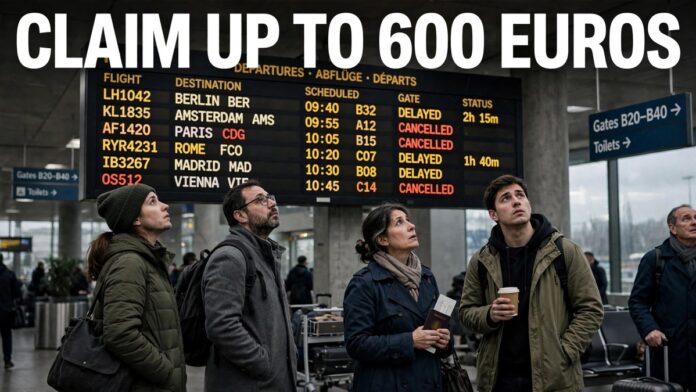
EU261 compensation pays a fixed cash sum of €250, €400 or €600 per passenger when a flight is delayed by three hours or more, cancelled at short notice, or when a passenger is denied boarding because the flight is overbooked. The amount depends only on the distance of the flight, never on the price of the ticket.
Most passengers who are owed this money never claim it. Some do not know the rule exists. Others accept a voucher at the gate, assume a rebooking settles everything, or give up after one ignored email. This guide explains exactly who qualifies, how much is owed, and how to file a claim step by step under Regulation (EC) No 261/2004, using the European Commission’s own guidance.
The rule has been in force since 2005, and in 2026 it still applies in full. A reform agreed by EU lawmakers in June 2026 keeps the three-hour threshold and the compensation amounts unchanged, so everything in this guide reflects the law as it stands today.
EU261 compensation at a glance
Who qualifies: any passenger with a confirmed booking who arrives at the final destination 3 hours or more late, whose flight is cancelled less than 14 days before departure, or who is denied boarding against their will.
How much: €250 for flights up to 1,500 km, €400 for intra-EU flights over 1,500 km and other flights between 1,500 and 3,500 km, €600 for all other flights.
How it is paid: in cash, by bank transfer or by cheque. The airline cannot force vouchers on a passenger.
What else is owed: meals, refreshments, two free communications and, if needed, a hotel and transport while waiting. This right to care applies even when compensation does not.
First step: claim in writing from the airline that operated the flight, then escalate to the national enforcement body if the airline does not answer or refuses.
EU261 compensation amounts: €250, €400 or €600 by flight distance
The compensation is fixed by law and worked out from the straight-line distance between the departure airport and the final destination. The ticket price makes no difference: a €29 ticket and a €900 ticket on the same flight attract the same payment.
| Flight distance | EU261 compensation | Example route |
|---|---|---|
| Up to 1,500 km | €250 | Madrid to Paris (about 1,050 km) |
| Intra-EU flights over 1,500 km | €400 | Lisbon to Warsaw (about 2,800 km) |
| Other flights between 1,500 and 3,500 km | €400 | London to Athens |
| All other flights (over 3,500 km) | €600 | Frankfurt to New York |
One reduction applies. On flights over 3,500 km, if the passenger arrives between 3 and 4 hours late, the airline may cut the payment by half, to €300. On shorter flights there is no such reduction.
Compensation is paid per passenger, so a family of four on the same delayed long-haul flight can be owed up to €2,400 between them. That is why it is worth claiming for every traveller on the booking, not just the person who paid.
Does EU261 compensation cover your flight?
EU261 compensation covers flights departing from any airport in the EU, whatever the airline. It also covers flights arriving in the EU from outside, but only when the flight is operated by an EU-licensed airline. Flights within the EU are covered regardless of the carrier.
The European Commission’s Your Europe air passenger rights guide sets out the scope plainly: EU means the 27 EU countries, and the same rules also apply to flights to and from Iceland, Norway and Switzerland. A passenger flying from New York to Paris on a non-EU airline, for example, is not covered by EU261, while the same route on an EU airline is.
Two points catch travellers out. First, the operating airline is the one that matters, not the airline that sold the ticket. A codeshare ticket bought from one carrier but flown by another is claimed from the operator. Second, the UK now runs its own separate scheme, known as UK261, after Brexit. It closely mirrors the EU rules, but claims for flights departing the UK fall under the UK system, not EU261.
Also read: IndiGo cuts Mumbai–Amsterdam flights: how to claim a refund, a worked example of what to do when a long-haul route is cut and a refund or rebooking is on the table.
The 3-hour EU261 compensation rule: how delay is actually measured
The delay that counts is the delay on arrival, not the delay at departure. A flight that leaves four hours late but makes up time in the air and lands two hours late does not trigger compensation. A flight that leaves on time, sits on the tarmac, and reaches the gate three hours late does.
Arrival time is the moment the aircraft reaches the gate and at least one door opens so passengers can get off. That is the official time, confirmed by the Court of Justice of the European Union, and guides to the three-hour delay rule stress the same point: the clock stops at the gate, not on touchdown. Note the time, photograph the gate display if possible, and keep any arrival notification the airline sends.
Missed connections count too. If the flights are on a single reservation and a delay on the first leg makes the passenger miss a connection, arriving at the final destination 3 hours or more late, compensation is owed for the whole journey. The distance is measured from the original departure airport to the final destination, not leg by leg.
Compensation for a delay is separate from the right to care. If a flight is delayed at departure by 2 hours (up to 1,500 km), 3 hours (intra-EU over 1,500 km and other flights between 1,500 and 3,500 km) or 4 hours (all other flights), the airline must offer meals, refreshments and two free communications, and a hotel with transport if the departure slips to the next day. If the delay reaches 5 hours, the passenger can choose a full ticket refund plus, where relevant, a return flight to the point of departure.
EU261 compensation for cancelled flights: the 14-day rule
If a flight is cancelled, compensation depends on how much notice the passenger received. When the airline informs the passenger more than 14 days before the scheduled departure, no compensation is owed, although the refund or re-routing choice still applies. When the passenger is informed less than 14 days before departure, compensation is owed unless the cancellation was caused by extraordinary circumstances.
The airline must prove if and when the passenger was personally informed of the cancellation. A message sent to an old email address, or a notice buried in an app the passenger never opened, does not automatically count.
A cancelled flight always gives the passenger a choice: reimbursement of the full ticket cost within seven days, re-routing at the earliest opportunity, or re-routing at a later date that suits the passenger. The airline cannot impose a voucher instead of a refund unless the passenger agrees. The Your Europe FAQ on air passenger rights confirms the seven-day refund deadline and that compensation has no separate payment deadline in the regulation itself, which is another reason to claim promptly and keep records.
A flight counts as cancelled not only when it never departs. It is also a cancellation when the original schedule is abandoned and the passenger is moved to another scheduled flight, or when the departure time is brought forward by more than one hour.
Denied boarding and overbooking: EU261 compensation still applies
A passenger who is denied boarding against their will because the flight is overbooked is entitled to compensation, a refund or re-routing, and assistance. The key words are “against their will”. A passenger who voluntarily gives up a seat in exchange for an airline offer, such as a voucher or a later flight, gives up the compensation claim in return.
Airlines overbook because a small number of passengers usually do not turn up. When too many do, the airline must first ask for volunteers. Only if nobody volunteers may it deny boarding to passengers, and those passengers keep the full set of EU261 rights.
The practical advice is simple. Do not accept a voucher at the gate without knowing what it is worth compared with the fixed compensation. €250 to €600 in cash is often worth more than a travel voucher with an expiry date and restrictions, and once a voluntary deal is accepted, the claim is gone.

Extraordinary circumstances: when EU261 compensation does not apply
Compensation is not owed when the disruption was caused by extraordinary circumstances that could not have been avoided even if all reasonable measures had been taken. The airline has to prove this, with evidence such as extracts from logbooks or incident reports, and it must give that evidence to the national enforcement body and to the passengers concerned.
Examples recognised by the European Commission include severe weather, air traffic management decisions, political instability and security risks. A volcanic ash cloud, a sudden airport closure or a strike by air traffic controllers can all qualify.
What does not automatically qualify is just as important. A routine technical fault is not automatically an extraordinary circumstance: the Court of Justice has ruled that ordinary maintenance and technical problems are part of running an airline. A strike by the airline’s own staff is also not automatically extraordinary. And even when circumstances genuinely are extraordinary, the right to care still applies: meals, a hotel and communications are owed regardless of the cause.
When an airline refuses a claim citing extraordinary circumstances, ask for the specific reason in writing. A one-line “operational reasons” reply is not evidence, and national enforcement bodies regularly overturn refusals where the airline cannot show what happened and what it did about it.
How to claim EU261 compensation in 6 steps
Step 1: confirm the arrival delay. Note the time the aircraft doors opened at the final destination, and keep screenshots of the flight status, delay notifications and any gate announcements.
Step 2: collect the documents. Keep the booking confirmation, boarding passes, baggage tags, receipts for food, hotels and transport, and every message from the airline about the disruption.
Step 3: ask for the reason in writing. At the airport, ask staff for the official cause of the delay or cancellation and get it in writing if possible. Ask for meal vouchers and a hotel if an overnight stay is needed.
Step 4: file the claim with the operating airline. Use the complaint or compensation form on the airline’s own website. Give the flight number, date, booking reference, what went wrong and the amount claimed. State the distance band and the figure: €250, €400 or €600.
Step 5: escalate if the airline does not answer. If the airline does not reply within two months, or the answer is unsatisfactory, escalate to the national enforcement body in the country where the disruption happened. The European Commission’s Your Europe portal lists the enforcement body for each country. For a cross-border flight, the European Consumer Centre in the passenger’s own country can also help.
Step 6: consider court or dispute resolution as a last resort. National enforcement bodies can investigate and take enforcement action, but they do not always order individual payments. If the claim is refused and the amount matters, a small-claims court or an approved alternative dispute resolution scheme is the final step. Many claims are settled before this point, once the airline sees a properly documented file.
One warning: compensation must be paid in cash, by bank transfer or by cheque. Do not accept vouchers as compensation unless the traveller genuinely prefers them, and never sign anything at the airport that waives the claim without reading it.
EU261 compensation time limits: why you should not wait
There is no single EU-wide deadline for claiming EU261 compensation. Time limits depend on the national law of each European country and vary across the EU, so a claim that is safe in one country can be time-barred in another. The European Commission advises passengers to check with the national enforcement body or a national consumer centre in the country concerned.
The practical rule is to claim as soon as the trip is over, while boarding passes, receipts and memories are fresh. Airlines also lose records over time, and a claim filed months later is harder to prove.
One change is coming. The Regulation (EC) No 261/2004 that underpins all of this dates from 2004 and has been in force since 2005. EU lawmakers agreed a reform in June 2026 that keeps the three-hour threshold and the compensation amounts, and once the reformed rules apply, expected in 2027, there will be a single nine-month window to file a claim with the airline. Until then, the current rules apply in full and the national time limits are what matter.
Also read: Norse Atlantic and Bamboo Airways stop flying: refunds and rebooking, for what happens when the airline itself stops operating and a normal EU261 claim meets an insolvency process instead.
EU261 compensation checklist: what to keep from the airport
Boarding passes and booking confirmation: the proof of the flight and the passenger’s identity on it.
Delay and cancellation messages: texts, emails and app notifications, with their times visible.
Arrival time evidence: a photo of the gate display or a screenshot of the flight status at arrival.
The airline’s written reason: ask gate staff for the official cause of the disruption in writing.
All receipts: meals, drinks, hotels, taxis and phone calls bought because of the disruption.
Names and times: the names of staff spoken to, and the times of every announcement.
EU261 compensation: three mistakes that cost passengers money
Myth: a cheap ticket means a small payout. False. EU261 compensation is fixed by flight distance, not by the fare paid. A €29 ticket on a delayed long-haul flight is worth the same €600 as a full-fare ticket.
Myth: being rebooked cancels the compensation. False. Re-routing is a separate right. A passenger who is rebooked and still arrives 3 hours or more late keeps the compensation claim, and a passenger who is rebooked on a flight the next day keeps the hotel and meals as well.
Myth: bad weather always blocks a claim. False. The airline must prove that the weather was genuinely extraordinary and that it took all reasonable measures. A routine weather delay at a hub airport, or a knock-on delay caused by the airline’s own earlier decisions, does not automatically qualify.
EU261 compensation is one of the strongest passenger rights in the world, and it is deliberately simple: fixed amounts, fixed distances, and a claim process that starts with a single form on the airline’s website. The passengers who get paid are the ones who keep their documents, ask for the reason in writing, and file the claim instead of letting it drift. Keep this guide bookmarked, and the next delayed flight becomes a claim worth filing rather than a story worth forgetting.

