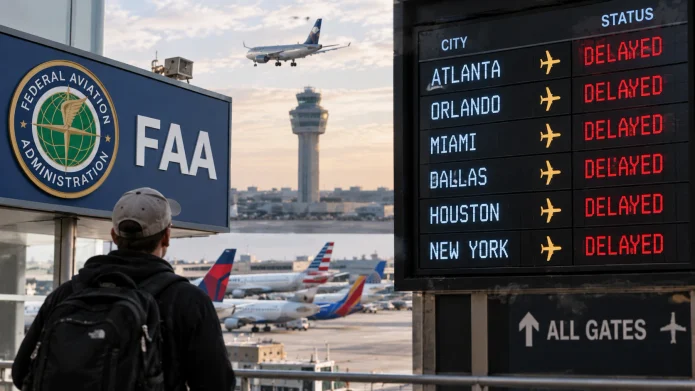
Travelers flying through several major U.S. airports should prepare for possible delays as thunderstorms, low clouds and strong winds affect different parts of the country.
The Federal Aviation Administration’s latest daily air traffic report identifies potential disruption at airports serving Atlanta, Charlotte, Florida, Dallas, Houston, New York, Philadelphia, Washington, Seattle, San Francisco and Las Vegas. The notice does not mean every flight will be delayed, but weather and air traffic restrictions may reduce the number of aircraft able to take off or land.
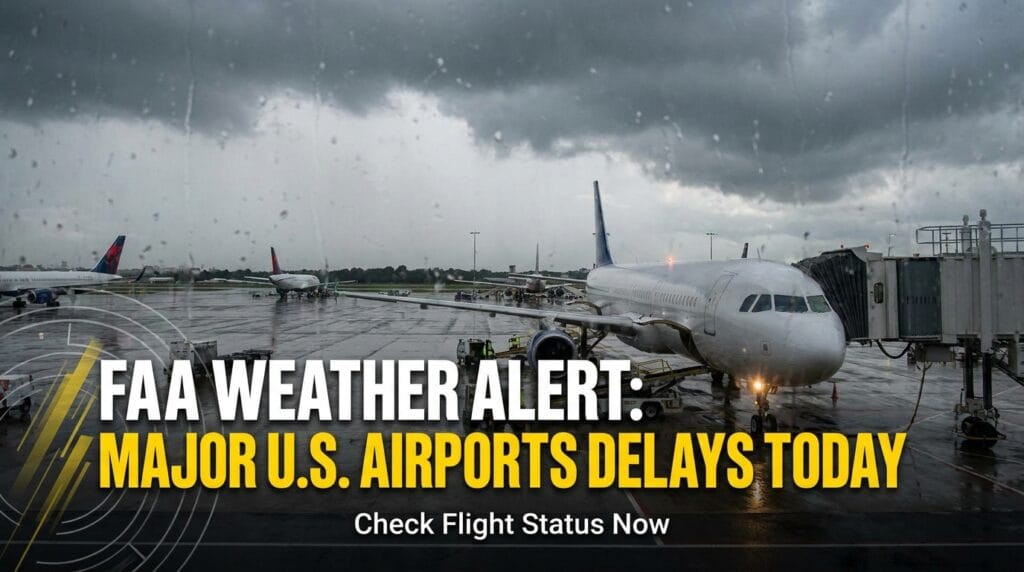
Passengers should check their airline’s app before leaving for the airport and continue checking it during the journey. The FAA says its report provides an operational outlook, while airlines provide the most relevant information for individual flights.
Which U.S. airports could face flight delays today?
The highest risk is linked to thunderstorms in the Southeast and Texas, low clouds in the Northeast and West Coast, and wind in Las Vegas.
| Area | Airports named by the FAA | Main concern |
|---|---|---|
| Georgia and the Carolinas | Atlanta (ATL), Charlotte (CLT) | Thunderstorms |
| Central and south Florida | Fort Lauderdale (FLL), Miami (MIA), Orlando (MCO), Tampa (TPA) | Thunderstorms |
| North Texas | Dallas/Fort Worth (DFW), Dallas Love Field (DAL) | Thunderstorms |
| Houston area | William P. Hobby (HOU), George Bush Intercontinental (IAH) | Thunderstorms |
| New York region | JFK, LaGuardia (LGA), Newark (EWR) | Low clouds |
| Philadelphia | Philadelphia International (PHL) | Low clouds |
| Washington, D.C. region | Reagan National (DCA), Dulles (IAD), Baltimore/Washington (BWI) | Low clouds |
| Pacific Northwest | Seattle-Tacoma (SEA) | Low clouds |
| Northern California | San Francisco International (SFO) | Low clouds |
| Nevada | Harry Reid International, Las Vegas (LAS) | Wind |
The FAA lists these conditions as possible causes of arrival or departure delays, ground stops and other traffic-management measures. Its daily report is a planning forecast, not a guarantee that a particular flight will be affected.
Why thunderstorms can delay flights even when the airport is open
Thunderstorms can slow airport operations because aircraft cannot safely fly through areas of heavy lightning, severe turbulence or strong wind.
When storms move near an airport, air traffic managers may:
- Reduce the number of aircraft allowed to approach
- Hold flights in the air or on the ground
- Reroute aircraft around storm cells
- Delay departures at the origin airport
- Temporarily stop arrivals or departures
- Send aircraft to alternate airports if conditions worsen
A flight can therefore be delayed even when the weather looks calm at the terminal. Storms may be several miles away but still affect arrival routes, departure paths or the wider airspace used by multiple airports.
This is especially important for passengers connecting through Atlanta, Dallas/Fort Worth, Miami, Orlando, Houston or Charlotte. A short delay on the first flight can become a missed connection if the connection time is limited.
What the FAA says about Atlanta, Charlotte and Florida flights
Atlanta and Charlotte are among the major airports listed for possible thunderstorm delays. Both are important connecting hubs, so disruption can spread beyond local routes.
Central and south Florida airports, including Miami, Fort Lauderdale, Orlando and Tampa, are also exposed to possible thunderstorm-related restrictions. A traveler flying from New York to Orlando, for example, could experience a delay before departure if the destination airport has limited arrival capacity.
The practical lesson is simple: check the status of both the departure airport and the destination airport. A flight may leave on time but arrive late because conditions change along the route or at the destination.
Travelers can monitor official air traffic information through the FAA airport status and delay information page. The FAA also directs passengers to its daily air traffic report and advises them to confirm flight-specific details with their airline.
Low clouds may affect New York, Philadelphia and Washington flights
The FAA forecasts low clouds around JFK, LaGuardia, Newark, Philadelphia, Reagan National, Dulles and Baltimore/Washington.
Low cloud cover can reduce visibility and limit the number of aircraft that can approach an airport at the same time. This creates a slower operating pace, particularly at busy airports where aircraft are already using tightly scheduled arrival and departure routes.
New York-area travelers should watch all three major airports—JFK, LGA and EWR—because airlines sometimes move passengers between airports or adjust aircraft schedules when one airport faces pressure.
Passengers traveling through the Washington region should also check whether their itinerary involves DCA, IAD or BWI. These airports serve different airlines and routes, so an alternative airport may not be a simple substitute.
What wind means for Las Vegas passengers
The FAA identifies wind as a potential concern at Las Vegas Harry Reid International Airport.
Strong or shifting winds can affect runway use, aircraft performance and the spacing between arrivals and departures. Wind does not always produce a dramatic airport closure; more often, it can create slower operations, changing runway assignments or late aircraft arrivals.
Travelers should pay attention to aircraft equipment and crew timing. A plane arriving late from another city may be delayed again if wind or air traffic restrictions slow the next departure.
How to check whether a flight is actually delayed
The FAA report provides a broad national picture, but the airline remains the best source for a passenger’s individual flight.
Use this order:
- Check the airline app or website. Look for the flight number, aircraft status and estimated departure time.
- Check the airport’s official status information. This can show wider operating conditions.
- Review the FAA’s live operations information through fly.faa.gov.
- Check the connecting airport, not just the airport where the journey begins.
- Look again before leaving home. Weather-related decisions can change quickly.
- Keep notifications enabled so gate changes and rebooking messages are not missed.
The FAA also points aviation users toward the Aviation Weather Center’s Graphical Forecasts for Aviation tool, which provides weather information used for aviation planning. It is more detailed than most leisure travelers need, but it can help explain why a route is being altered.
What passengers should do before going to the airport
Arrive with enough time for check-in, security and possible gate changes, but avoid rushing to the airport hours earlier than necessary without checking the airline first. A long wait at the terminal will not solve a weather delay and may make it harder to respond if the airline changes the booking.
Keep these items accessible:
- Phone charger or power bank
- Prescription medication
- Identification and travel documents
- A small amount of food and water after security
- Details of the next available flights
- Hotel or ground-transport information if an overnight delay is possible
Passengers with tight connections should speak with the airline before boarding if the first flight is already delayed. Ask what alternatives are available and whether the airline can protect the connection on a later flight.
What travelers should not assume
A weather warning does not automatically mean a flight will be canceled. It may operate normally, depart late or arrive late depending on the storm’s location and movement.
Travelers should also avoid relying only on flight-tracking apps or airport display boards. Those tools can lag behind airline updates, especially during rapidly changing weather. The most useful combination is the airline’s direct notification system, the FAA’s operational information and the airport’s own updates.
The FAA report is also not a promise that delays will occur at every listed airport. It is an expectation of possible effects on normal air traffic operations and is subject to weather, staffing, equipment and other changing conditions.
The most important takeaway for today’s flights
Passengers using Atlanta, Charlotte, Florida, Dallas, Houston, New York, Philadelphia, Washington, Seattle, San Francisco or Las Vegas airports should prepare for possible schedule changes.
The best approach is to:
- Check the airline before leaving home
- Allow extra time for connections
- Monitor both departure and arrival airports
- Keep essential items in carry-on baggage
- Use official FAA and airline updates
- Avoid making non-refundable ground-transport plans until the flight is confirmed
For the latest official updates, follow the FAA daily air traffic report, check live FAA air traffic operations, and monitor the agency’s official news and alerts on X. The FAA specifically reminds travelers that airlines provide the final flight-specific delay information.

