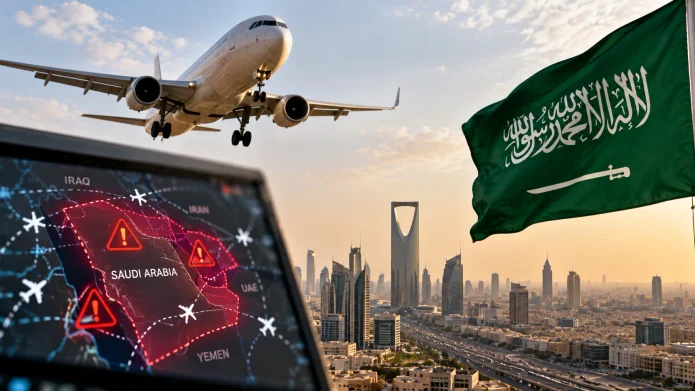
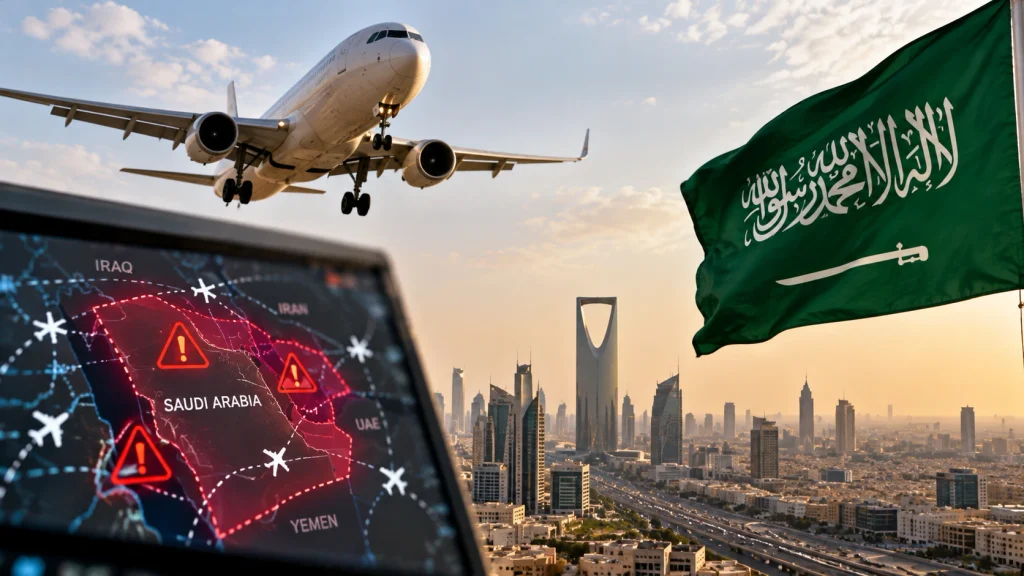
To fly safer during the current Saudi Arabia airspace disruptions, you must re-route your connections away from Riyadh, monitor real-time airspace warnings, and book daytime flights with carriers that bypass northwestern flight corridors. The aviation security environment changed drastically over the October 10-11 weekend after deadly strikes hit major transit hubs.
Why Are Flights Currently Disrupted in Saudi Arabia?
Flights are facing massive cancellations because Houthi rebels launched fatal drone and missile strikes on Riyadh’s international airport, killing 13 people and injuring over 300. These attacks forced civilian airport operations to halt immediately to prevent further mass casualties.
The Federal Aviation Administration (FAA) issued an urgent Notice to Airmen (NOTAM) ordering all US airlines to exercise extreme caution. The agency cited active military operations and severe navigation system interference as primary threats to passenger jets at all altitudes. This critical safety directive remains fully active until at least December 10, 2026.
The European Union Aviation Safety Agency (EASA) expanded its own airspace warnings, explicitly advising commercial airlines to avoid the northwestern regions of Saudi Arabia entirely. Air defense systems actively intercepting incoming missiles create a high risk of falling military debris striking commercial aircraft. Furthermore, active electronic warfare significantly increases the danger of a passenger jet being misidentified by military radar.
Which Major Airlines Are Canceling Routes?
Multiple international carriers immediately halted operations into Riyadh to protect their passengers and crew from incoming fire. The Lufthansa Group, Etihad Airways, and flydubai proactively canceled dozens of scheduled flights into the Saudi capital and surrounding airports like Abha and Yanbu.
If you hold a ticket on a regional carrier, you must log into your booking portal daily to check for unannounced groundings. Airlines will not fly civilian aircraft into an active interception zone, meaning sudden cancellations at the boarding gate are highly likely until the security environment stabilizes.
Also read – Russia Plague Scare: Check US Travel Warnings and Rules
How to Rebook Your Flight Safely
You must actively manage your flight itinerary to avoid the highest-risk geographical zones rather than relying on automated airline systems. Never assume your airline will automatically optimize your route for safety over fuel efficiency when crossing active conflict zones.
Follow these specific fixes to secure a safer flight path:
- Avoid Riyadh layovers: Reroute your connecting flights through safer neighboring hubs like Doha or Dubai instead of King Khalid International Airport.
- Demand a cash refund: If your flight is canceled due to airspace closures, demand a full cash refund rather than accepting a voucher, allowing you to rebook on a safer European carrier.
- Monitor official advisories: Check the U.S. Department of State travel advisory dashboard 24 hours before your departure for sudden “Do Not Travel” escalation notices.
- Use offline navigation: Download offline GPS maps to your smartphone, as regional military jamming frequently disrupts commercial satellite navigation systems.
Strict Ground Security Rules for Passengers
Landing safely in Saudi Arabia is only the first step; you must maintain strict operational security while inside the country. The US government currently enforces a Level 3 “Reconsider Travel” advisory due to the relentless threat of cross-border terrorism and drone strikes. American citizens and government employees are strictly forbidden from traveling within 20 miles of the Yemen border.
If your flight successfully lands, avoid lingering inside the airport terminal. Move directly to your secure hotel and avoid large public gatherings, as terrorist groups explicitly target transportation hubs and heavily populated venues. The U.S. Embassy in Saudi Arabia strongly advises all expats and tourists to maintain a concrete emergency evacuation plan that does not rely on commercial airport operations.
What to Do If You Are Stranded at the Airport
You must act quickly to secure local accommodation if a sudden drone strike forces air traffic control to ground your flight while you wait at the gate. Do not wait in line at the customer service desk with hundreds of panicked passengers. Immediately open your airline’s mobile application to initiate the rebooking process while calling the international support number.
Because these disruptions are classified as acts of war or terrorism, standard travel insurance policies invoke “force majeure” clauses. This means the airline is not legally required to pay for your emergency hotel room or meals during the delay. You must have access to emergency funds on a secure credit card to cover unexpected lodging costs if the airport suspends operations for several days.
Comparing High-Risk vs. Safer Transit Zones
Understanding exactly which regions are currently under attack helps you plan a safer alternative route.
| Travel Zone | Current Threat Level | Required Passenger Action |
| Riyadh (King Khalid Airport) | Extreme Risk (Active Strikes) | Avoid completely; rebook connections |
| Northwestern Airspace | High Risk (Falling Debris) | Ensure your airline routes around this zone |
| Yemen Border (Within 20 miles) | Do Not Travel (Armed Conflict) | Strictly forbidden for US personnel |
| Eastern Gulf Hubs (Doha/Dubai) | Moderate (Standard Security) | Safest alternatives for regional transit |

