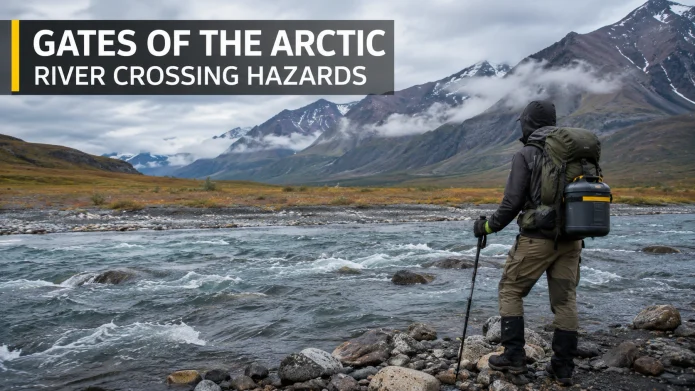
Gates of the Arctic National Park contains zero trails, zero roads, and zero mobile phone service. If you are planning a backpacking trip into this 8.4-million-acre Alaskan wilderness, your biggest threats are not just grizzly bears, but fast-moving freezing rivers and sudden hypothermia. The National Park Service (NPS) explicitly warns that independent trekkers must possess elite wilderness navigation skills and carry specialized survival gear long before a bush pilot drops them off on the remote tundra.
How to Safely Cross Arctic Rivers Without Drowning
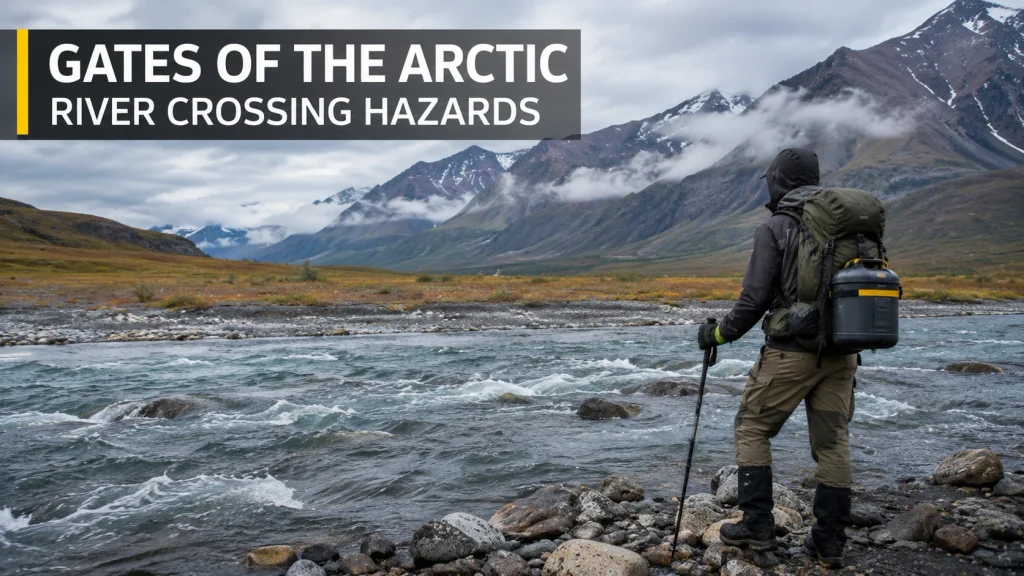
Water crossings represent the single highest cause of injury and fatality in the Brooks Range. The water flowing down from the northern mountains remains barely above freezing year-round, and the riverbeds contain incredibly slick, shifting glacial rocks that easily trap boots.
You must never cross a braided arctic river barefoot. Bring dedicated, closed-toe water shoes that aggressively grip wet stones to protect your toes from getting crushed by rolling boulders. Before stepping into the rushing current, immediately unbuckle your heavy backpack’s waist belt and chest strap. If you slip and fall into the rapids, a buckled 60-pound backpack will instantly drag you underwater and trap you against the river bottom.
The U.S. Geological Survey (USGS) monitors regional hydrology and notes that glacial rivers flow fastest and deepest in the late afternoon due to accumulated daily snowmelt. You should always set up your camping tent near the riverbank at night and attempt your physical crossing early the next morning when the water levels naturally drop to their lowest point.
Also read – 35 Off the Beaten Path Places to Visit in the USA
Why 6 Miles is a Full Day of Hiking in the Brooks Range
You cannot calculate your hiking itinerary using standard trail mileage because designated dirt paths simply do not exist in this park. Backpackers must navigate purely by using a physical topographic map and compass through dense alder thickets, deep valley bogs, and miles of exhausting tussocks. Tussocks are highly unstable, bowling-ball-sized mounds of grass sitting in freezing mud that easily twist ankles and destroy knee joints.
Experienced Alaskan wilderness guides consider six miles of forward progress a completely successful, deeply exhausting ten-hour day. Do not plan a 15-mile daily route. Pushing for high mileage over this rugged terrain will instantly force you behind schedule, exhaust your calorie reserves, and compromise your pre-arranged floatplane pickup date.
Mandatory Bear-Resistant Food Canisters and Tundra Storage
Grizzly bears and black bears roam the entirety of the park, requiring you to physically protect every single piece of scented gear, from freeze-dried meals to toothpaste. Park management mandates the use of Interagency Grizzly Bear Committee (IGBC) approved Bear Resistant Food Containers (BRFC) for all backcountry camping. Hanging your food bag from a tree is physically impossible here, as the vast majority of the park sits entirely above the tree line where no tall timber grows.
The Alaska Department of Fish and Game (ADFG) advises trekkers to cook, eat, and store all provisions at least 100 yards downwind from their sleeping tents. You can borrow a certified bear canister entirely for free at the Fairbanks Alaska Public Lands Information Center or the local ranger stations, provided you wash it out before returning it.
Critical Gear Checklist to Prevent Sudden Hypothermia
Summer temperatures in the Arctic Circle frequently plummet below freezing, and massive snowstorms routinely hit the Brooks Range in the middle of July. Hypothermia kills significantly faster than wildlife, especially if you get trapped in a multi-day freezing rainstorm without the correct insulation layers.
Your backpack must contain gear designed specifically for extreme, wet conditions.
| Essential Survival Item | Core Purpose in Gates of the Arctic | Danger of Forgetting It |
| Satellite Messenger | The only way to contact a bush pilot or call for an emergency rescue. | Total isolation during a severe medical crisis. |
| Synthetic Sleeping Bag | Retains physical body heat even when soaked by a freezing rainstorm. | Down sleeping bags lose 100% of their warmth when wet. |
| DEET and Headnet | Blocks massive, relentless swarms of arctic mosquitoes and biting flies. | Severe psychological distress and physical facial swelling. |
| Water Filter System | Purifies giardia and bacteria from clear streams and glacial runoff. | Debilitating intestinal illness miles from civilization. |
Checking Ranger Station Seasonal Closures Before You Fly
You cannot assume a physical ranger station will be open when you arrive at the edge of the wilderness boundary. The Bettles Ranger Station, the Anaktuvuk Pass Ranger Station, and the Coldfoot visitor centers operate on strict seasonal schedules and completely shut down their physical operations during the harsh, dark winter months.
Always call the main Fairbanks headquarters directly to file your backcountry itinerary before flying into the bush. If you break your leg on a remote mountain ridge, the Alaska State Troopers rescue coordination center will only know where to send a recovery helicopter if your exact flight route and expected pickup coordinates sit securely on a ranger’s desk in the city.

