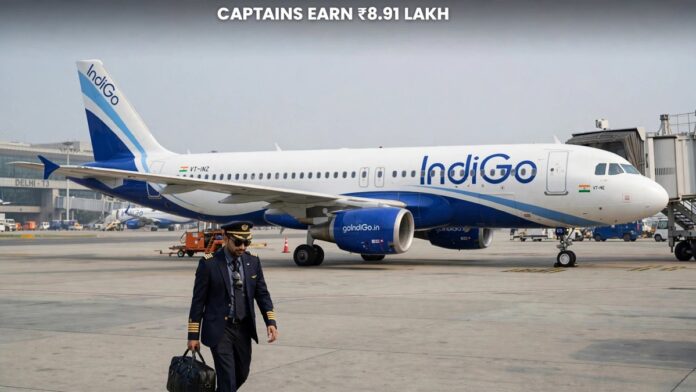
IndiGo pilot salary in 2026 runs from ₹2.67 lakh a month for a newly released first officer to ₹10.5 lakh a month for a type rating instructor, on a 70-hour committed monthly CTC. But the first fact any reader needs is the one most salary posts bury: IndiGo does not publish an official pay scale, so every figure in this guide is a reported 2026 range drawn from the airline’s reported internal compensation structure, not an IndiGo press release.
That distinction matters more than the numbers themselves. IndiGo is India’s largest carrier by market share and fleet size, and the single biggest employer of commercial pilots in the country, so its pay bands set the benchmark every other Indian airline is measured against. The figures below come from the airline’s reported internal Airbus Compensation Structure slide, as published by Pilots Academy and cross-checked against Flying Star Aviator’s 2026 guide, which labels them reported rather than officially verified. Treat them as the best available picture of what IndiGo pilots earn, not as a promise printed on an IndiGo letterhead.
IndiGo Pilot Salary 2026: The Full Pay Table by Rank
The IndiGo pilot salary table below is the heart of this guide. Pay rises in steps tied to total flying hours logged and to rank, not to annual appraisals. Crossing 1,000 hours lifts a first officer’s pay, crossing 2,500 hours as a captain lifts it again, and the training roles above senior captain pay more still.
| Rank | Monthly CTC (70-hour committed) | Annualised CTC |
|---|---|---|
| First Officer (under 1,000 hrs) | ₹2.67 lakh | About ₹32 lakh |
| First Officer (over 1,000 hrs) | ₹3.37 lakh | About ₹40 lakh |
| Senior First Officer | ₹4.85 lakh | About ₹58 lakh |
| Captain (under 1,000 PIC hrs) | ₹8.15 lakh | About ₹98 lakh |
| Captain (over 1,000 PIC hrs) | ₹8.42 lakh | About ₹1.01 crore |
| Senior Captain (over 2,500 PIC hrs) | ₹8.91 lakh | About ₹1.07 crore |
| Line Training Captain (LTC) | ₹9.77 lakh | About ₹1.17 crore |
| Type Rating Instructor (TRI) | ₹10.5 lakh | About ₹1.26 crore |
Two features of the table deserve attention. First, the jump from senior first officer to captain is the single biggest leap in an Indian pilot’s career: monthly CTC rises from ₹4.85 lakh to ₹8.15 lakh, an increase of more than two-thirds, and it is the moment a pilot moves from the right-hand seat to the left-hand seat as pilot-in-command. Second, the gap between a junior first officer and a senior captain is more than threefold, from ₹2.67 lakh to ₹8.91 lakh, which is why the early years feel so different from the later ones. The figures are CTC, cost to company, and they assume the airline’s 6E Prime structure with 30 days of privilege leave, as reported by Pilots Academy.
An independent cross-check supports the same shape. BeAPilot’s 2026 guide puts IndiGo first officers at roughly ₹1.8–3.5 lakh a month depending on hours flown, captains at roughly ₹6–8 lakh and up, and the most senior captains above ₹1 crore a year. The ranges are wider than the table above because BeAPilot reports indicative bands across different rosters and flying hours, while the table reports the committed 70-hour CTC. Both sets of numbers point the same way: a first officer earns a solid professional salary, and a captain earns more than a crore a year.
How the IndiGo Pilot Salary Is Built: The 70-Hour Committed CTC Explained
IndiGo’s pay structure is the outlier among India’s big carriers, and understanding it is the key to reading the table correctly. Instead of a 40-hour fixed-pay base topped up with an hourly flying allowance, IndiGo commits to a monthly CTC benchmarked directly against 70 hours of flying. The CTC bundles fixed pay and the committed flying component at 70 hours into a single figure, so the headline number already assumes a full flying month.
That has two consequences readers should grasp. First, a pilot who flies beyond 70 hours in a month earns extra hourly pay on top of the committed CTC, so a busy peak-season roster pays more than the table shows. Second, comparing IndiGo’s figures with another airline’s fixed pay is misleading unless the hours are matched: Air India and Akasa Air quote fixed pay at 40 hours and add flying allowance separately on top, so their headline numbers look lower for the same flying month. As Pilots Academy puts it, comparing the three carriers fairly means comparing projected pay at the same flying hours, not the headline fixed-pay number alone.
Beyond the committed hours, IndiGo pilots receive night-stop and layover allowances for nights spent away from base, which Flying Star Aviator lists as part of the standard package alongside the 70-hour CTC. The airline operates Airbus A320 and A321 aircraft on its mainline network and ATR turboprops on regional routes, and fleet assignment affects rosters, layover patterns and therefore the allowances a pilot actually collects. Take-home pay also moves with the pilot’s leave choices: opting for standard leave rosters or buying back additional privilege leave changes the monthly figure, as does seasonal roster utilisation and international short-haul layovers.
There is also a retention sweetener that sits outside the monthly CTC entirely. IndiGo runs a longevity payout for pilot-in-command worth an additional ₹15 lakh paid out over five years, effectively a retention incentive layered on top of monthly CTC for captains who stay with the airline long term. Spread evenly it is worth about ₹25,000 a month, but its real purpose is different: it rewards captains who do not leave for a rival or a Gulf carrier, and it is one of the reasons senior captains think twice before moving.
IndiGo Pilot Salary vs Air India and Akasa Air: What the Comparison Really Shows
No salary guide is complete without the comparison readers actually search for, but the comparison needs its hour bases stated honestly, or it misleads. The table below uses the same 2026 sources, with each airline’s own benchmark hours shown so the numbers can be judged fairly.
| Airline | First Officer (monthly) | Captain (monthly) | Pay basis |
|---|---|---|---|
| IndiGo | ₹2.67–₹4.85 lakh CTC | ₹8.15–₹8.91 lakh CTC | 70-hour committed CTC |
| Air India Express | ₹2.35–₹3.45 lakh | ₹7.50–₹8.50 lakh (Sr Commander) | Fixed pay at 40 hrs, plus hourly allowance |
| Akasa Air | ₹2.60 lakh fixed (₹3.21 lakh at 60 hrs) | ₹5.50–₹6.25 lakh fixed (₹7–₹9.60 lakh at 60–80 hrs) | Fixed pay at 40 hrs, plus hourly allowance |
The honest reading is that IndiGo’s numbers look higher at every rank on paper, largely because its CTC already assumes 70 hours of committed flying baked into the base figure, while Air India Express and Akasa quote fixed pay at 40 hours and add flying allowance separately. At 60 to 80 flying hours, Akasa’s projected captain pay reaches ₹7–9.60 lakh a month, which closes much of the gap with IndiGo’s ₹8.15–8.91 lakh. The real differences between carriers are therefore smaller than the headlines suggest, and hiring cycles, fleet growth, base locations and upgrade speed matter at least as much as the pay table when a pilot chooses an airline.
One difference does survive the adjustment: IndiGo’s scale and growth. As India’s largest carrier by market share and fleet, it is the single biggest employer of commercial pilots in the country, which means more command vacancies opening each year and a faster route to the left-hand seat when aircraft deliveries are running on schedule. That is a career argument, not a salary argument, but for a pilot weighing two offers it is often the deciding one.
The IndiGo Pilot Career Path: From First Officer to Training Captain in Six Steps
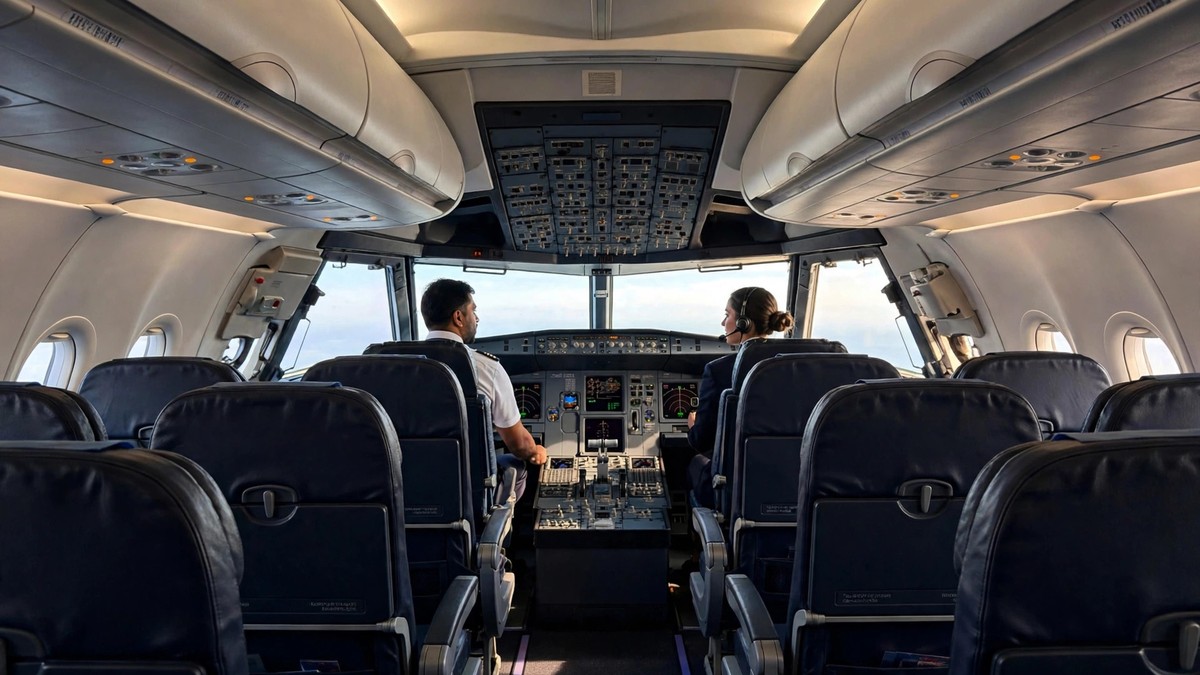
The road to the top of the pay table is long, and the salary at each step is tied to hours logged, licences held and vacancies available. The six stages below show how a pilot climbs from training to the ₹10.5 lakh TRI tier.
- Earn the Commercial Pilot Licence. A DGCA CPL qualifies a pilot to fly light single- and multi-engine aircraft, with roughly 200 hours of total flying time. On its own it does not guarantee an airline job: scheduled airlines operate multi-crew jets that require an aircraft-specific type rating, typically on the Airbus A320 family for IndiGo.
- Complete the type rating and airline training. During ground, simulator and line training, trainees typically receive a stipend of around ₹50,000 a month before stepping up to line pay. A type rating itself typically costs ₹15–25 lakh, according to BeAPilot, and is often funded by a loan or a training bond.
- Get released as a first officer. Once simulator checks and supervised line flying are complete, the pilot is released to the line as a junior first officer on about ₹2.67 lakh a month CTC. Crossing 1,000 flying hours lifts pay to ₹3.37 lakh, and the first years are about building hours and clearing the ATPL, the advanced licence that is mandatory to become pilot-in-command.
- Become a senior first officer. With an unfrozen ATPL, earned after 1,500 total flying hours, a pilot becomes a senior first officer on ₹4.85 lakh a month CTC. This is the waiting room for command: the pilot holds the licence but needs a command vacancy and a pass at the airline’s internal command upgrade board.
- Upgrade to captain. Command is the big jump, from ₹4.85 lakh to ₹8.15 lakh a month, and it typically takes six to twelve years from joining, depending on fleet growth and delivery schedules. During rapid fleet induction a first officer can reach command in five to six years; during slowdowns the same upgrade can take eight to ten.
- Move into training roles. Senior captains with more than 2,500 pilot-in-command hours earn ₹8.91 lakh, and those who qualify as line training captains or type rating instructors reach ₹9.77 lakh and ₹10.5 lakh a month. These roles also carry the longevity payout, worth an extra ₹15 lakh over five years for pilots-in-command who stay.
Promotion timelines are never guaranteed, and that is the warning every source in this guide repeats. Vacancies depend on aircraft deliveries and attrition, not just on a pilot’s eligibility, so two pilots who join in the same batch can reach command years apart.
What IndiGo Pilots Actually Take Home: Tax, Allowances and the CTC Trap
The most common mistake in reading any Indian pilot salary figure is confusing CTC with take-home pay. Every figure in the table above is CTC before income tax, which bundles fixed pay, the committed flying component and the employer side of provident fund and gratuity. Income tax comes off what is left, and all Indian airline salaries are subject to statutory income tax deductions, as Flying Star Aviator notes. The monthly bank credit is therefore lower than the CTC figure, sometimes materially so.
Two quiet deductions shrink early pay in particular. First, loan EMIs: if a pilot borrowed for training, a large EMI comes out first, and it can absorb most of a junior first officer’s take-home pay in the first year or two. Second, the type rating bond: some airlines deduct bond repayments from early salary, which further reduces what reaches the account. BeAPilot puts it bluntly: the honest question is not what a captain earns, but what a pilot will take home in year one, minus the EMI.
On the other side of the ledger, allowances paid on top of CTC soften the picture. Night-stop and layover allowances, extra hourly pay beyond 70 hours, and the longevity payout all add to the monthly figure, and international short-haul layovers can be worth a meaningful sum across a busy roster. The practical advice for anyone comparing offers is to compare like with like: CTC against CTC at the same flying hours, then add the allowances, then subtract the tax and the EMI. Only that final number is the salary that matters.
Also read: Qatar Airways Pilot Salary 2026: Captain and First Officer Pay
Is the IndiGo Pilot Salary Worth the Training Cost? A Checklist Before Applying
The long-run earning potential is high, but the early years are lean and the upfront cost is large, and that trade-off is the decision this guide exists to inform. A captain earning ₹8.15–8.91 lakh a month is a real destination, yet it arrives after six to twelve years, a type rating costing ₹15–25 lakh, and several years on ₹2.67–3.37 lakh a month while a training loan is being repaid. Anyone weighing the career should run the numbers honestly before committing.
- Check the current openings first. IndiGo lists pilot and cadet vacancies on its careers portal, which is the only place to confirm what the airline is actually hiring for right now. IndiGo does not publish a pay scale there, so do not expect salary figures on the application pages.
- Model year-one take-home, not captain pay. Start from the ₹2.67 lakh junior first officer CTC, subtract income tax and any training loan EMI, and ask whether the remainder covers living costs for two years.
- Ask which hours the offer assumes. Confirm the pay is the 70-hour committed CTC and what the hourly rate is beyond 70 hours, since a quiet roster month pays less than the table.
- Weigh upgrade speed against headline pay. A slightly lower-paying airline with faster command upgrades can be worth more over a career than a higher first officer salary with a long wait for the left-hand seat.
- Compare with the Gulf alternative. International captains at Emirates, Qatar Airways and Etihad can earn up to three times Indian pay, tax free, which is why many Indian captains eventually look abroad. The trade-off is leaving the Indian seniority system behind.
For readers weighing that Gulf move, the comparison is instructive: Emirates cabin crew pay and allowances for 2026 show how the same tax-free structure works at the other end of the aircraft, and how much of a Gulf package sits in housing and schooling rather than in cash salary. The lesson carries over to pilots: compare take-home cash with take-home cash, not one airline’s package with another’s basic salary.
The bottom line on the IndiGo pilot salary is the one the reported figures support: a newly released first officer earns about ₹2.67 lakh a month, a senior first officer ₹4.85 lakh, a captain ₹8.15–8.42 lakh, a senior captain ₹8.91 lakh, and a type rating instructor ₹10.5 lakh, all as 70-hour committed CTC before tax, with night-stop and layover allowances and a ₹15 lakh longevity payout on top. It is a strong professional salary that rewards patience, hours and seniority, and it starts with two lean years that every aspiring pilot should plan for before signing up.

