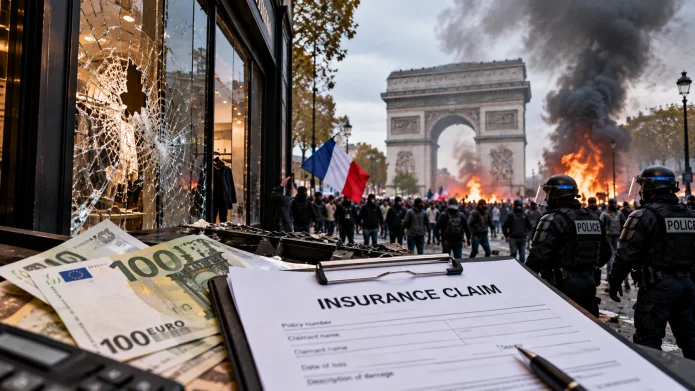
Insurance companies face a staggering €1.2 billion bill following severe nationwide riots across France in late October 2026. What began as public protests over living costs escalated rapidly into widespread arson, looting, and street violence. Financial analysts at Morningstar DBRS confirm this event will severely impact property and casualty earnings for the year, marking it as one of the most expensive civil unrest incidents in modern European history.
Which Businesses and Cities Suffered the Most Damage?
The riots physically damaged or completely destroyed at least 3,000 businesses across major urban centers like Paris, Marseille, and Limoges. Rioters specifically targeted high-end retail locations, smashing storefronts for luxury brands including Louis Vuitton, Hermès, Kenzo, Sephora, JD Sports, and Apple. While burned vehicles generated thousands of individual insurance claims, commercial property destruction accounts for the vast majority of the financial losses.
Rioters did not restrict their attacks to private businesses; they also heavily targeted public infrastructure. Arsonists severely damaged the town hall in Limoges and torched dozens of municipal vehicles. Historical data from previous unrest shows that damage to government buildings typically accounts for over 25 percent of the total national riot costs.
Comparing the 2026 Riots to Previous French Unrest
Historical data clearly shows that civil unrest in France is becoming increasingly destructive and expensive for local property owners. The official France Assureurs federation noted that the 2023 unrest cost roughly €793 million, which was already a massive spike compared to older protests.
| Protest Event | Year | Estimated Insured Losses |
| Suburban Riots | 2005 | €200 Million |
| Gilets Jaunes | 2018-2019 | €220 Million |
| Summer Riots | 2023 | €793 Million |
| October Protests | 2026 | €1.2 Billion (Projected) |
Also read – Which Underrated European Destinations Offers Luxury in Less Cost …
Why Standard Insurance Policies Are Facing a Breaking Point
The €1.2 billion payout tests the absolute limits of traditional property insurance networks across Europe. France recently passed legislation to create a mandatory state-backed riot insurance pool run by the public reinsurer CCR, but that system is not yet active. Because the government backstop remains offline, primary insurance companies must absorb this massive financial shock entirely on their own.
These domestic carriers will eventually pass the heavy financial burden onto global reinsurance markets and specialty political violence funds located in London. For foreign investors and US multinationals operating retail spaces inside France, this event serves as a strict warning to audit their current commercial property policies immediately.
How the French Government and Insurers Are Responding
The French government is actively intervening to prevent mass bankruptcies among targeted small business owners. French Finance Minister Roland Lescure announced direct state support measures, while the government promised a partial unemployment fund for staff unable to return to work. The Ministry of the Economy and Finance is holding emergency meetings with banking federations to ensure damaged retail locations can secure rebuilding loans quickly.
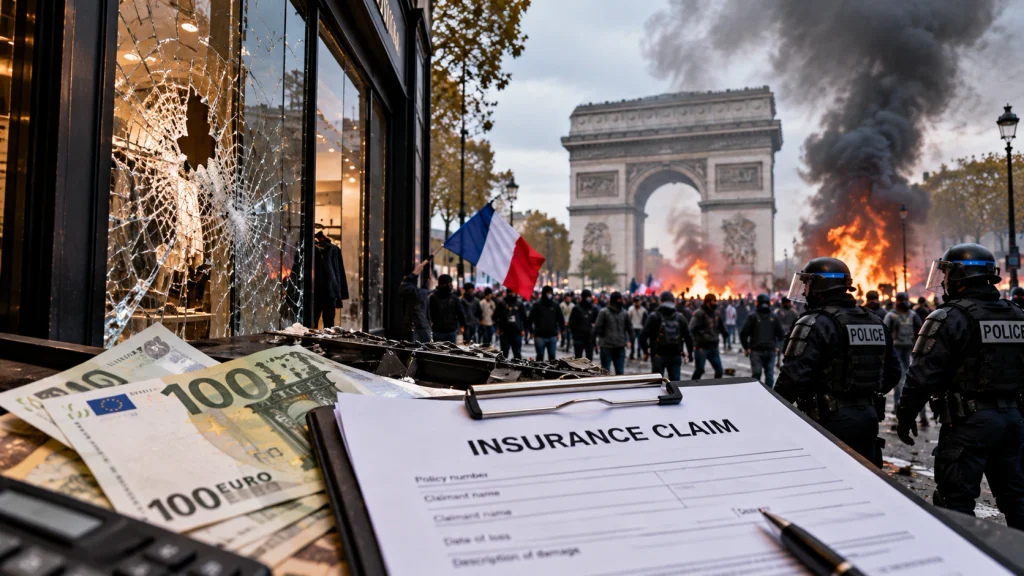
Steps for Business Owners to File a Riot Insurance Claim
Major insurance carriers like Axa and BPCE Assurances officially extended their standard 5-day claim reporting deadline to a full 30 days to help overwhelmed victims.
Property owners must act precisely to secure their compensation under this extended window:
- Document everything immediately: Take extensive photographs and high-resolution videos of all shattered glass, burned inventory, and structural damage before touching or sweeping anything.
- File a formal police report: You must submit a formal criminal complaint at your local police station to prove the damage resulted directly from public riots rather than standard vandalism.
- Submit within 30 days: Contact your insurance broker directly and submit your preliminary claim paperwork before the extended 30-day grace period expires.
- Secure the premises: Board up broken windows and doors immediately to prevent secondary looting, and save all contractor receipts for these emergency repairs to hand to your claims adjuster.
Property owners should constantly monitor local safety alerts through the European Commission and local prefectures to ensure their specific neighborhoods are completely secure before sending construction crews to begin repairs.

