Italy faces a nationwide general strike on Friday 4 December 2026, and the rail stoppage starts the night before. Trains stop from 21:00 on Thursday 3 December to 21:00 on Friday 4 December. That 24-hour window is the part to plan around, because a Friday train that looks fine on the timetable may not run at all.
We checked the strike times against the ministry calendar — rail stops 21:00 Thursday to 21:00 Friday, and that is the window to plan around.
The strike is called by grassroots unions including CUB, SGB and SI-COBAS, and it covers rail, air, local transport, ferries and motorway staff. It falls on the Friday before the Immacolata long weekend on Tuesday 8 December, so the trains and flights around it are already busy. A cancelled Friday train pushes displaced passengers onto Saturday flights that were already full.
Italy Strike: what stops, and when
The strike times differ by sector, and the rail time is the one that matters most for travellers.
| Sector | Times | What happens |
|---|---|---|
| Rail | 21:00 Thu 3 Dec – 21:00 Fri 4 Dec | Most trains stop; guaranteed trains only. |
| Motorways | 22:00 Thu 3 Dec – 22:00 Fri 4 Dec | Motorway staff walk out. |
| Local transport | Announced city by city | Each operator sets its own guaranteed bands. |
| Air | Times not yet published | Protected flights expected 7–10am and 6–9pm. |
| Ferries | Times not yet published | Seafarers’ participation not yet announced. |
Rail strikes in Italy normally keep guaranteed trains at peak commuter hours, 6am to 9am and 6pm to 9pm, but that was not yet confirmed for this strike when the listings were checked on 28 November. Check the operator’s list of guaranteed trains the day before you travel, because the list is published late and changes.
The Italian Ministry of Infrastructure and Transport publishes the official strike calendar, and Trenitalia publishes its guaranteed-train list and refund rules. Trenitalia gives full refunds for trains cancelled by a strike. Italo publishes its own strike advice for its high-speed trains. The strike guarantee commission can ask unions to shorten or move a strike, and no such request had been reported as of 23 November, but walkouts are sometimes called off or reduced at short notice, so check again on 3 December.
What to do if you are travelling in Italy on 4 December
- Move the train journey, do not hope the strike misses it. Travel on Thursday 3 December before the 21:00 rail cut-off, or wait until Saturday 5 December. That is the simplest plan, and it is the one the strike listings recommend.
- If you cannot move the journey, check the guaranteed-train list on the operator’s site the day before, and have a second day in reserve.
- Avoid tight rail-to-airport connections on 4 December, because a cancelled train and a busy Friday flight leave no room to recover.
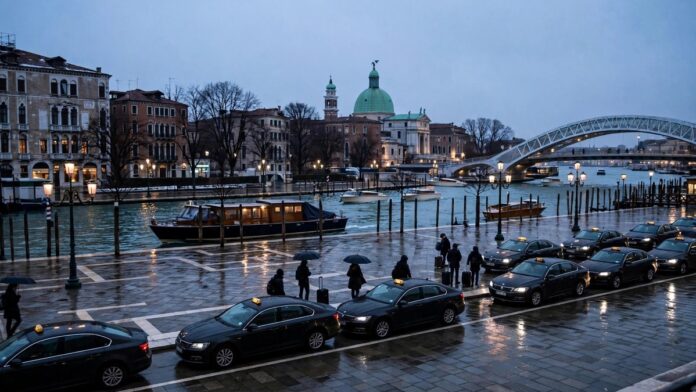
- Book a taxi or private transfer to the airport in advance on the strike day, rather than counting on a cab rank or a bus that may run only in a guaranteed band.
- Keep every receipt if the strike forces a change. Trenitalia refunds cancelled trains, and travel insurance may cover extra hotel nights, but only with receipts and a record of the cancellation.
- Do not book a non-refundable hotel for the night of 4 December until you know the train will run.
Venice on strike day: the extra problem
Venice adds a second problem to the strike. The city has no cars in its historic centre, so every arrival depends on a boat, a bus or a walk from Piazzale Roma. When trains stop, the buses and boats that replace them are the ones under pressure, and the hours for ACTV, which runs Venice’s vaporetto water buses and city buses, were not in the strike lists yet when the briefing was checked on 26 November.
A base in Mestre, on the mainland, is the one to rethink on those days. Mestre depends on the train into Venezia Santa Lucia, and that train is the service the strike stops. A base in the historic centre, reached by bus or boat from the airport, is less exposed, because the airport buses and Alilaguna boats are not rail services. Check the ACTV site a few days before you travel for its strike hours.
Venice Marco Polo Airport (VCE) sits on the mainland edge of the lagoon. From there the ATVO express bus and ACTV bus line 5 run to Piazzale Roma, and the Alilaguna boats cross the lagoon to Venice and Murano, slower but straight to the water. On a strike day, allow an extra hour for every transfer, and do not plan a train out of Santa Lucia on the evening of 3 December or at any time on 4 December.
Venice airport transfers: the real costs
The transfer from Marco Polo Airport to Venice is where visitors lose the most money, and the strike week is the worst time to get it wrong. The prices below are the fixed and published fares, not the price a driver quotes at the rank.
| Transfer | Price | Notes |
|---|---|---|
| ATVO / ACTV bus to Piazzale Roma | About €10 | Cheapest way to the city. |
| Alilaguna boat, one-way | €18 | Straight to the water, slower. |
| Alilaguna boat, return | €32 | Buy the return if you know the date. |
| Land taxi, airport to Piazzale Roma | €40 fixed | Includes all supplements. |
| Land taxi, airport to Mestre centre | €35 fixed | Includes all supplements. |
| Shared water taxi, per person | €35–€39 | Booked in advance. |
| Private water taxi | €120–€190 | Per boat, not per person. |
| Uber Boat | From about €120 | In-app water-taxi booking. |
| Traghetto across the Grand Canal | €2 cash | Standing crossing, a few minutes. |
The €40 land taxi from the airport to Piazzale Roma is a fixed fare, and it includes every supplement: the €1.20 per large bag, the €4.80 airport link and the €3.20 night or holiday supplement are already inside the €40. Ask for the fixed fare by name before the ride starts, or demand the meter instead. Both are your right. Do not let a driver add the €4.80 airport extra on top of the €40, because the fixed fare already contains it.
Land taxis reach Piazzale Roma and no further. The historic centre has no cars at all, so the taxi ends at the bus station square and the rest of the journey is on foot or by boat. A land taxi on the meter starts at €3.20, with an €8 minimum, and charges €1.70 a kilometre until the fare reaches €16.52, then €2.15. A 3km ride on the mainland costs about €9 to €12.
Venice transfers: what does not exist
There is no UberX anywhere in Italy. Uber runs licensed cars on the mainland and, since 2024, Uber Boat for in-app water-taxi booking from about €120 a boat. Bolt and FreeNow do not operate in Venice. Land taxis book through the local cooperative, and water taxis book through the boat operators or a hotel.
That matters on a strike day, because the app that works at home does not work in Venice. A visitor who opens Uber at Marco Polo expecting a €20 car to the hotel finds no UberX, and the only in-app option is a €120 boat. Book the transfer before you land, or take the bus to Piazzale Roma and walk from there.
The shared water taxi, at €35 to €39 per person, and the Alilaguna public airport boat, at €18 one-way or €32 return, bridge the gap between walking from Piazzale Roma and paying €190 for a private mahogany boat. For the vaporetto itself, including the €9.50 75-minute ticket trap, see the Venice vaporetto ticket guide on travelohlic.com. The €9.50 ticket covers 75 minutes, not a day, and it does not cover Alilaguna or the airport boats.
Quick answers
When does the Italy strike stop trains? From 21:00 on Thursday 3 December to 21:00 on Friday 4 December 2026.
Can I get a refund for a cancelled train? Yes. Trenitalia gives full refunds for trains cancelled by a strike.
How much is a taxi from Venice airport to Piazzale Roma? €40 fixed, including all supplements. Do not pay the €4.80 airport extra on top.
Is there UberX in Venice? No. There is no UberX anywhere in Italy. Uber Boat starts at about €120.
What is the cheapest airport transfer? The bus to Piazzale Roma, about €10, or the Alilaguna boat at €18 one-way.

