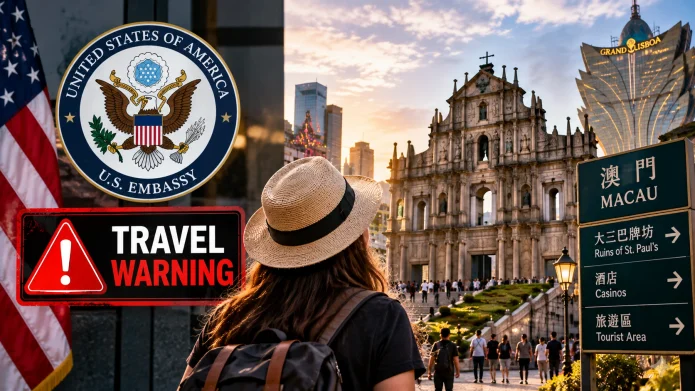
The U.S. State Department has raised its travel advisory for Macau to Level 3: Reconsider Travel. Americans are urged to rethink trips because of limited emergency consular services and the risk of arbitrary enforcement of local laws. The update forms part of a broader set of China-related advisories issued in early September 2026.
I reviewed the official advisory after friends asked whether a planned Macau stop was still wise. The language is clear and specific. Here is what the warning actually means, the practical risks, and the steps that reduce exposure if you still decide to go.
What the New Macau Travel Advisory Says
Macau, a Special Administrative Region of China, is now at Level 3: Reconsider Travel. The two main reasons listed are:
- Limited ability of the U.S. government to provide emergency consular services.
- Arbitrary enforcement of local laws.
The advisory notes that China imposes travel restrictions on U.S. diplomatic personnel. Even in an emergency, U.S. diplomats accredited to Macau must apply for and receive visas before they can enter. Approval typically takes at least five to seven days. That delay sharply reduces the speed of any help the U.S. Consulate General in Hong Kong can offer.
You can read the full advisory on the State Department site at travel.state.gov.
How Macau’s Advisory Compares with China and Hong Kong
Mainland China and Hong Kong remain at Level 2: Exercise Increased Caution. Both share concerns about arbitrary enforcement of local laws, the use of exit bans, and the risk of unjust detention. Macau sits one level higher mainly because of the extra barrier to consular access.
Exit bans can stop travelers from leaving while authorities investigate civil, commercial, or criminal matters. These bans may be applied with little or no advance notice and can last for extended periods. Private electronic messages critical of China, Hong Kong, Macau, or the Chinese Communist Party have also been cited in related guidance as potential grounds for detention or deportation.
Dual U.S.-Chinese citizens and U.S. citizens of Chinese descent may face additional scrutiny. Macau does not recognize dual nationality in the same way the United States does.
Also read – U.S. Lowers Travel Advisory Level for Bangladesh
Why Consular Access Matters in Practice
If you are arrested, detained, lose your passport, or need urgent medical help, the usual rapid response from a U.S. consular officer is not available in Macau. The visa requirement for diplomats creates a built-in delay. In a real emergency that delay can matter.
I have spoken with travelers who experienced paperwork issues in the region. The difference between having a consular officer on site within hours versus waiting days is significant. The Level 3 rating exists precisely because that difference is structural, not temporary.
Practical Steps If You Still Plan to Visit Macau
Enroll in the Smart Traveler Enrollment Program (STEP) before you leave. It lets the State Department locate you and send alerts in an emergency.
Carry your U.S. passport at all times and enter Macau on that passport.
Keep a low profile. Avoid political discussions, public criticism of local or Chinese authorities, and sharing sensitive content on social media or messaging apps while in the region.
Make copies of your passport, itinerary, and insurance documents. Store them separately from the originals and leave a set with someone at home.
Purchase comprehensive travel insurance that includes emergency medical evacuation and legal assistance. Confirm the policy covers the specific risks listed in the advisory.
Have a clear exit plan. Know the nearest border crossings and flight options out of Macau and Hong Kong in case you need to leave quickly.
Monitor the State Department advisory page daily while you are there. Conditions can change.
What the Advisory Does Not Mean
The Level 3 rating is not a ban. It is a strong recommendation to reconsider non-essential travel. Millions of visitors still enter Macau each year for gaming, dining, and short stays. The warning focuses on the reduced ability of the U.S. government to help if something goes wrong and on the broader legal environment.
Crime rates for typical tourist activities remain relatively low compared with many other destinations. The core concerns are legal process, exit controls, and consular reach rather than street crime or terrorism.
Who Should Be Especially Careful
Dual nationals, journalists, researchers, business people involved in disputes, and anyone with family or commercial ties that could attract official attention should weigh the advisory most carefully. Even private digital communications sent from outside the region have been referenced in related guidance as potential triggers for action once a traveler is inside.
If your trip is purely recreational and short, the practical risk for most visitors is lower, but it is not zero. The advisory exists so that every traveler makes an informed decision rather than discovering the limits of help after a problem starts.
Final Advice Before You Book or Cancel
Read the full Macau page on travel.state.gov yourself rather than relying on summaries. Compare it with the China and Hong Kong advisories for context. Enroll in STEP, secure strong insurance, and decide whether the limited consular safety net is acceptable for your situation.
The update does not close Macau to Americans. It simply states the current reality: help may take longer to arrive, and local legal enforcement can be unpredictable. That information alone is enough for many travelers to pause and reassess. Use it to make a clear-eyed choice rather than an optimistic one.

