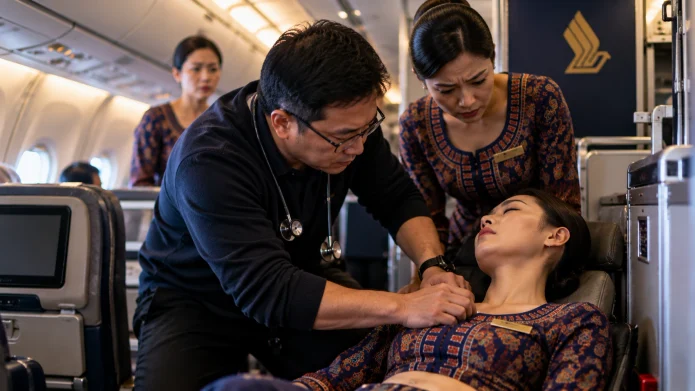
A passenger with former emergency room experience successfully stabilized an unconscious Singapore Airlines cabin crew member during a flight from China to Singapore. The severe medical emergency took place on October 17, 2026, aboard flight SQ843 departing from Chengdu Tianfu International Airport and heading to Singapore Changi Airport. The quick intervention by the trained medical professional prevented a potentially fatal situation from escalating while the aircraft was miles above the ground.
Details of the Medical Emergency on Singapore Airlines Flight SQ843
The incident occurred at approximately 7:00 PM local time, just thirty minutes after the aircraft departed from Chengdu. Passengers heard a sudden overhead announcement requesting immediate assistance from any medical personnel on board the aircraft. A female passenger, identified by her social media username Nicole K, found a young male flight attendant lying on the floor with a very faint pulse and freezing cold limbs. The crew member appeared highly confused, struggled to speak clearly, and complained of severe nausea.
Why the Passenger Doctor Initially Hesitated to Answer the Call
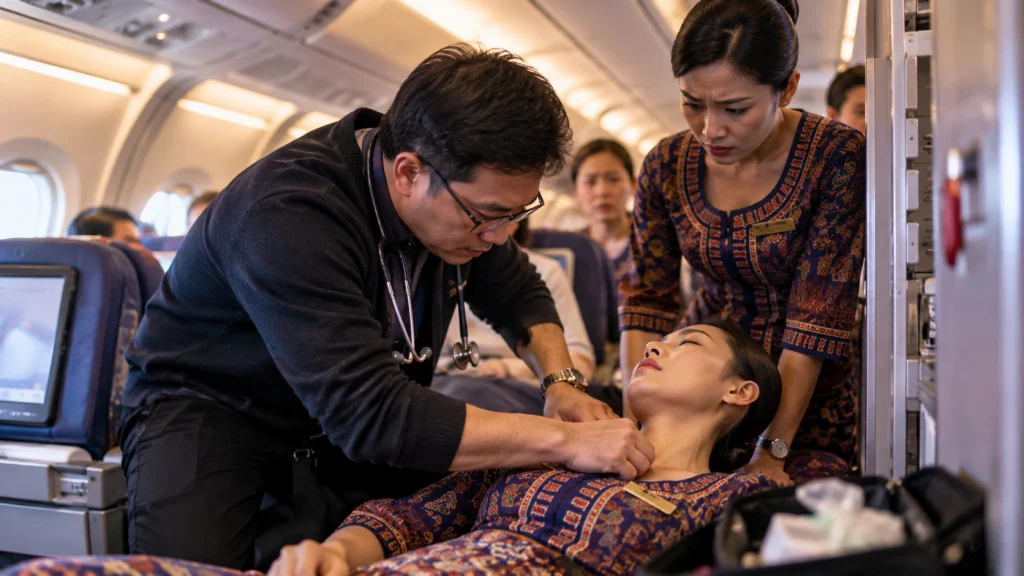
Nicole initially remained in her seat because she naturally assumed other active doctors would step forward to handle the situation. She currently practices aesthetic medicine and had not worked in a hospital emergency room for ten years. Her primary concern was that her emergency response skills had rusted away over the past decade. However, when the flight crew made a second desperate announcement, she realized nobody else was coming and immediately rushed to help the fallen attendant.
Medical Procedures Performed on Flight SQ843 to Stabilize the Crew Member
The former emergency room worker quickly established an intravenous (IV) line to deliver essential fluids directly into the crew member’s bloodstream. She requested a stethoscope from the flight’s medical kit and directed the remaining cabin crew to measure the patient’s blood pressure, oxygen levels, and blood sugar. Nicole also administered strong anti-nausea medication to prevent the unconscious patient from choking while lying flat on the floor. Within thirty minutes of receiving the IV drip, the young man’s pulse strengthened and he became significantly more alert.
Also read – Singapore Airlines Confirms 1GBPS Starlink Wi-Fi for 2027
How the Remaining Cabin Crew Supported the Emergency Rescue Mission
The remaining flight attendants played a critical role by quickly locating the necessary medical equipment and following the doctor’s step-by-step instructions. Nicole publicly praised the Singapore Airlines crew for their extreme cooperation during a highly stressful and unfamiliar medical crisis. Operating without a familiar hospital team forced the doctor to rely entirely on the aviation staff to fetch supplies and comfort the patient. The combined effort ensured the young man received continuous care for the remaining three hours of the flight.
| Passenger Action Taken | Medical Benefit Achieved | Time to Show Improvement |
| Checked Blood Pressure & Oxygen | Established baseline vitals to determine the severity of the collapse. | Immediate |
| Inserted Intravenous (IV) Line | Delivered hydration and medication directly into the bloodstream. | 5 Minutes |
| Administered Anti-Nausea Medication | Prevented the unconscious patient from choking on stomach fluids. | 10 Minutes |
| Continuous 3-Hour Monitoring | Ensured the patient’s pulse remained steady until landing in Singapore. | 30 Minutes |
Official Protocol for Handling In-Flight Medical Emergencies
Flight attendants undergo rigorous medical training to handle standard emergencies, but severe cases always require a licensed medical professional to intervene. The Federal Aviation Administration (FAA) requires commercial aircraft to carry expanded medical kits containing stethoscopes, IV equipment, and emergency medications exactly for these situations. When a passenger steps forward, the airline’s ground-based medical support team often communicates with the onboard doctor via satellite phone to coordinate treatment.
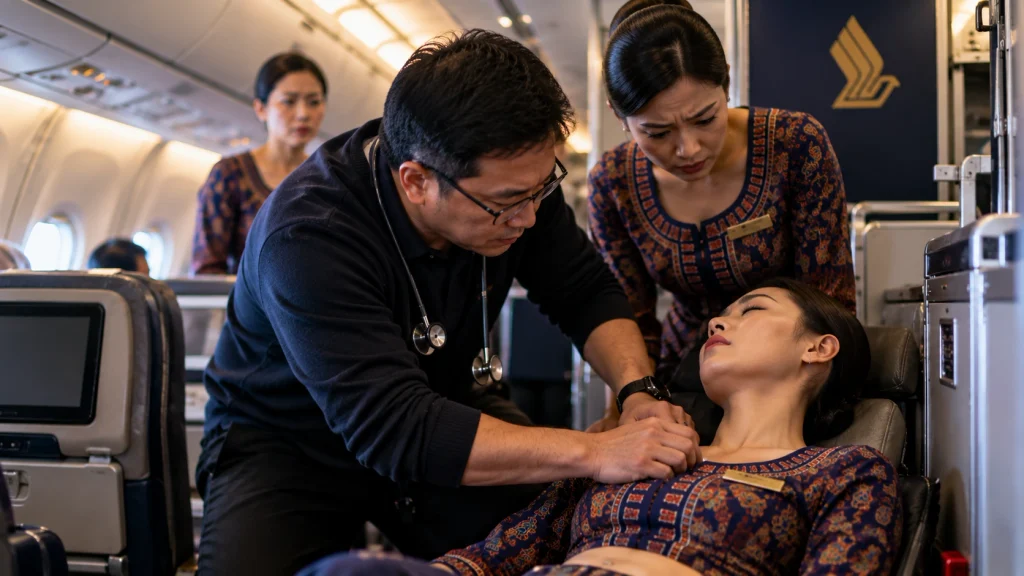
Travelers with medical backgrounds should always identify themselves to the crew during an emergency, even if they feel out of practice. The World Health Organization (WHO) notes that basic medical intervention during the first critical moments of a collapse drastically increases survival rates. Upon landing safely at Changi Airport, Nicole handed the stabilized crew member directly over to the waiting Ministry of Health (MOH) ground medical personnel for further hospital treatment.
4 Steps Average Passengers Should Take During an Overhead Medical Page
Average travelers without a medical degree still play a vital role when someone collapses in an airplane aisle.
Follow these exact steps to assist the flight crew during a medical emergency:
- Clear the aisle immediately: Move your arms, legs, and bags completely out of the walkway so medical professionals can sprint to the patient without tripping.
- Stay completely silent: Stop talking to your seatmates so the responding doctor can clearly hear the patient’s faint heartbeat through the stethoscope.
- Press the call button for others: If you notice a passenger or crew member fainting near you, press the overhead call button rapidly to alert the flight deck.
- Offer translation services: If the responding doctor and the patient do not speak the same language, volunteer to translate their medical symptoms to speed up the treatment process.

