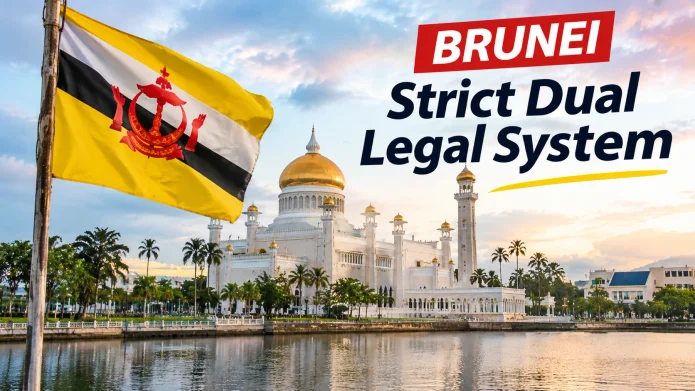
You are packing for a Southeast Asian getaway, expecting the relaxed atmosphere of Bali or Thailand, but Brunei operates on an entirely different legal frequency. SafeTravel New Zealand recently highlighted a critical reality for visitors: the Brunei dual legal system. If you step off the plane in Bandar Seri Begawan without understanding these rules, you risk severe criminal penalties for everyday habits.
The country strictly enforces both common civil law and a comprehensive Syariah Penal Code that operates in parallel. Your foreign passport does not shield you from these intense local statutes. From what you pack in your suitcase to how you interact with your partner in public, every action falls under intense scrutiny. Before you cross the border, you need to understand exactly how this parallel legal framework dictates your personal freedom during your stay.
What is the Brunei Dual Legal System?
The Brunei dual legal system means the country enforces common law alongside strict Islamic law. How does Sharia law affect tourists in Brunei? It applies to everyone, regardless of nationality or religious background. Foreigners often mistakenly assume these rules only apply to the local Muslim population.
When the government fully enacted the Syariah Penal Code in April 2019, it introduced severe corporal and capital punishments for offenses like adultery and blasphemy.
- Common law handles standard administrative, commercial, and certain secular criminal proceedings.
- The Sharia court system judges offenses based on strict Islamic moral codes.
- Both legal frameworks carry provisions for capital punishment and physical discipline.
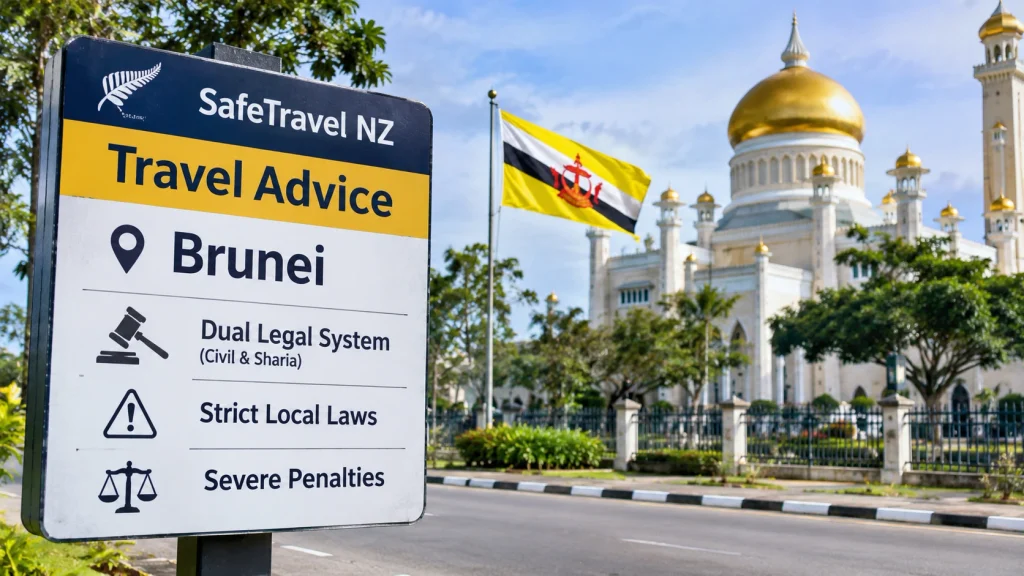
Did You Know? Brunei is the only country in Southeast Asia to implement a nationwide Sharia penal code at the federal level that heavily dictates daily public behavior for all residents and visitors.
Navigating Restricted Imports in Brunei and Alcohol
One of the fastest ways to trigger a Brunei travel advisory warning is mishandling your customs declaration. Can you bring alcohol into Brunei? Yes, but only if you are a non-Muslim adult over 17 years old and strictly follow the local quota system. Selling or consuming alcohol in public spaces is an immediate criminal offense.
If you plan to bring beverages for private consumption inside your hotel room, follow these exact steps at the border:
- Ensure you carry no more than 2 liters of spirits or wine, and exactly 12 cans of beer.
- Walk directly to the red customs declaration lane upon arrival at the airport or land border.
- Fill out the official yellow customs importation form detailing your items, or use the official Customs.BN mobile app to generate a QR code.
- Keep the stamped customs paperwork in your wallet for your entire trip to prove legal entry if questioned by authorities.
Quick Tip – If you hire a local taxi from the airport, keep your declared alcohol hidden entirely inside your zipped suitcase. Displaying alcohol in a public vehicle violates strict local statutes.
Personal Conduct and Brunei Strict Local Statutes
Your physical behavior in public spaces is heavily regulated by local authorities. Travelers frequently wonder what is illegal in Brunei for foreigners when it comes to social interaction. Under the Syariah Penal Code, authorities strictly monitor physical contact between genders.
The concept of close physical proximity makes it a punishable offense for a non-Muslim to be in intimate situations with a Muslim. Avoid these specific actions to remain compliant with Brunei public conduct rules:
- Engaging in intimate public displays of affection, including holding hands or kissing.
- Eating, drinking, or using tobacco outdoors during the daylight hours of the fasting month of Ramadan.
- Wearing clothing that exposes the shoulders, knees, or chest in government buildings and local markets.
Did You Know? Public criticism of the Sultan, the royal family, or the legal system carries immediate prison sentences under the Sedition Act. This includes negative comments posted on your personal social media accounts while using local Wi-Fi networks.
Also read – How to Use Airbnb’s New Shared Travel Wishlists & AI …
The Reality of Drug Offenses and Severe Penalties
Every official Brunei travel advisory from agencies like Smartraveller Australia features an uncompromising warning regarding narcotics. What happens if you break laws in Brunei regarding controlled substances? You face a mandatory death penalty for certain drug offenses. There is absolutely no leniency or diplomatic immunity for tourists caught with illegal substances.
Even items considered legal in your home country are classified as strictly restricted imports in Brunei. This includes medical marijuana and specific prescription amphetamines.
To ensure you do not accidentally violate these narcotics policies:
- Thoroughly clean all luggage compartments and backpacks before packing for your trip.
- Never agree to carry packages or bags across the border for strangers or casual acquaintances.
- Check your standard prescriptions against the local controlled substances list before booking flights.
Quick Tip Always carry a doctor’s prescription translated into English for your standard daily medications. Declare them immediately to customs officials upon arrival to avoid legal misunderstandings.
Is Brunei safe for Western tourists? Yes, but only for those who maintain total situational awareness and absolute compliance with local mandates.
Key Takeaways
- SafeTravel New Zealand warns all visitors about the severe consequences of the strict dual legal framework.
- The Brunei dual legal system applies the Islamic Sharia penal code to both Muslims and non-Muslim foreigners.
- You can import a strict limit of alcohol for private use but must declare it via official customs forms.
- Public displays of affection are highly illegal and can result in immediate arrest.
- Consuming food or water in public during Ramadan fasting hours violates local law.
- Drug possession, including medical marijuana, carries mandatory capital punishment.
- Criticizing the royal family or the government is a severe criminal offense.
Frequently Asked Questions
What exactly is the Brunei dual legal system?
The country operates both common civil law and an Islamic Sharia penal code simultaneously. Both systems enforce their own distinct Brunei strict local statutes carrying severe penalties.
How does Sharia law affect tourists in Brunei?
The law applies directly to foreign visitors, meaning tourists can be prosecuted for moral offenses. This includes public displays of affection, improper dress, or consuming alcohol outside private quarters.
Can you bring alcohol into Brunei?
Yes, but with strict limitations. Non-Muslim adults can import up to two liters of wine or spirits and 12 cans of beer for private consumption, but it must be formally declared at customs.
What is illegal in Brunei for foreigners?
Foreigners cannot buy or sell alcohol, eat in public during Ramadan, criticize the royal family, possess illicit drugs, or engage in extramarital sexual relations.
What happens if you break laws in Brunei?
Penalties are extremely severe and non-negotiable. They include massive financial fines, lengthy prison sentences, corporal physical punishment, and for certain offenses, the death penalty.
What are the standard Brunei public conduct rules?
Visitors must dress modestly covering shoulders and knees at all times. You must also avoid pointing with your index finger and absolutely refrain from any intimate physical contact in public spaces.
Is Brunei safe for Western tourists?
The country features incredibly low rates of violent street crime, making it generally safe physically. However, tourists remain highly vulnerable to severe legal trouble if they ignore local behavioral codes.

