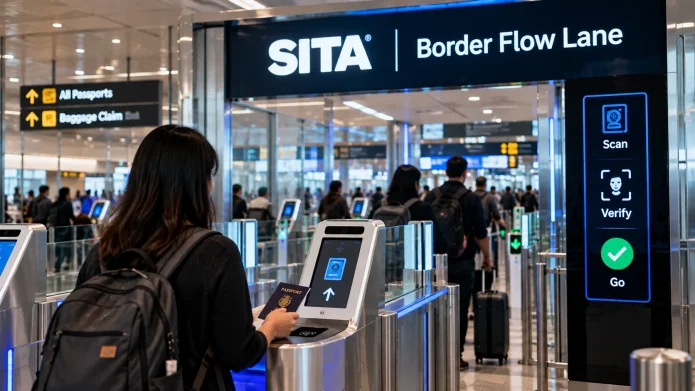
The new SITA Border Flow lane allows international travelers to walk straight through airport immigration without ever stopping to scan a physical passport. Instead of waiting at mechanical eGates, passengers simply stroll down a designated corridor while high-speed biometric cameras scan their faces in motion. This technology completely removes physical barriers, allowing airports to process hundreds of arriving passengers per hour without causing massive terminal bottlenecks.
By eliminating the traditional stop-and-scan process, airport operators can clear entire wide-body aircraft arrivals in a fraction of the usual time. The system relies entirely on secure digital credentials created by the traveler before they even leave for the airport.
How the Invisible Border Scans Faces in Motion
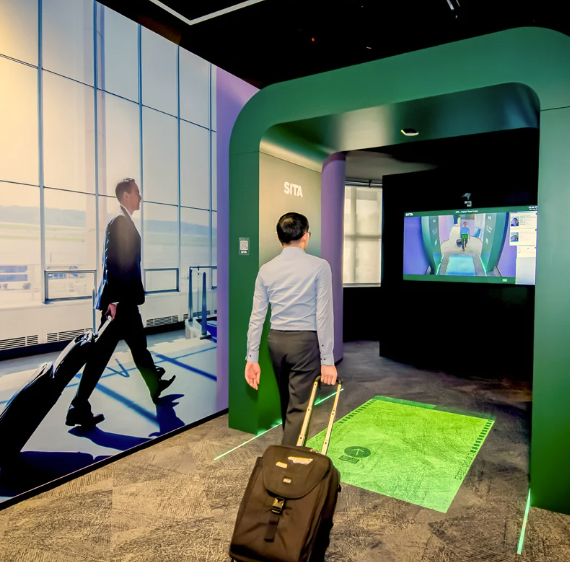
The Border Flow system replaces physical gates with an invisible, camera-lined walkway that captures a passenger’s biometric data as they walk at a normal pace. The technology instantly matches the live facial scan against a pre-registered digital profile stored in a secure government database. If the system confirms a perfect match, the traveler keeps walking directly toward the baggage claim area without breaking their stride.
This hardware utilizes global standards set by the International Civil Aviation Organization (ICAO) for Digital Travel Credentials (DTC). If the cameras detect an unmatched face or an individual requiring a secondary security check, a physical door at the end of the lane gently closes. An immigration officer then steps in to perform a manual passport inspection, ensuring border security remains incredibly tight.
Also read – India Just Made Flying to Smaller Cities Actually Affordable …
Exact Steps to Pre-Register for Frictionless Border Entry
Travelers must create a digital version of their passport at home to use these seamless walk-through lanes at the airport. You cannot simply walk through the biometric corridor if you have not securely shared your data with border authorities beforehand.
Follow these exact steps to register your biometric profile correctly:
- Download the verified application: Use the specific airline or government application required by your arrival destination.
- Scan your physical passport chip: Hold your smartphone against the back cover of your passport to read the embedded NFC (Near Field Communication) chip.
- Capture a live selfie: Take a well-lit photo of your face using your phone’s front-facing camera to prove you are the actual passport holder.
- Submit the data: The application encrypts and sends your digital token directly to border authorities before your flight departs.
Aviation regulators like the U.S. Customs and Border Protection (CBP) increasingly rely on this pre-arrival data to run background checks while the passenger is still flying over the ocean.
Why Traditional eGates Are Becoming Obsolete
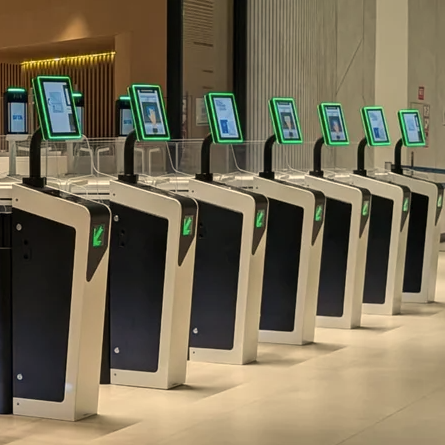
Standard eGates frequently cause massive airport delays because passengers struggle to scan their passports correctly on the glass readers. People often leave their passport covers on, push the document in upside down, or fail to stand on the exact floor markers for the camera.
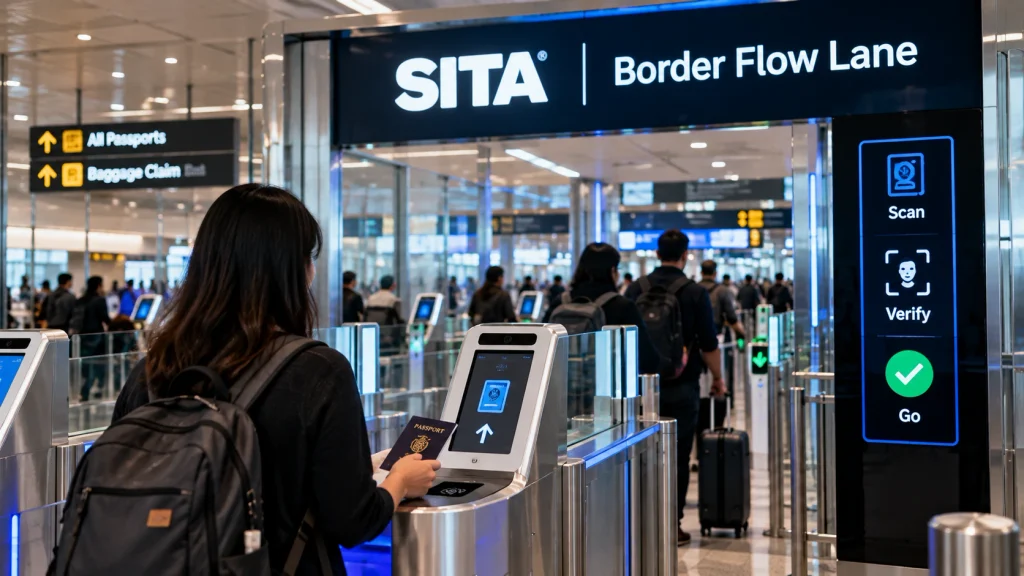
The SITA Border Flow lane completely removes user error from the immigration process. The Transportation Security Administration (TSA) and global airport authorities are actively testing similar frictionless concepts because removing the physical interaction speeds up the entire terminal flow.
| Feature | Standard Airport eGate | SITA Border Flow Lane |
| Physical Barrier | Hard plastic doors | Open walkway corridor |
| Passenger Action | Stop, insert passport, look at camera | Walk normally without stopping |
| Processing Speed | 15 to 20 seconds per person | Less than 5 seconds per person |
| User Error Risk | High (scanning errors, bad positioning) | Near zero |
How Governments Protect Your Biometric Data
Strict data privacy laws govern exactly how long airport authorities can hold your facial recognition data after you walk through the border lane. Airlines and technology providers like SITA do not permanently store your biometric identity in a private commercial database. The facial image captured in the corridor acts only as a temporary key to unlock the verified passport data already sitting on government servers.
The European Commission strictly enforces the General Data Protection Regulation (GDPR), which legally requires airports to delete biometric transit scans immediately after the passenger clears customs. Furthermore, the International Air Transport Association (IATA) works closely with global governments to ensure these digital travel credentials remain encrypted on the passenger’s mobile device, giving the traveler total control over who receives their data.

